
In September this year, Catherine Clarke, professor at the Institute of Historical Research, published A History of England in 25 Poems. This chronological hike through England’s history via verses that its people have left behind was released to great acclaim – and no wonder, when the book manages to be comfortable and accessible, yet alsoContinue reading “A Voice for the Voiceless: English’s Lost Consonants”
Tag Archives: philology
Reflections of Trieste

Like an insufferable fin-de-siècle socialite, I’m writing this on my honeymoon, a three-stop holiday that naturally never once ventures outside the old borders of the Austrian Empire.¹ As any self-respecting new husband should, it’s giving me the time to reflect on the two dearest things in life: a beautiful wife, and language history. No otherContinue reading “Reflections of Trieste”
PIE was not SOV

Reading time: quite a while Having dedicated over four years of my life to the subject, I have one or two thoughts about the word order of Proto-Indo-European. Somebody somewhere had to have them. This reconstructed language – the ‘lost’ common ancestor proposed to explain the countless similarities across the Indo-European languages – has nowadaysContinue reading “PIE was not SOV”
New Article: ‘Wackernagel’s Law in Vedic and Old Irish’
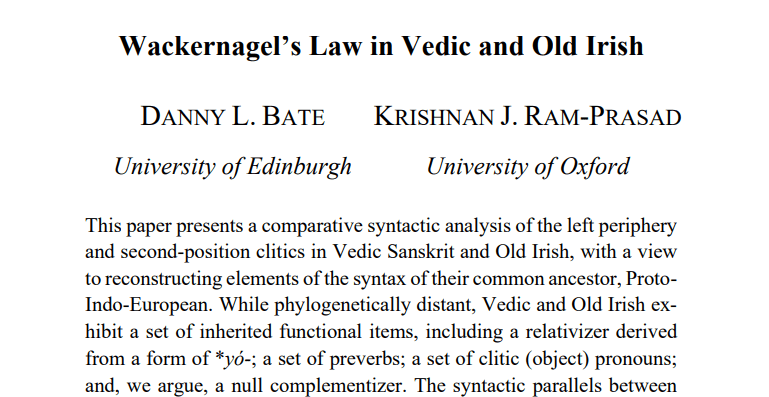
By a happy twist of fate, January 2025, just like January 2024, has allowed me to announce a new academic publication! This time, it’s Wackernagel’s Law in Vedic and Old Irish, a paper co-authored with my brilliant colleague and dear friend Krishnan Ram-Prasad. The paper has been included among the proceedings for the thirty-fourth annualContinue reading “New Article: ‘Wackernagel’s Law in Vedic and Old Irish’”
Relics in Roman Writing
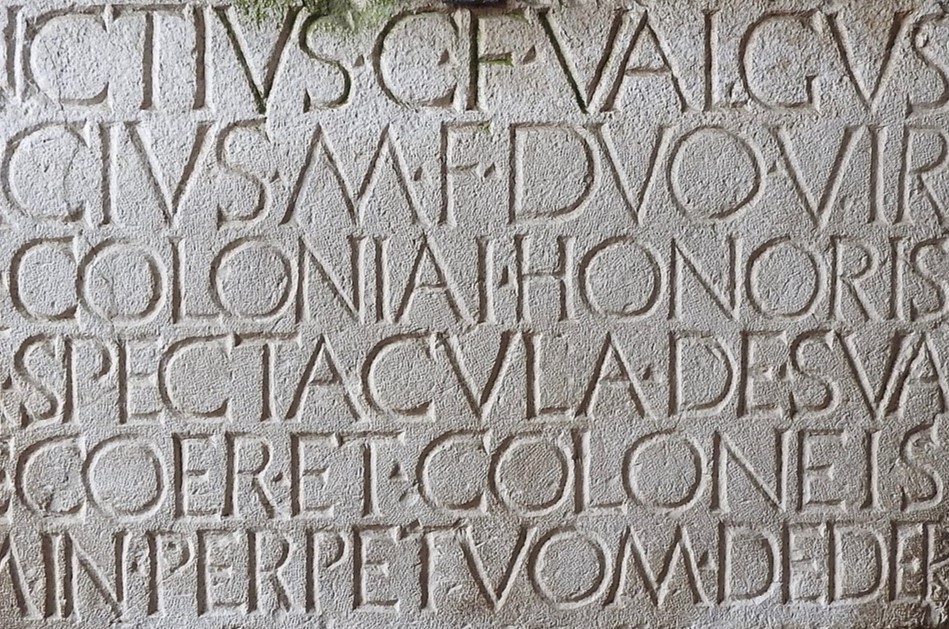
Reading time: 5 minutes When we look at impressive Latin inscriptions from the days of Rome, there is something very fixed and familiar about the look of the letters. We recognise the roughly square-shaped capital letters like A, B and C as our own, and they more or less serve the same functions now asContinue reading “Relics in Roman Writing”
The Path of ‘Path’

Reading time: 5-10 minutes For this month, I’d like to shine an etymological spotlight on a humble bit of English vocabulary, which, at first glance, you wouldn’t give a second thought. As this post’s title implies, the everyday word in question is path. What, I hear you cry, is so special about path? It’s aContinue reading “The Path of ‘Path’”
Christmas Trees and Etymologies

Reading time: 5 minutes As an etymological Christmas gift from me for 2023, here’s a quick dive into the story and connections of one festive word: the humble Christmas tree. Now, Modern English tree goes back to Old English trēow, which could mean a specific tree or the substance of wood. … Ġeseah iċ wuldres trēow,wǣdum ġeweorðode, wynnum sċīnan,ġeġyred mid golde; ġimmas hæfdonbewriġene weorðlīċeContinue reading “Christmas Trees and Etymologies”
The Reichenau Glossary and the Birth of French

Reading time: 10 minutes Now, I must confess, I have been somewhat preoccupied for the past two months, and so haven’t dedicated time to this site. The jump into the world of podcasting has taken a lot of effort, and yet the website hasn’t been far from my thoughts. So, for this October, I’m gettingContinue reading “The Reichenau Glossary and the Birth of French”
Five Antiquities of English

Reading time: 10-15 minutes To listen along in an audio format, just click here: IT’S WELL KNOWN that English has undergone many significant changes down the centuries. Events like the Norman Conquest have drastically altered the shape of the language, influencing words and sounds so much that a new kind of English was born. YetContinue reading “Five Antiquities of English”
Why does Czech sound like that?

Reading time: 10-15 minutes To listen to this piece and my mixed success at pronouncing both modern-day Czech and ancient Slavic, click here: To hear the sounds denoted between /slashes/, click here for an interactive IPA. The Czech language has, among language learners and lovers, a fairly fierce reputation. Over the intricacies of its grammarContinue reading “Why does Czech sound like that?”
 Danny L. Bate