By a happy twist of fate, January 2025, just like January 2024, has allowed me to announce a new academic publication!
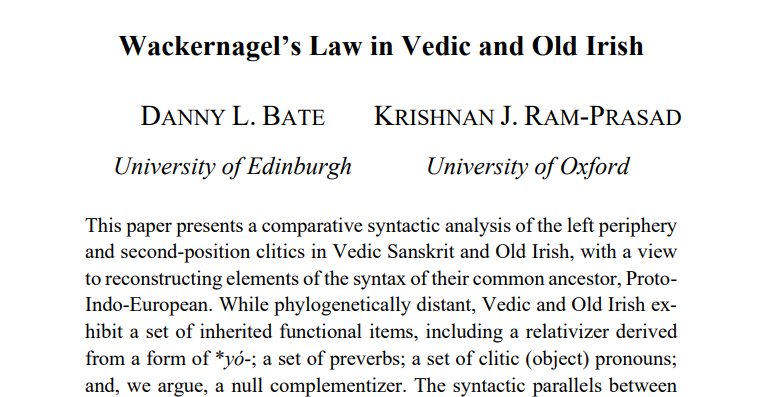
This time, it’s Wackernagel’s Law in Vedic and Old Irish, a paper co-authored with my brilliant colleague and dear friend Krishnan Ram-Prasad. The paper has been included among the proceedings for the thirty-fourth annual UCLA Indo-European Conference (WeCIEC), held in Los Angeles back in October 2023. I am grateful to the conference organisers for having us, and to Helmut Buske Verlag for the publication.
The published paper is therefore the written version of a conference presentation, and that conference paper began life back in the hallowed halls of Oxford, where Krishnan scribbled Sanskrit syntax on a board, and I some thoughts about Old Irish syntax, until we came to realise that we were scribbling the same sort of thing.

We then got to take our scribbles and present them to an outrageously impressive and eminent collection of Indo-Europeanists, all the while battling against transatlantic jetlag. We made the most of the Californian expedition, setting off north from LA and getting to experience strange and exotic local customs – like staying in a roadside motel, drinking a bottle of beer at a bar, or buying something from Walmart.

The main thrust of the paper is that Vedic Sanskrit and Old Irish can together tell us something about one aspect of the syntax of their common ancestor, Proto-Indo-European.
More specifically, this aspect is the phenomenon of Wackernagel’s law, an observation and generalisation (rather than an actual ‘law’) that words without an accent in early Indo-European languages tend up to bunch after the first word or phrase of a clause, regardless of their role in the overall sentence. This gives them the appearance of being in ‘second position’. For example:
“mātā́ ca me chadayathaḥ samā́“
‘And you and my mother appear alike’ (Literally: ‘mother and of-me appear alike’)
Vedic Sanskrit, Rigveda 8.1.6
Krishnan and I hold a distinct view about what lies behind the patterns of Wackernagel’s law, or rather how they can be best explained. We consider Wackernagel’s law as a bit of a mirage, more like two separate word-order phenomena hiding in a trenchcoat, and our formal analysis involves a joint operation of syntax and phonology, as opposed to phonology alone.
We used the paper to propose that this composite process goes all the way back to Proto-Indo-European itself, and was then inherited by many of that prehistoric language’s linguistic offspring.
To back up this argument, we had to include a section on the idea and practice of proposing what the word order of a prehistoric language was like – that is, syntactic reconstruction. This is a topic that the two of us care very deeply about, so it’s nice to get our combined thoughts down on paper. We also needed evidence from at least two of those aforementioned offspring. Despite being geographically and chronologically very distant from each other, Vedic Sanskrit and Old Irish nicely offered the evidence that we needed.
The paper takes evidence specifically from relative clauses in the two languages, which at first glance seem to have little in common. Vedic Sanskrit works like Latin, Ancient Greek and conservative English, and uses a separate, inflecting word (yá-) to form such clauses. Old Irish does its own thing, and relies on sound alternations or an uninflecting particle to create equivalent relative clauses.
However, scratch the surface, and the origins of the funky Old Irish behaviour in fact lie in a very similar system to what Vedic Sanskrit displays. That system was what we propose for Proto-Indo-European. As we put it:
“The relative clause in Vedic and Old Irish offers a case study by which we may reconstruct something of the syntax of their prehistoric ancestor. This proto-syntax
Bate & Ram-Prasad 2025: 15-6
is better preserved by Vedic: an unsurprising conclusion, given its date of attestation and generally conservative profile. Old Irish by contrast shows several syntactic innovations.”
In other words, relative clauses and Wackernagel’s law worked a certain way in Proto-Indo-European, a situation that Vedic Sanskrit largely preserves, but that has been worn down and modified over the centuries leading up to Old Irish – to the extent that it’s barely recognisible. This is pretty typical stuff for Old Irish, as I’ve written about previously.
So, there’s another historical-syntax paper out there now. Hopefully it’ll be of interest to someone somewhere, beyond Krishnan and me.
END.
References
- Bate, D. L., & Ram-Prasad, K. (2025). Wackernagel’s Law in Vedic and Old Irish. Proceedings of the 34th Annual UCLA Indo-European Conference. Buske Verlag. 1-21.


Leave a Reply