Indo-European
-
New Article: ‘Wackernagel’s Law in Vedic and Old Irish’
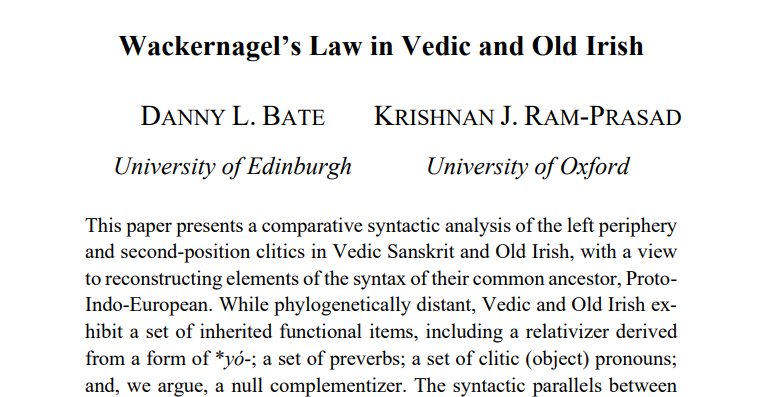
By a happy twist of fate, January 2025, just like January 2024, has allowed me to announce a new academic publication! This time, it’s Wackernagel’s Law in Vedic and Old Irish, a paper co-authored with my brilliant colleague and dear friend Krishnan Ram-Prasad. The paper has been included among the proceedings for the thirty-fourth annual… Continue reading
-
A CHRISTMAS Full of Etymology

Reading time: 5 minutes It’s December now, the month when the calendar helpfully provides me with a topic for the monthly article. So, here’s a short and sweet linguistic post with a festive theme: nine Christmas-related words that I think have interesting etymologies, one for each of the nine letters of the word Christmas. I… Continue reading
-
The Path of ‘Path’

Reading time: 5-10 minutes For this month, I’d like to shine an etymological spotlight on a humble bit of English vocabulary, which, at first glance, you wouldn’t give a second thought. As this post’s title implies, the everyday word in question is path. What, I hear you cry, is so special about path? It’s a… Continue reading
-
Prehistoric Syntax and Public Linguistics with Jackson Crawford

A personal bit of news: a return to rambling enthusiastically on YouTube! I’ve another rare appearance in visual format, as I was delighted to be invited back by Dr Jackson Crawford for a second interview with him and his Patreon supporters. Last time, it was all about etymology; this time, I got to talk very… Continue reading
-
The Fates of the Dual

The Story of Indo-European’s (Mostly) Lost Number Introduction One book, many books. One cat, many cats. One woman, many women. One sheep, many… Well, also sheep. In Modern English, the grammatical options for nouns are limited to two. A given noun can be singular, referring to one individual thing, or plural, which is used for… Continue reading
-
Christmas Trees and Etymologies

Reading time: 5 minutes As an etymological Christmas gift from me for 2023, here’s a quick dive into the story and connections of one festive word: the humble Christmas tree. Now, Modern English tree goes back to Old English trēow, which could mean a specific tree or the substance of wood. … Ġeseah iċ wuldres trēow,wǣdum ġeweorðode, wynnum sċīnan,ġeġyred mid golde; ġimmas hæfdonbewriġene weorðlīċe… Continue reading
-
Digging Old Irish

Reading time: 15-20 minutes Old Irish has a bit of a bad reputation. This historical form of the Irish language, dated to between c. 600 AD and c. 900 AD, is a challenge for learners, even for those who already know some Modern Irish. Its systems of spelling, sounds, word order and grammar are very… Continue reading
-
Cheat Your Way to Czech II: Learning (and Loving) the Lexicon

Reading time: 10 – 15 minutes For many people, myself definitely included, the most difficult part of learning a new language is the vocabulary. There’s just always so much of it and, unlike grammar, I find it hard to condense down into learnable bites. The world is full of things, so language is full of… Continue reading