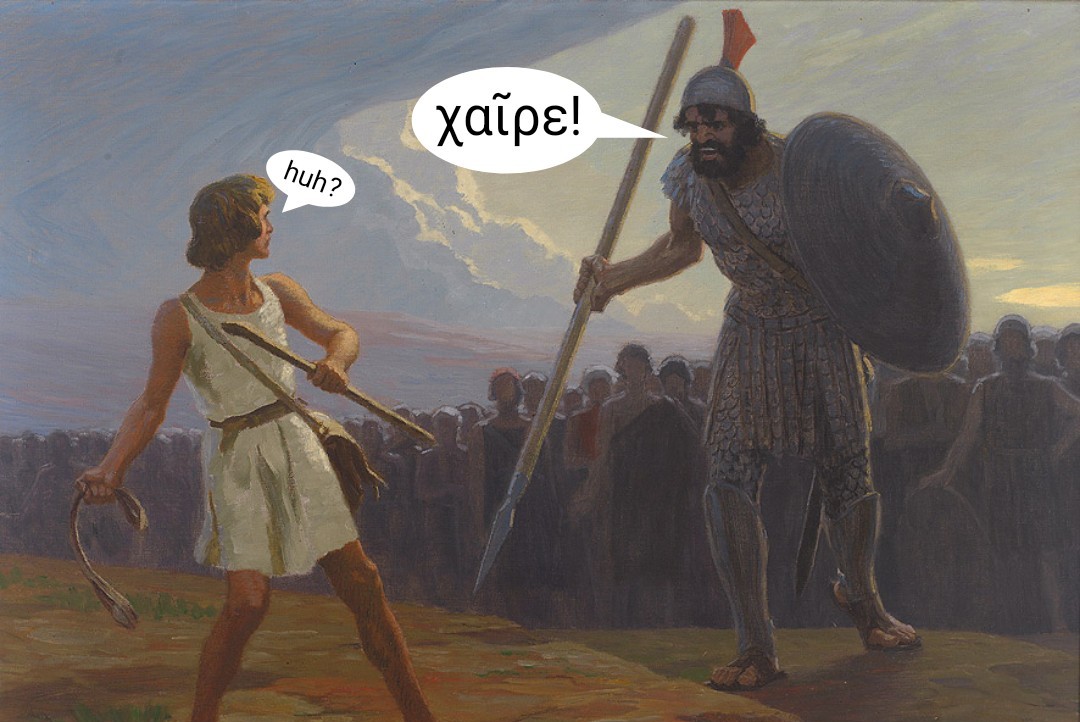
It’s often nice to spot familiar faces where you don’t expect them, like an unforeseen run-in with a friend while on holiday. Joy in unexpected encounters is possible in the intellectual realm too; during my wanderings through the linguistic past, I’ve delighted in meeting languages and their humans whom I already know from elsewhere.
One example is the Hittites. A culturally Christian upbringing had acquainted me with this mighty nation of the semi-historical past, mentioned in various passages of the Hebrew Bible/Old Testament. Later in life, I plunged into the world of the Indo-European language family, there to find that the ‘Hittite’ language is something of a celebrity.
19th- and 20th-century excavations in central Anatolia unearthed not only the remains of an impressive civilisation, but also plenty of documents in a local language. Its decipherment from 1915 revealed it to be a very old and very informative species of Indo-European, and also contributed to the identification of the civilisation with the Hittites of the Bible.
Of course, no sooner have you found this Biblical people in your linguistics textbook than you read that the equation of the two is not at all settled; there are good reasons for either believing or not believing that the literary individuals who sold land to Abraham and got betrayed by King David were meant to be kin with the historical people of Hattusa.
More recently in my personal past, my eyes stumbled over mentions of another unexpected union between Biblical characters and Indo-European speech. This time, the people were the infamous Philistines. It’s not at all far-fetched to think that they spoke an Indo-European language; it could plausibly have been (very) Ancient Greek.
But what’s the evidence that makes this plausible?
The Philistines are some of the Bible’s baddies, perhaps the archest of enemies for the story’s heroes, the Israelites. Always seen from the goodies’ perspective, the Philistines are the 2D villains who are responsible for either the greatness (e.g. David, slinger and slayer of the Philistines’ giant champion Goliath) or the tragedy (e.g. Samson, shorn by Delilah, crushed by Philistine masonry) of much more rounded Israelite characters.
The Bible admits that each side was capable of being awful to the other; if you don’t mind wincing, turn to 1 Samuel 18:24-27. Nonetheless, the Israelites are the stars of the show. The Philistines’ status as vilified others is ultimately behind the use of lower-case philistine to mean ‘uncultured person’ – apparently via student slang in 17th-century Germany.
The existence of the Philistines was by no means limited to the scrolls of Biblical narrative; they were a real and distinct people of the Iron Age! More confidently than on the reality of the Biblical Hittites, we can say that the Philistines lived in the southern Levant, where the Mediterranean coastline turns westwards towards Egypt.

Their region, Philistia, chiefly comprised five cities – a ‘pentapolis’ situation. Four (Ashdod, Ashkelon, Ekron and Gath) have been excavated in detail, but not the fifth, which remains densely populated to this day: Gaza.
The association between the ancient Philistines and present-day Palestinians doesn’t stop at a shared inhabitation of Gaza; Philistia and the Philistines are indeed the origin of the geopolitical term Palestine.
A form of the ancient term seems to have been passed around the Mediterranean (perhaps via the Hebrew, then the Aramaic language) until it reached the ears, eyes and pens of the Greeks. At some point in this lexical journey, the term widened in scope, broadening beyond a corner of coastline.
In the fifth century BC, the Greek historian Herodotus used the word Παλαιστίνη (Palaistínē) and explicitly described its range as all the land that runs southwards from Syria to Egypt. The Romans, ever in keeping with the Greeks, maintained this definition; they saw no toponymic problem in renaming the whole province of Judea as Syria Palaestina after the Bar Kokhba Revolt against Rome in the 130s AD. Suffice it to say, these loanwords, redefinitions and etymologies are of serious significance for the geopolitics of today.
Such words have long outlived the Philistines themselves; as a state, Philistia disappears from view after the Babylonian conquest of the region in the seventh century BC. The Philistines’ departure from history is something of a whimper, unlike the bang with which they had first arrived in the area.
The Philistines are closely associated with the so-called ‘Late Bronze Age Collapse’. As the name hints at, this seismic set of changes in the late 13th and early 12th centuries BC was not fun to live through. Beyond that fact, there is little that we can definitively and confidently say about what happened. Some Bronze-Age societies, namely Mycenaean Greece and the Hittite Empire, imploded. Others, like the New Kingdom of Egypt, militarily and economically took a beating.

The causes and consequences remain unclear from our modern point in time, but are nonetheless very interesting to contemplate. Lest I start getting the facts wrong, I’ll just recommend this long (but highly watchable) explainer with Prof. Eric Cline.
When the dust settled and the Iron Age dawned, the map of the eastern Mediterranean looked a little different. For one thing, there were now Philistines where there were none before. The traditional view has considered the Philistines as active participants in the shenanigans, one of the mysterious ‘Sea Peoples’ who sailed around, invaded various lands, and wrought havoc on the Bronze-Age establishment.
This view draws strength from Egyptian references to the Peleset, a warrior people or confederation of peoples whom the Egyptians barely managed to defeat in c. 1175 BC. Peleset and similar-looking names in Akkadian are fairly straightforwardly taken by the experts to refer to the same people: the Philistines.

But where had the Peleset/Philistines come from? The consensus is that they originated to the west of Egypt and the Levant, somewhere on the northern coast of the Mediterranean. From this base, they could hit the Hittites and ruin Ugarit with their full strength and the element of surprise, and probably with a lot of the elements of copper and tin too. Egypt, that bit further away, withstood the assault, but couldn’t stop the Peleset from settling on their northeastern border.
More precisely, the lands around the Aegean Sea are suggested to be the launchpad for the Philistines and other participants in the ‘Sea Peoples’ phenomenon. From this view came my introduction to the topic, in the form of occasional remarks that they were “of Greek, or at least of Aegean” extraction. Genetics and archaeology do somewhat bear this out.

One DNA study from 2019 on the skeletons of Ashkelon found that “a gene flow from a European-related gene pool entered Ashkelon either at the end of the Bronze Age or at the beginning of the Iron Age … we model the southern European gene pool as the best proxy for this incoming gene flow … it had a limited genetic impact on the long-term population structure of the people in Ashkelon”. In other words, people from southern Europe arrived at the turn of the Bronze and Iron Ages, and were in time genetically absorbed into the local population.
Likewise, archaeological finds indicate a close link between Philistia and the Aegean; similar-looking humanoid statuettes turn up in both places, resembling seated women and feminine figurines with raised arms. The latter are cutely known as ‘psi-type figurines’, because they look like the Greek letter Ψ.

These may offer evidence of a non-elite religious culture brought over from Greece – such common, humble objects aren’t products of a priestly class or big public cult of worship.
A pool of evidence therefore points to the Aegean Sea and Greece as the origin of the Philistines. One immediate objection is that the dominant culture there at this time (aforementioned Mycenaean Greece) also collapsed during the era of the ‘Sea Peoples’.
It’s an odd narrative that locates the Philistines-to-be in Greece, then has them destroy their own palaces and cities before smashing up the other big players in the region. This invites doubt into the idea that the Philistines were simply agents of Bronze-Age chaos; perhaps they were victims of it too.
Nonetheless, having hesitantly tracked the Philistines back to Greece, it’s fair to wonder: were they Ancient Greek speakers? Archaic forms of the Greek language were already present there; we have plenty of documents from the Bronze Age in Mycenaean Greek. Does the language of the Philistines look like a kind of Greek?
No, it does not – because we have so little evidence for it that it doesn’t ‘look like’ anything at all. The Philistines haven’t left us any texts that are obviously Greek or foreign (non-Semitic), whether it be in vocabulary, grammar or script. Our knowledge of ‘Philistine’ is instead a mere handful of words and names, carelessly strewn through the Biblical books and the archaeological sites of the Levant. The Philistines, it seems fair to say, were not literary overachievers; we must study their language from its hazy silhouette.
From the Bible, for example, the name Goliath can be put under the microscope. All names are potential etymological windows, but unfortunately, Goliath is rather opaque. It’s been compared with a name in the ancient Lydian language of western Anatolia, close to where Greek speakers were living and doing their whole Greek thing. If this derivation is right, can we then identify Goliath or the actual Philistines as Lydians? No, because names travel between languages; my own name is of Hebrew origin, and I’m neither Jewish nor a Hebrew speaker. (חבל)
The single source behind Philistine/Palestine/Peleset is also absolutely worthy of consideration. Yet here again, the name resists easy etymologising. Greek origins have been proposed, but none are immediately convincing. Also, there is the danger of circular thinking; when we presume that the Philistines came from Greece, we go off looking for a Greek root.
Elsewhere in the Bible, we have the title of seren, held by the ruler of one of the five Philistine cities. It’s used several times in the Biblical tales of the Philistines, and the rank may also have turned up as “ṬRN” on a bit of pot from Ashkelon. It’s relevant for our linguistic inquiry is because (a) it’s exclusive to the Philistines and (b) it looks a bit like the Greek title of τύραννος (túrannos).
This is the origin of English tyrant, although it didn’t mean quite the same thing for the Greeks. A τύραννος was an absolute ruler who seized power by non-legal means, as opposed to a legally constrained and legitimate ruler. They weren’t necessarily bad people, unless you think that all absolute rulers are bad, in which case, yes, they were bad people.
Seren could be our smoking gun, a sure link to the Greeks, if the Greeks themselves hadn’t got the word from elsewhere. The title is absent from our early (Mycenaean) Greek sources; this and the shape of the word mark it out as a borrowing, perhaps again from an Anatolian language.
Much ink has also been validly utilised in discussing the Ekron Royal Dedicatory Inscription, a large inscription from the seventh century BC, which displays a royal dedication and, quelle surprise, was found in the remains of the Philistine city of Ekron. The script and language are a kind of Phoenician, which is odd, because Phoenician was a northern tongue. Nonetheless, it’s as good as we’re going to get for an in-situ text from among the Philistines.
It does contain some non-Phoenician elements, like the kingly name or title “ʾKYŠ”. This also appears (as Achish) in the Bible, and it can very cautiously be compared with Achaean, that catch-all name for the Greeks that Homer liked to use in the Iliad.

The inscription also includes the sequence “PT[ ]YH”, with an unclear third letter. What immediately follows means ‘lady’ or ‘mistress’, who is asked to bless the dedicator. So, PT[ ]YH is likely a goddess. Scholars, squinting at the lettering, have consequently tried to fill the gap and identify the goddess.
If the missing letter is a ‘G’ – that is, the Phoenician equivalent of G – then we have PTGYH. Some experts (e.g. Schäfer-Lichtenberger (1998)) have understood this to be ‘Pytho-Gaia’, the goddess Gaia of the Greek sacred site of Pytho/Delphi.
Other experts (e.g. Demsky (1997)) see an ‘N’. They therefore read it as PTNYH, and recognise therein the Greek word πότνια (pótnia) ‘mistress’. If this is correct, then we are on firmly Greek linguistic territory; πότνια is a securely Indo-European word, distantly related to English despot, and the Mycenaean Greeks were constantly using the word to refer to their goddesses.
Other other experts (e.g. Press (2012)) disagree with the above conclusions. They state instead that “the identification of the goddess at this point is simply unknown”. These partypoopers do have a point; it’s a lot of Greek to read into four and a half Phoenician letters.
Excluding some even smaller and vaguer texts, that is basically it for the language of the ancient Philistines. That they had a language (or languages) is unquestionable; historically, humans have tended to. That it was a flavour of Greek, however, is not at all demonstrated by its few available witnesses. All we have are Greekish whispers, and possibly deceptive ones at that.
What then is my answer to the titular question? Did the Philistines speak Greek?
Actually, contrary to Betteridge’s law of headlines, my answer is: yes.
I think that we can validly believe that if you travelled back to early Philistia, you would hear a lot of archaic Greek in the streets of their pentapolis. I just don’t think this on the ‘strength’ of the linguistic evidence. Instead, what was presented before, the genetic and archaeological evidence, seems to me to be a strong basis for this affirmative claim.
Those two sources point securely to an Aegean pool for the founders of Philistia. On the land and islands that rise from that sea, Greek was a (if not the) dominant language of the Late Bronze Age. Building on these two premises, it instead becomes unlikely that there were no Greek speakers at all among the Philistines and ‘Sea Peoples’.
Until a scholarly Samson knocks those dual pillars of argumentation down, it seems highly plausible to believe that at least some Philistines spoke Greek as their mother tongue. I trust you won’t find it too much of a linguistic sleight of hand to consider some of the Philistines an acceptable affirmative answer to a question worded “the Philistines”.
What percentage the Greek speakers were and how long Greek endured in Philistia, I can’t say – the Philistines were likely to have been an Aegean and Anatolian “conglomerate” (Kempinski 1987) right from the start, then to melt into the Semitic linguistic landscape of Canaan. But at least at the beginning, the interconnectivity of antiquity would have allowed many Greek speakers to join in with the Philistinism.
Sometimes, everything but ancient language informs us about ancient language.
END.

Post-publication updates
- Expert and general good egg Benjamin Suchard shared a further piece of Biblical evidence in support of the Aegean origin of the Philistines, which is that they are “repeatedly said to come from Caphtor, very likely an old name for Crete (Deut 2:23; Jer 47:4; Amos 9:7)”.
- Daniel Lenski commented that “the wild boars of the region are genetically closer to wild boars in Europe than to others from the Middle East, and are thought to have been introduced by the Philistines”, with a link to a study into the matter.
- Koen Crolla referred me to his 2025 MA thesis on this very topic (Philistine: An Indo-European language?), summarising his argument thus: the Philistines “spoke bog-standard Canaanite with no recognisable trace of IE influence. But we don’t have any (readable) material from the earliest period”. That is, if there was a foreign linguistic character in the first Philistines’ language, it was lost without trace, as they had come to accept the local Canaanite tongue by the time of our few witnesses.
- Joseph Chenard also responded with a linguistic point, namely that we have a find from Tell Jemmeh that displays several words, interpreted to be non-Semitic Philistine names, that end with the letter shin. Noted by Joseph Naveh (1985), this shared -š ending, Chenard points out, is reminiscent of the nominative singular -s ending of Indo-European languages (e.g. Latin domus, fīlius). Crolla’s MA thesis is aware of the names and the Naveh article (p. 28), but does not seem to entertain the same point about an Indo-European resemblance in what is pretty late Philistine linguistic material (late eighth/early seventh century BC).
I don’t think these four contributions, joyfully and gratefully received, contradict or diminish my own conclusion; rather they add colour to it.
Non-linked references
- Ben-Shlomo, D., & Press, M. D. (2009). A Reexamination of Aegean-Style Figurines in Light of New Evidence from Ashdod, Ashkelon, and Ekron. Bulletin of the American Schools of Oriental Research, 353. 39–74.
- Brug, J. F. (1978). A Literary and Archaeological Study of the Philistines. British Archaeological Reports.
- Cross, F. M. (2008). Inscriptions in Phoenician and Other Scripts. In Stager, L. E., Schloen, J. D., & Master, D. M. (Eds.) Ashkelon I: Introduction and Overview (1985–2006), ed. p. Final Reports of the Leon Levy Expedition to Ashkelon 1 (Harvard Semitic Museum Publications), 339. Winona Lake, IN: Eisenbrauns. 333–372.
- Demsky, A. (1997). The Name of the Goddess of Ekron: A New Reading. Journal of the Ancient Near Eastern Society, 25(1). 1–5.
- Gitin, S., Dothan, T., & Naveh, J. (1997). A Royal Dedicatory Inscription from Ekron. Israel Exploration Journal, 47(1/2). 1–16.
- Kempinski, A. (1987). Some Philistine Names from the Kingdom of Gaza. Israel Exploration Journal, 37. 20–24.
- Killebrew, A. E., & Lehmann, G. (Eds.). (2013). The Philistines and Other “Sea Peoples” in Text and Archaeology. Society of Biblical Literature.
- Maeir, A. M., Davis, B., and Hitchcock, L. A. (2016). Philistine Names and Terms Once Again: A Recent Perspective. Journal of Eastern Mediterranean Archaeology and Heritage 4(4). 321–40.
- Press, M. D. (2012). (Pytho)Gaia in Myth and Legend: The Goddess of the Ekron Inscription Revisited. Bulletin of the American Schools of Oriental Research, 365. 1–25.
- Press, M. D. (2014). The Chronology of Philistine Figurines. Israel Exploration Journal, 64(2). 140–171.
- Schäfer-Lichtenberger, C. (1998). PTGYH—Göttin und Herrin von Ekron. Biblische Notizen, 91. 64–76.
- Schäfer-Lichtenberger, C. (2000). The Goddess of Ekron and the Religious-Cultural Background of the Philistines. Israel Exploration Journal, 50(1/2). 82–91.
- Yasur-Landau, A. (2016). The Two Goddesses and the Formation of a Pantheon in Philistia. In Driessen, J. (Ed.), RA-PI-NE-U, Studies on the Mycenaean World offered to Robert Laffineur for his 70th Birthday, Aegis, 10. Presses universitaires de Louvain.
Images my own, from Wikimedia Commons or from credited sources. Only human intelligence was used in the creation of this article.


Leave a Reply