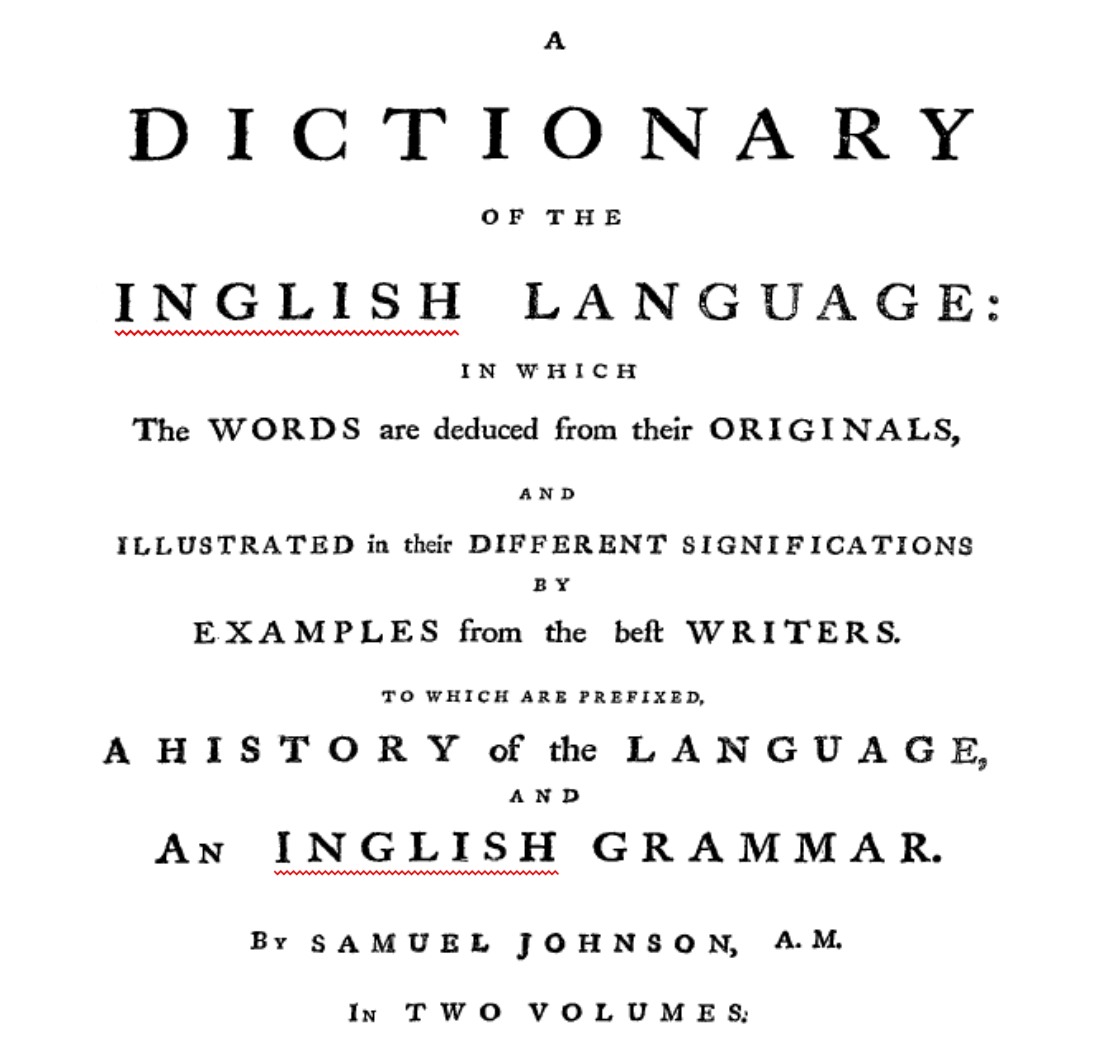
It seems all too appropriate that a language infamous for its quirks of spelling should display a quirk of spelling in its very name. The word English would reasonably guide total newcomers to pronounce it with a short E, like the one typically to be heard in pen. Instead, their ears are due to be stung by its initial short I-sound, like the one in pin, as if the word were written ‘Inglish’.
Across most of English today, these are two separate vowels dependably represented by two separate letters: E and I. Yet, at the beginning of English, the former muscles in on the phonetic territory of the latter.
This is quite the oddity. To my linguistically obsessed brain, no comparable words with this E-I mismatch* readily come to mind. Without such allies, it can’t be formulated and tolerated as a predictable rule. Upward and Davidson, in their mighty History of English Spelling, refer to the word as “a sound-symbol anomaly” (2011: 40).
Nonetheless, we can try to explain and understand the lonely quirk. In this effort, we encounter grand forces at work behind language, namely the complex dances between speech and spelling, logic and emotion.
As a rule of thumb, if a written English word looks to be pronounced a certain way, it most probably is or was thus spoken. This rule certainly covers English.
For one thing, it’s perfectly possible to pronounce the first syllable of English as it’s written. Weird as it will sound, there’s nothing impossible or phonetically awkward about such an ‘eng’ sequence of sounds; German speakers manage it in their equivalent word Englisch, just as English speakers manage it in penguin and ginseng tea.
Besides, the E of English is consistently present throughout the written record of the language, right back to the Old English period (c. 450–1100 AD). In texts from those days of yore, Englisc is the usual spelling for the language of the Engle living in Engla land. True, there is variation (including “Ænglisc” and even the rare “Onglisc”), but the E-forms are the norm.
“ic Ælfrīc wolde þās lytlan bōc āwendan tō engliscum gereorde of ðām stæfcræfte þe is gehāten grammatica”
‘I Ælfric wanted to translate into the English language this little book about the writing skill that is called grammatica’
(Ælfric’s Grammar, c. 990 AD)
With such principles of articulation and consistency of attestation, we have no reason to think that the initial vowel of Engle and Englisc was pronounced as anything other than a normal short E. That is, it was a sound made with the tongue forwards and at a medium height in the available mouth space for vowels:
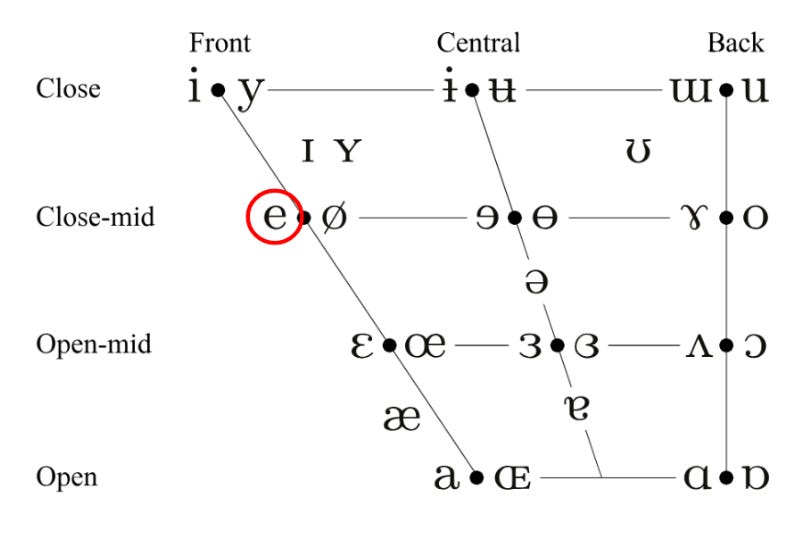
This sound was the product of a shift in the prehistoric development of English. Known as i-umlaut, this change moved vowels in words forwards in the mouth to become ‘front’ vowels, on the condition that the following syllable in the word also contained a front vowel or semivowel. Those subsequent syllables have since largely dropped off, but the umlaut that they triggered remains very much present in English.
On the vowel trapezoid above, we can visualise i-umlaut as a leftward shift, as back vowels on the right became their matching front vowel on the left (while some already front-ish vowels became higher and front-er too). It shunted vowels not only in Pre-Old English, but across the emerging Germanic languages, with the curious exception of Gothic.
The change can explain so much of English’s grammar and vocabulary today, being responsible for the difference in vowels between man and men, tooth and teeth, foot and feet, full and fill, gold and gild, long and length, food and feed, bank and bench, Frank and French, and many words more. Note the frequent E in the second word of these pairs, which is the umlauted one. The change has also been at work in the word English.
The English-to-be first appear in history in Roman writings. The historian and politician Tacitus, writing in the first century AD, provides us with a rare mention in his description of the barbarous foreigners to the empire’s north:
“Reudignī deinde et Aviōnes et Angliī et Varīnī et Eudosēs et Suardōnēs et Nuithōnēs flūminibus aut silvīs mūniuntur.”
‘Then the Reudigni, the Aviones, the Anglii, the Varini, the Eudoses, the Suardones, and Nuithones, protected by rivers or forests.’
(Tacitus, Germania 40)
The “Angliī” listed here are the English, at least etymologically. Their Latinised name is spelled with an A because such a low back vowel was what the Romans heard at the time. It was most likely a tribal name with a geographical basis, assumed by the inhabitants of a peninsula in what is today the north tip of Germany.
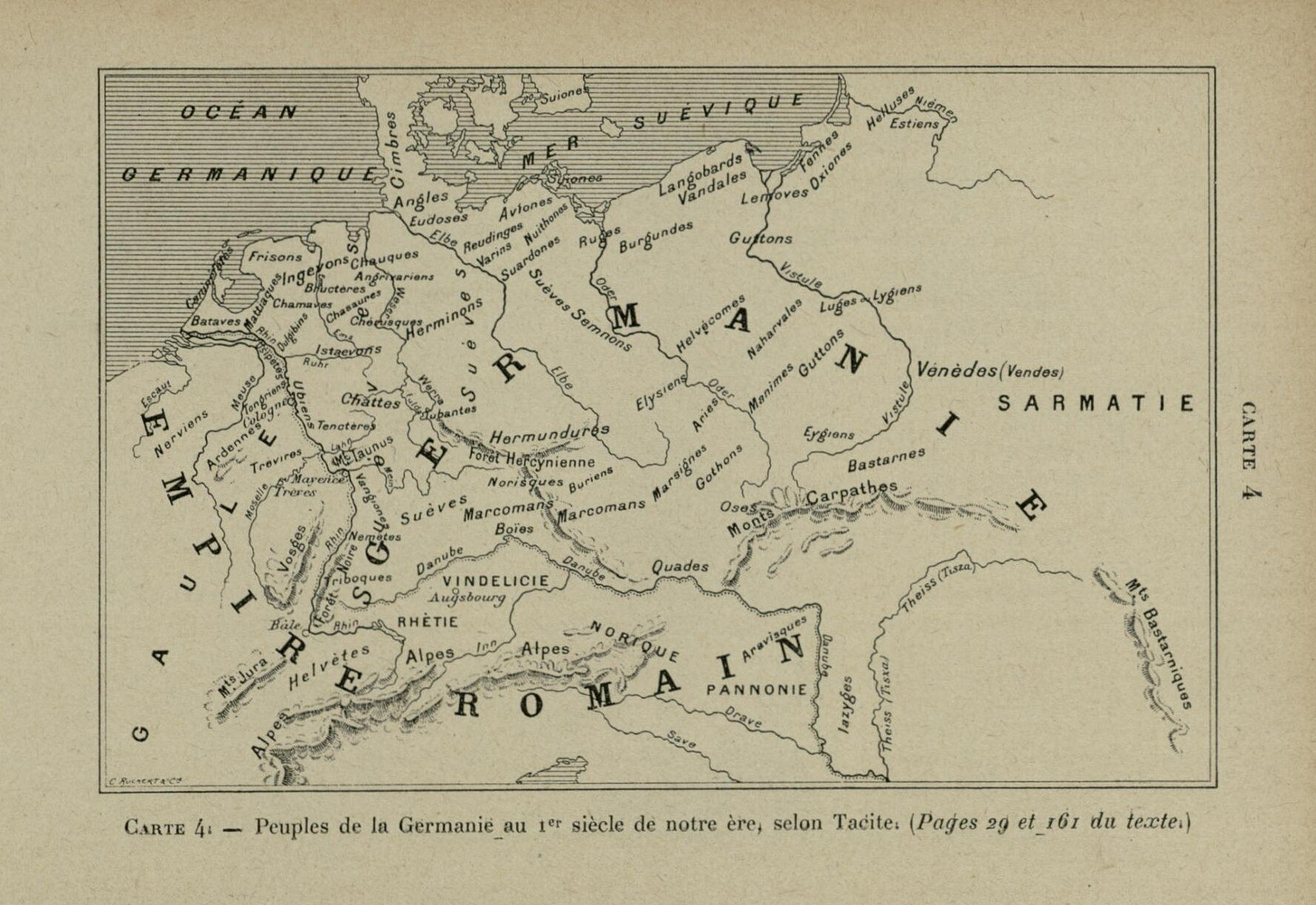
From this self-designation, the Romans coined their noun Anglus. This has since given English vocabulary like Angle, Anglo– and anglicise.
Back in the local Germanic speech of the Anglii, i-umlaut would in time take effect. It shifted the original A-type vowel forwards and upwards, resulting in Old English words like Engle and Englisc. A parallel story belongs to the great river known to the Romans as the Albis, but later to the Germans as the Elbe.
The evidence (present, historical and pre-historical) indicates that the E of English was once a ‘normal’ E in earlier stages of English, i.e. spelling the umlaut-fronted, mid-high vowel that we’d expect it to. This harmony between speech and spelling, however, became discordant in the post-1066 period of Middle English.
We can detect a distinct sound change, small in scope, that affected a handful of spoken words in the Middle English period. It was all a matter of the right sounds in the right order.
When a vowel of middle tongue-height occurred before the consonants /ŋg/ or /ŋk/ (hear the NG in finger and the NK in pink), this environment had the power to raise up the vowel up. In other words, that specific combination of sounds triggered a vocalic shift among medieval speakers, and turned mid-high vowels into high ones. Speculating, I suppose that this was a kind of articulatory assimilation. In the vowel space, the simple shift looks so:
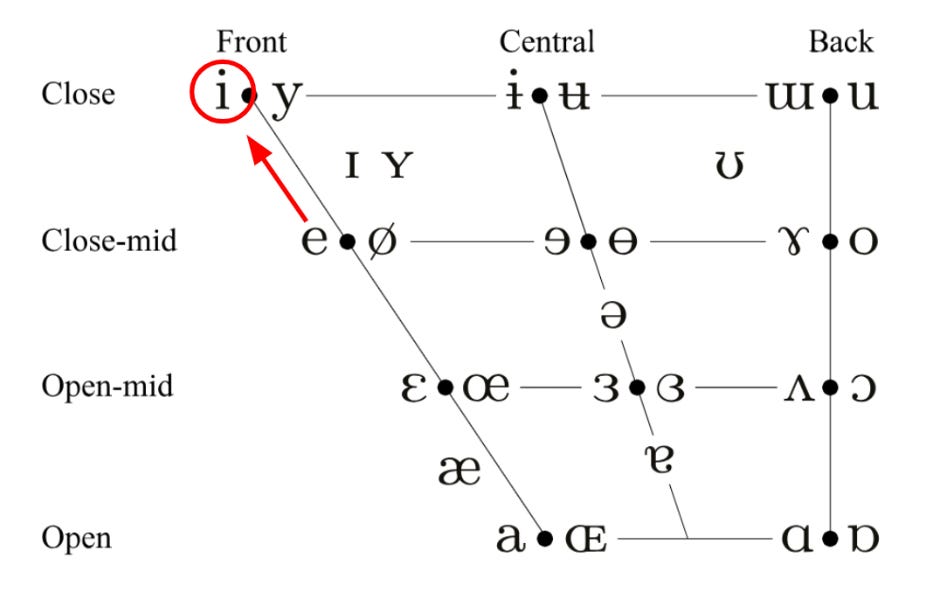
Thankfully for us linguists, this shift is reflected in ye olde spelling. In Middle English texts from before 1500, we find words like weng, streng and lenger turning into their modern forms wing, string and linger. Possibly also, fleng became fling.
Likewise, from the thirteenth century onwards, we observe the substance enk shifting to ink. This change in sound and letter obscures the loanword’s etymology, being a sister of French encre and derived from Ancient Greek ἔγκαυστος (énkaustos), literally ‘in-burnt’.
Even the common verb think could belong to this exclusive set of words. It does derive from Old English þencan, although modern think might instead be the offspring of a confusion between the similar verbs þencan ‘to think’ and þyncan ‘to seem’. The latter, by the way, is behind the odd and affected formulation methinks. It was originally no stranger than saying ‘it seems to me’ today.
It wasn’t only the front E-vowel that was a candidate for elevation; the counterpart back O-vowel could find itself raised up into the territory of U. This could be behind the pronunciation of among, which rhymes with sung, not song.
With an appreciation of this change, we can partly explain English. Since its first syllable included the same environment of sounds, it too underwent the shift heard with wing, string, linger and ink. Unlike them, of course, there was a complication; the spoken word left its spelling behind.
The truth of the matter is therefore that the English sounds in English have developed regularly; it’s spelling that is instead the source of bother, being in need of the E-to-I update that other words unproblematically received.
Why then isn’t English spelled Inglish, to match wing and ink? Well, it has been, and occasionally still is.
Across the eras of Middle English and Early Modern English, our sources for the language attest a great number of shifted spellings: “Inglysshe”, “Inglis”, “Inglish”, “Inglishe”, “Inglisce”, and also same-sounding Y-initial variants like “Ynglis” and “Ynglysche”. These are all in tune with the change in speech.
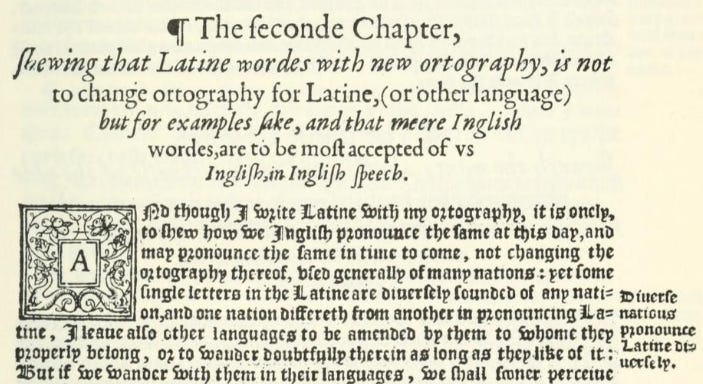
This alternative is still current in some places. Over in Ireland, at a distance from the writing conventions of Britain, the Ulster English dialect can be referred to in writing as Ulstèr Inglis. Elsewhere, varieties of English that are heavily influenced by Chinese languages are not Chenglish, but rather Chinglish. In this case, the letter I ensures the right pronunciation. Of course, Inglish may also occur as a spelling ‘mistake’ by writers with less exposure to the standard.
Such variants, past and present, are not to be dismissed. All deserve consideration by scholars, because spelling is a matter of consensus and community. Although one way of spelling a word may rise to such a status that alternatives seem weird or inferior by comparison, that standard fundamentally remains one possible variant among others, its God-given standing just an illusion of inevitability. So often, it’s not a matter of how a word is written that wins it status, but rather who writes it that way – and whether they’re aligned with the powers of an elite.
Contemplating the ban on Inglish pokes a hole in the perceived certainty and soundness of the standard. Since the early modern period, the writers-that-be have overwhelmingly rallied behind the conservative spelling English, despite its phonetic flaw. And why? My answer has to be: if not passive imitation, then active sentimentality.
As strange and non-linguistic as that answer may feel, methinks it’s the most plausible explanation. True, there is a great deal of unfeeling inertia to be seen in the history of spelling. Yet conservatism alone cannot say why English couldn’t shift in its written form, when weng, streng, lenger and enk clearly could.
Instead, its status as the title of the language – that truest tongue of England, penned by Shakespeare and Chaucer, wielded since the days of Offa and Alfred the Great – might have inspired an idiosyncratic reluctance to recognise in spelling any changes in speech. By comparison, innovative Inglish would feel odd and alien, as coldly logical as the Newspeak promoted under Ingsoc (English Socialism) in George Orwell’s 1984.

Singular affection for English may therefore be to blame for this singular “sound-symbol anomaly”. If so, it’s a sobering reminder for the historical linguist who so often deals in sweeping, language-wide changes and the unconscious workings of linguistic logic – you can’t take the human out of the picture, in particular our capacity to get emotionally attached to individual words.
English speakers and their identities are reflected in the E of the word English itself. While not rational or practical, this nonetheless, as said, seems all too appropriate.
END.
Footnote
*No other examples came to mind at time of writing, but Yoïn van Spijk has since noted the same mismatch in pretty. All due credit to him for the good catch. Without the same nasal environment, this won’t be due to the sound change discussed here, nor do my spelling speculations for English apply. Methinks pretty needs its own article.
Primary sources
Secondary sources and references
- bosworthtoller.com
- Dobson, E. J. (1968). English pronunciation 1500–1700, Vol. II, 2nd edition. Clarendon Press.
- Minkova, D. (2013). Historical phonology of English. Edinburgh University Press.
- oed.com
- Upward, C., & Davidson, G. (2011). The History of English Spelling. John Wiley & Sons.
- Wright, J., & Wright, E. M. (1923). An Elementary Middle English Grammar. Oxford University Press.
Images either my own masterpieces or taken from Wikimedia/Wikipedia and other public-domain sources.
 Danny L. Bate
And in “women”, the /ɪ/ sound is even more strangely spelled with an “o”. As for the vowel represented by “e”, the Wiktionary shows the transciption /ˈwɪm.ɪn/ (thus another /ɪ/ spelled as “e”, like in “English”. But the vowel reduction in the unstressed syllable makes it manifest as /ˈwɪmɨn/, if not an outright schwa.
LikeLiked by 1 person