Yours truly has been far from home again, this time strutting the streets and trekking the trails of the Republic of Armenia. I travel for history; I travel for food and drink; and, most importantly and on-brand-ly, I travel for language. Just as you might savour the aroma of an outlandish vintage or cuisine, I find immersion in a different linguistic milieu deeply stimulating and enjoyable.
Over six days, Armenia, what with its distinctive alphabet and flavour of Indo-European, served up such stimulation in abundance. Until last week, I was only a fan from afar. So, being hosted at home by the Armenian language was thrilling.
To organise my many thoughts, as I’ve done with Hungarian before, this is a report from a linguist abroad that shares some personal observations and reflections from the land where people speak hayeren. They relate to, in order, the linguistic lie of the land in Armenia, the lexical ingredients of the language, and the alphabet that helps to define a nation.
Armenia, if your internal map of the world is fuzzy and currently failing to pinpoint the place, finds itself in the Caucasus region, south of Russia and north of the Middle East. This mountainous land defies easy assignment to either Europe or Asia – continents are complicated concepts – and so here the term Eurasia proves its worth.
With this position, the Armenians have passed through periods of both independence and subordination to local powers. One of these was Russia, first Tsarist and later Communist, and Armenia was one of the Soviet Socialist Republics that constituted the USSR until 1991. The relationship with Russia remains complex and variable; it’s not lost on Armenians that today’s republic emerged from those Armenian lands that lay under Russian rule before the First World War. As witnessed by pre-WWI mappings and post-WWI proposals for independence (such as ‘Wilsonian Armenia’), these represent only an eastern fraction of historically conceivable Armenia.
Its western portions outside of Russia were subject to ethnic cleansing and cultural erasure by Ottoman Turks; Armenians there tragically inspired a contribution the global lexicon: genocide. The minimalisation or outright obliteration of the historical Armenian presence has continued since 1915, infamously in the early 2000s in the Nakhchivan exclave of Azerbaijan, and after 2023 with the surrender of the Republic of Artsakh.

Armenia may have now shrugged off direct rule from the Kremlin, but decades of dominion and enduring political and economic connections mean that the Russian language holds a prominent position in the modern republic. Everywhere I went, Russian was never long out of earshot. In shops and cafés, Armenians consistently assumed that I was Russian myself, most likely on the basis of my complexion, which had me reflecting on the irony and dodgy etymology of the word Caucasian. English has achieved a popular presence too, especially among the youth of Yerevan; outside of the capital, I was only saved in several interactions by my skill in Slavic.
Russian was resorted to when the conversation exhausted the meagre handful of Armenian words and phrases that I’d managed to fix in mouth and memory. Armenian is an Indo-European language – nominally within my linguistic comfort zone – but this genealogy was of little practical use for me. It unlocked only a handful of words encountered in the wild. Equipped with knowledge of some Armenian-specific sound changes, I was pleased to comprehend տուն (tun) ‘house’ off the back of Latin domus, Czech dům, etc.
The thing is, Armenian is something of an Indo-European outlier, the ‘bad boy’ of the family. It gets its own branch of the tree, having undergone some truly brow-furrowing developments in sounds, grammar and vocabulary. Greek is widely held to be Armenian’s closest cousin, but the exclusively Graeco-Armenian features are few and any point of connection would be very old.
More obvious are the very uniquely Armenian sound changes, and also the exceptions to those changes. These have infamously meant that the Armenian relative of the Indo-European numbers two/twee/zwei/deux/dos/dva is of course երկու (yerku). The kinship terms father/vader/Vater/père/padre find their Armenian cousin in հայր (hayr).
Meanwhile, the pronoun for singular ‘you’ is դու (du), looking just like German du – except that it’s irregular, unexpected, and unexplained. What fun!
The special position of Armenian, relative to the rest of Indo-European, was only recognised in the 1870s, after philologist Heinrich Hübschmann unearthed the distinct Armenian foundations under strata of loanwords.
“Better known are the lexical borrowings from Greek, Syriac and above all Iranian, which has had a marked influence on Armenian for many centuries. Within the great mass of Iranian borrowings, different layers can be perceived; the oldest … goes back to the time of the Achaemenids (550–330 BC), when Armenia was under Iranian domination but not completely Iranianized … The majority of Iranian borrowings, however, belong to the period during which a branch of the Parthian dynasty of the Arsacids (AD 53–428) was dominant in Armenia … A more recent and less obvious layer comprises loans from Middle Persian of the Sasanian epoch. In this period there come in mainly technical terms relating to the military, administrative, legal and commercial spheres…”
(Ajello 1998: 201)
After these ancient acquisitions, later adoptions from Russian, French (e.g. մերսի (mersi) ‘thanks’) and English have been added to the heap. Such a lexical debt owed to other languages is nothing bad or unusual; for one comparandum, see the language you’re reading right now.
Unfamiliar words fit within an unfamiliar structure of grammar. Armenian nouns do change their endings, to express the functional information of case and number, but there the obvious similarities with the rest of Indo-European end. To make a river, գետ (get), nominative and plural in Classical Armenian was գետք (getkʻ); nowadays it’s գետեր (geter). Neither plural ending, –kʻ nor -er, is recognisable from a general Indo-European point of view, and I believe both are etymologically debated.
I expect that Armenian will look different from the perspective of different languages; I come at the language from the west, armed with Greek, French, Russian and English, and recognise only a few familiar faces – one being եկեղեցի (yekeghecʻi) ‘church’ from Greek ἐκκλησία (ekklēsía).
But for someone instead approaching it from the east, from Persian, then I imagine that Armenian will look much less opaque.
What obscures Armenian from all angles, regardless of the direction of approach, is its alphabet. This phonemic system of spelling is fair in offering few headstarts to users of other systems; purported connections with the Georgian scripts to the north are not at all clear to me. This is because the Armenian alphabet was devised exclusively for Armenian. Its invention is traditionally attributed to God, with assistance from the saintly scribe Mesrop Mashtots, in the 5th century AD.
The story goes that the scholar looked around for a writing system for Armenian, but was dissatisfied with the scripts on offer at the time. So, rather than adopt and adapt one of them, Mesrop Mashtots/God devised one from scratch, beginning a centuries-long bond between speech and writing. This invention and its success I find deeply interesting; new alphabets face an uphill climb towards acceptance, and their longevity is caught up with the linguistic needs and social circumstances of the time. I’ve shared previously, such as in conversation with Jackson Crawford, my theorisings about why some alphabets of the Late Antique/Early Medieval era blossomed (e.g. Armenian, Georgian), while others (e.g. Glagolitic) wilted.
There are some possible influences in Armenian letters from pre-existing scripts. The choice of a digraph (ՈՒ) to represent the vowel /u/ must be modelled on Greek ΟΥ, for example. So too does the alphabetical order somewhat mirror the Greek. But overall, the Armenian alphabet demands simple memorisation from would-be readers and writers. I set to it ahead of travelling, and a ‘technique’ of sounding out Armenian vocabulary and transcribing international words had lodged maybe half of the letters in my brain before landing in Yerevan.
Progress was impeded by the existence of upper and lower cases, equivalent letters in which can appear quite divergent – as they can in the Roman alphabet (consider R and r, D and d). Progress was greatly assisted, though, by the mass of transliterated signs throughout the capital. Businesses, I believe for legal reasons, require an Armenian rendition beside any Roman or Cyrillic originals. This happily offers a speedy test-and-answer for the student of Armenian!

That said, the assistance was weighted towards those letters with counterparts in foreign languages like English. It sped and shored up my recognition of Ա (A), Բ (B), Ի (I), Լ (L), Ս (S) and others, but less so of the aspirated affricates Չ (Čʻ) and Ց (Cʻ). It was also interesting to note that an English word or brand-name might get borrowed with one of the aspirate letters, representing a breathy consonant, when the English prototype doesn’t contain (or at least doesn’t consciously contain) such a sound.
But, my word, the most remarkable observation about the Armenian alphabet must be its cultural value. Armenians can’t get enough of it! For one thing, it’s widely available to buy as a gifty object, be it printed on posters or stitched into shawls.

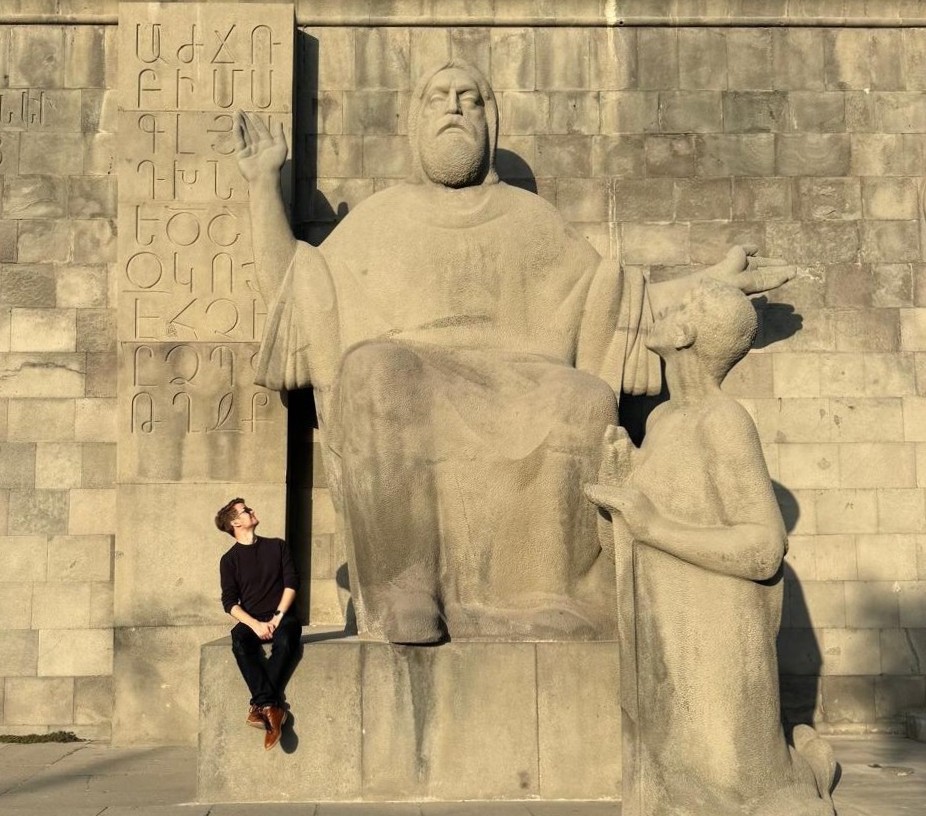
The Matenadaran, Yerevan’s institute and museum of manuscripts, was not only heaving with visitors when I visited, but also doing a roaring trade in alphabetic merchandise.
But I got the impression that the Armenian alphabet as an expression of identity goes back a long way. Armenia’s world-famous churches, sombrely and soberly decorated in comparison with Orthodox buildings, are enveloped in inscriptions, both official and illicit. I have to wonder whether this use of writing as a primary means of adornment was an Armenian response to the exalted position of calligraphy in Islam.

The Armenian alphabet clearly occupies a prominent position in the national consciousness. It’s a token of Armenian identity and a generator of Armenian pride, and it achieves a presence far beyond a background status as a mere linguistic tool. English’s alphabet is ubiquitous, universal and rather unloved. Armenian’s, meanwhile, is cherished and celebrated, and I’m all for people recognising and delighting in the brilliance that is the written word.
Շնորհակալություն, Հայաստան!
END.

Non-linked references:
- Ajello, R. (1998). Armenian. In The Indo-European Languages. 197–227. Routledge.
- Hübschmann, H. (1875) Ueber die Stellung des Armenischen im Kreise der indogermanischen Sprachen. Zeitschrift für vergleichende Sprachforschung auf dem Gebiete der indogermanischen Sprachen, 23 (1), 5–49.
- Kim, R. I. (2018). Greco-Armenian: the persistence of a myth. Indogermanische Forschungen, 123. 247–71.
- Martirosyan, H. (2009). Etymological Dictionary of the Armenian Inherited Lexicon. Brill.
- Matasović, R. (2009). A grammatical sketch of Classical Armenian. Ms. University of Zagreb.
- Meyer, R. (2019). Introduction to the History of Classical Armenian: I. General Introduction (Comparative Philology Seminar 22nd January 2019).
- Olsen, B. A., & Thorsø, R. (2017). Armenian. The Indo-European Language Family: A Phylogenetic Perspective. 202–222. Cambridge University Press.
Images my own, from Wikimedia Commons or from credited sources. Only human intelligence (or lack thereof) was used in the creation of this article. Cover picture: me, looking up to Mesrop Mashtots, outside the Matenadaran. With thanks to the humans and cats of Armenia.


Leave a Reply