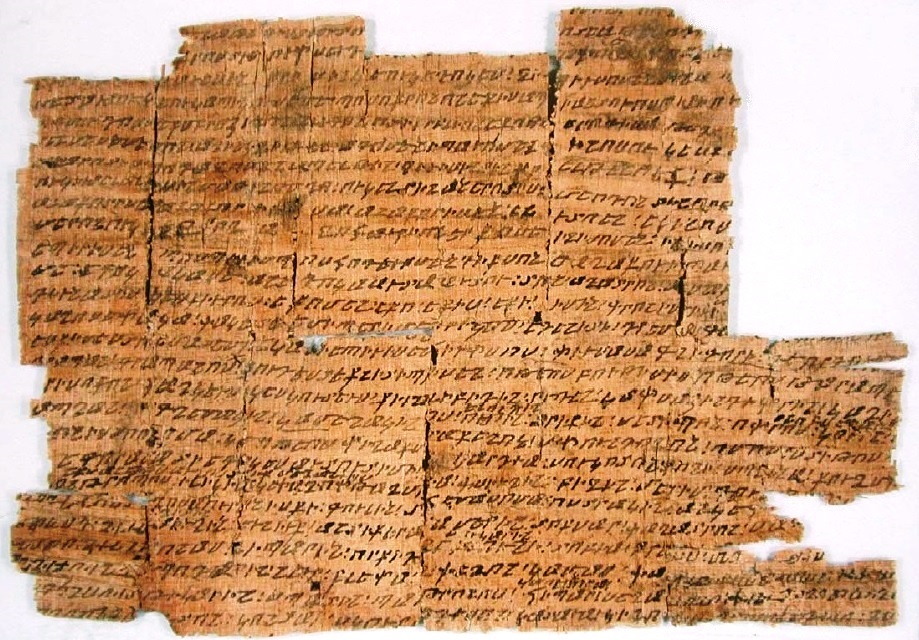
Or: Why my (probably) favourite historical document is a unique Armenian text without a word of Armenian.
But first, a break from your scheduled linguistics, with a message from our sponsor (my fledgling writing career), which will self-destruct after a couple of days.
Friends, forgive the advertisement. The US release of my book, Why Q Needs U, is on the horizon and Barnes & Noble are including it until March 26th in their preorder offer for members. If you’re one such member or know someone in America who is, I’d like to tell you that preordering WQNU on the B&N website now can make an incredible difference to the book’s fortunes in the future. 25% off its price is like getting seven letters’ histories for free. It is also a very pretty book that would look lovely on your shelf.

Thank you! Now, back to the language.
Centuries before the translation apps and pocketable phrasebooks of today, people who found themselves far from home made do with ink and papyrus. For reasons of pure linguistico-historical nerdery and joy, I’d like to introduce you to a special document from my beloved era of Late Antiquity.
It comes from Egypt, which today we generally think of as an Islamic, politically independent country where people speak Arabic. In the days of this document, though, Egypt was Christian, ruled by Roman emperors in Constantinople, and a place where people spoke Greek – among other languages, one of them apparently being Armenian.
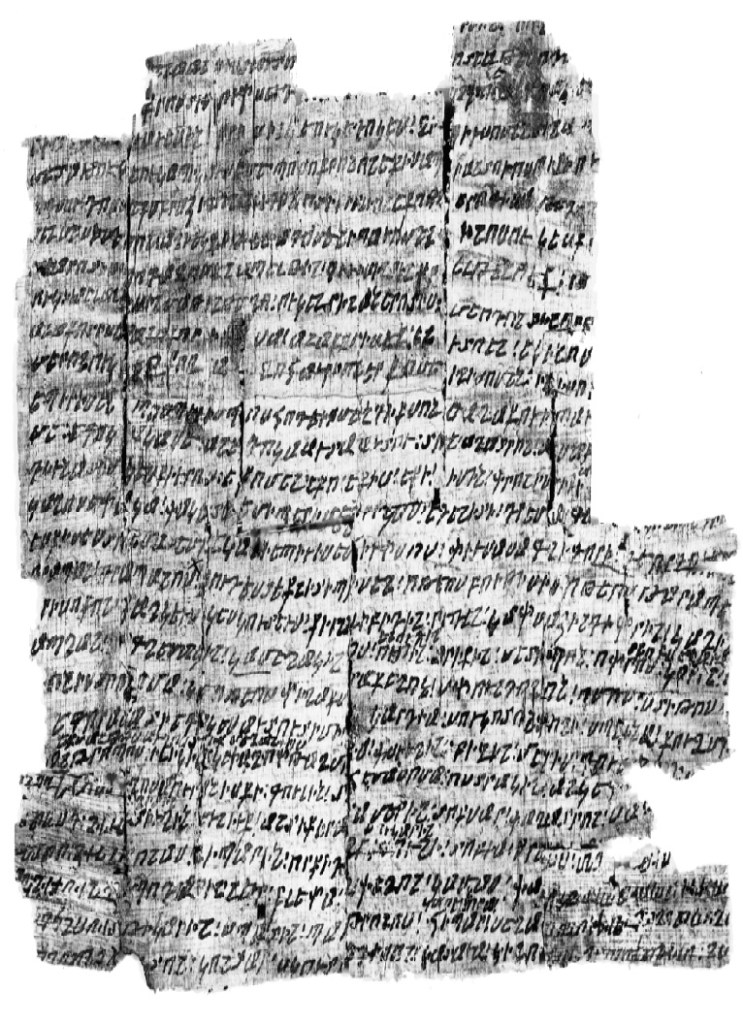
Two of the four fragments of the papyrus, from one side, which together form a single document (1) 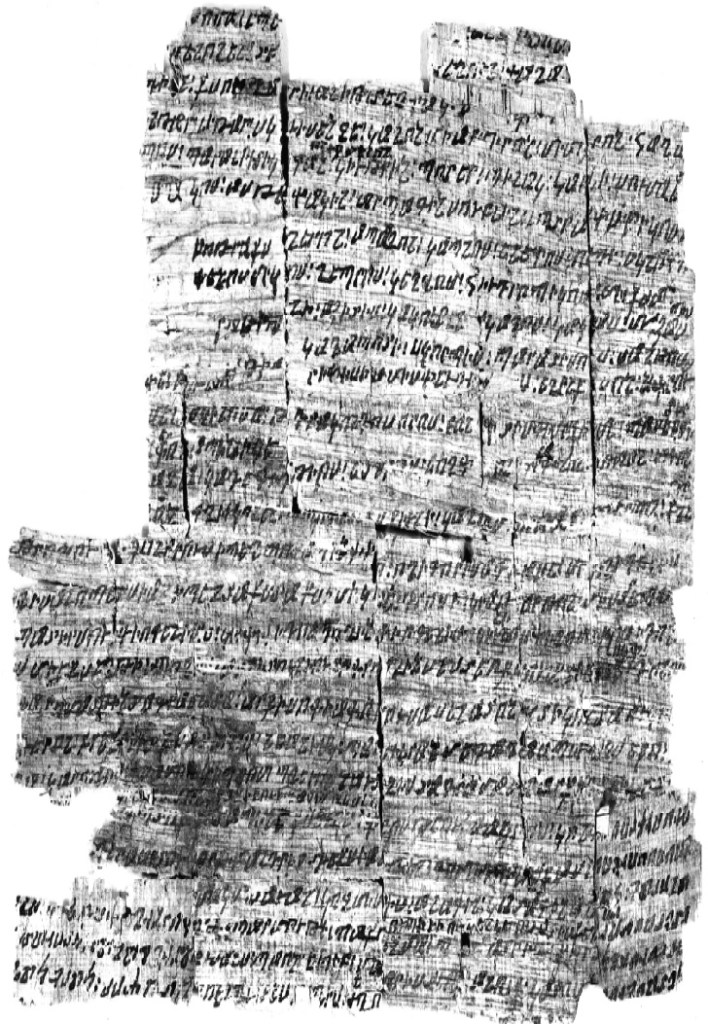
Two of the four fragments of the papyrus, from one side, which together form a single document (2) 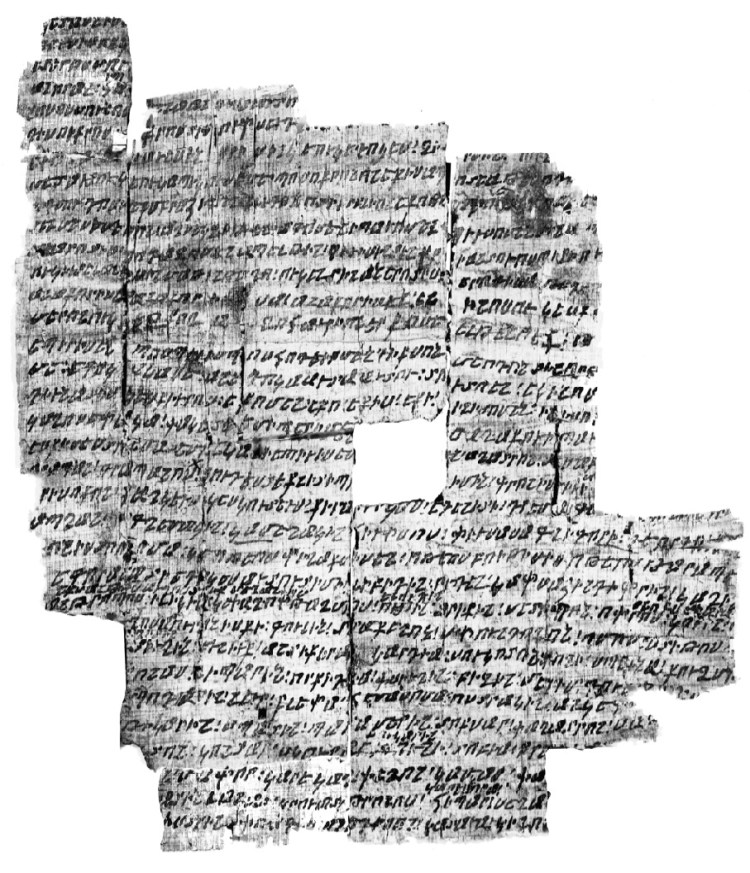
Two of the four fragments of the papyrus, from one side, which together form a single document (3) 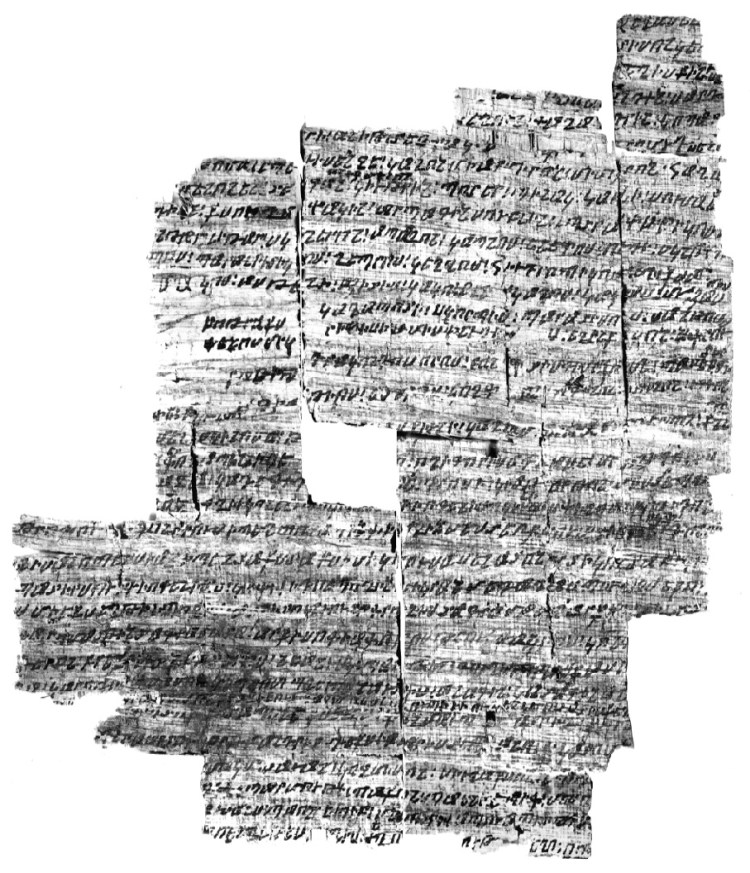
Two of the four fragments of the papyrus, from one side, which together form a single document (4)
Written in Armenian letters for an unknown individual navigating the Greek-speaking society of Roman Egypt, it’s an absolute goldmine of historical and linguistic information. It’s both a testament to a multicultural Mediterranean world, and a valuable early witness to the Armenian language and its speakers. This is in spite of the fact that it doesn’t contain a single word of Armenian.
First things first: what we have here is an ancient piece of papyrus, written over with neat ink lettering. The script is Armenian, an alphabet exclusively devised for Armenian speech in the early 5th century AD. Its invention is attributed to the saintly Mesrop Mashtots, and, although there are some apparent external influences (such as in the alphabetical order), it’s very distinct from other writing systems of the world.
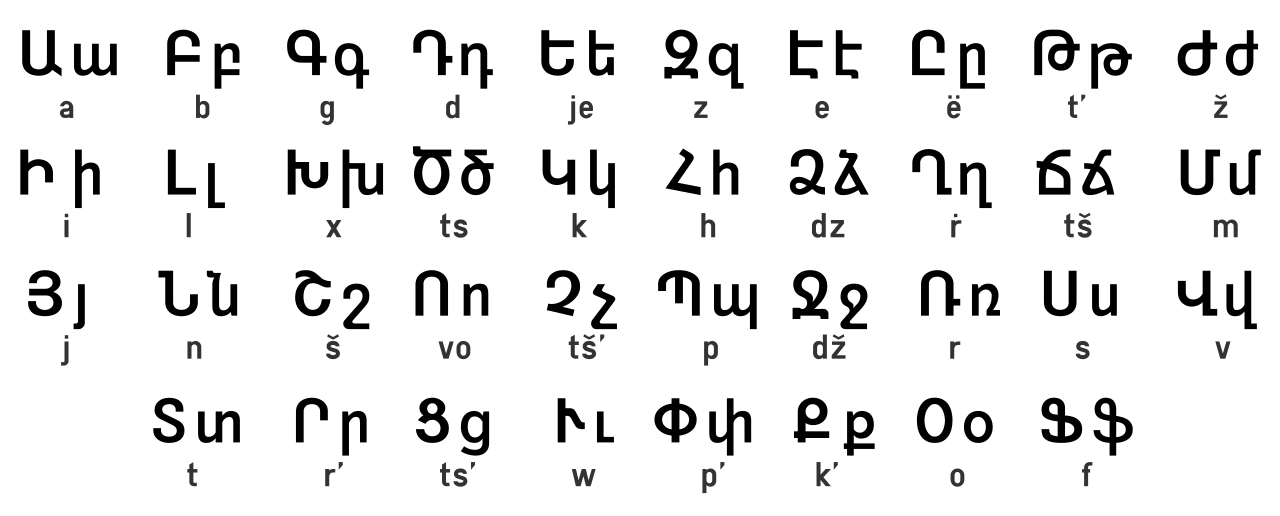
The creation of the alphabet was a natural consequence of Armenia’s embrace of Christianity in the previous century – the first state to do so officially, something that Armenian Christians are proud of. Armed with their own script, Armenians were ready to translate the Word and its holy texts. We therefore see an eruption of Armenian language and literature around this time. From then on, we can get the internal perspective, where previously we are reliant on references by outsiders (e.g. the Persians, the Greeks).
This document, cautiously dated to around the 5th–7th century AD, is a very early example of the Armenian alphabet, and the only one written with papyrus for its material. Yet it doesn’t come from anywhere near lands ever known as ‘Armenia’, nor does it write down Armenian speech. Its provenance is unclear. The French scholar Auguste Carrière bought the parpyrus from a dealer at the end of the 19th century. Scholars worked off a photograph of just one side until the original was rediscovered in 1993 by historian Dickran Kouymjian at the French Bibliothèque Nationale (designation: BnF Arm 332). Before Carrière, the trail goes cold, but the arid, papyrus-preserving climate of Egypt is the likeliest resting place. As for its language, the document is nothing but words of Greek.
Line after line, the document faithfully renders nouns, adjectives, verbs, phrases and whole sentences of Greek in Armenian letters. Following James Clackson’s (2000) reading and transcription, this is a taste of how it looks:
… ԱՆԹՐՈՊՈՍ:ԻԼԻԿԻԱ:ԿԵՓԱՂ:ՈՓԹԱՂՄՈՍ:ՈՒՏԻՆ…
(BnF Arm 332a: line 26)
Matching each Armenian letter up with its closest Greek equivalent gives us this version:
… ανθροποσ:ιλικια:κεφαλ:οφθαλμοσ:ουτιν…
Finally, these words, helpfully kept separate by a colon, we can render in standard Ancient Greek and translate:
… ἄνθρωπος (‘man’): ἡλικία (‘age’): κεφαλή (‘head’): ὀφθαλμός (‘eye’): ὠτίον (‘(little) ear’)…
Behind the Armenian and the Greek, we find a list of body parts waiting for us! This is the essence of the Graeco-Armenian papyrus; it’s not great literature, but rather a delightfully practical document.
In other parts, we have humble vocabulary for the kitchen and the table (“pan: jug: cup: plate: cup”) and for the family (“sister: daughter: aunt: uncle: companion: lap: wifeless”). There are practice verbs, familiar to any student of Greek: “we have: I have: you have: he has”. There are useful Greek phrases for everyday life: “you did not pay the price… I have a book… I want to learn… today I am not at leisure, tomorrow I am going… where do we go: show me the road… I ate well: eat don’t wait”.
There are more complex sentences too, such as memorable sayings about the philosopher Diogenes. Biblical quotations, monotheistic well-wishing (“God help you”) and the twelve months of the Egyptian calendar together point to the document’s origin in Greek-speaking Christian Egypt.
Now, I see two seams of information to be excavated from the papyrus: one about historical language (quelle surprise), but another about historical society. Let’s dig into the first.
Evidence for language past
The thing is, the papyrus is an excellent acoustic witness to how Greek sounded back then. The language, caught between its Koine and Medieval forms, is plentifully attested in historical sources from Late Antiquity, but such sources are necessarily silent. We know that Greek speech has undergone many changes down the millennia, but pinpointing when (and where) these changes occurred tends to be imprecise – we say things like ‘Oh, that consonant shifted during the Koine period’, which narrows things down to about nine hundred years.
This touches on a tension that I explored in Why Q Needs U: when speech changes, writing can often stand perfectly still. For alphabets and other systems based on the sounds of a language, if instances of a particular sound change across the board, without exception, then its associated written symbol need not shift too. It straightforwardly spells one sound, both and after the change.
For instance, the Greek B originally stood for the consonant /b/. That stop sound has since shifted into the fricative /v/. This has turned the letter’s name from beta into ‘veta’, but the letter is otherwise unbothered; now, it spells /v/. The letter’s inertia obscures the fact that any change in speech has taken place.
Alternative scripts are therefore of great importance for the historical linguist. Rendering speech in new letters is not bound to any archaic spelling and established standard, but instead is accurate to sound. This Armenian spelling of Late Antique Greek lifts the veil on the spoken language, giving us a precious glimpse of what changes had (or hadn’t) occurred.
There is good evidence that the author was not reading and transliterating written Greek, but rather listening attentively to the spoken language. The Armenian alphabet has a broad array of letters at its disposal, and the author of the papyrus chose carefully among them, on the basis of either what they heard in Greek speech, or what they thought they heard.
The Armenian alphabet has two letters, Լ and Ղ, which at the time spelled two L-like sounds. These were a ‘light L’ and a ‘dark L’, as can be heard in many accents of English. In my accent, Armenian Լ would spell the L at the start of like and language, while Ղ was for the L at the end of ball and ill. Both are used consistently in the papyrus, in spelling words for Greek has only one letter: Λ (lambda). Rather than chaotic employment of Լ/Ղ, the author may have identified a ‘light/dark’ difference in spoken Greek and applied the letters accordingly. If so, this is news to me; I’ve not read of such a distinction in Greek elsewhere.
The active choice of Armenian letters offers us whispers of the accent behind the words. For example, it has Բ, which stood and still stands for the voiced stop sound /b/. Greek words spelled with B are here mostly Armenian-ised with Բ, rather than another letter that would indicate a thorough shift towards the voiced fricative /v/, such as the W-letter Ւ. There are a couple of spellings that hint at its onset, though. For instance, “ՍԱՒԱՆ” (‘sawan’) spells σάβανον ‘linen cloth’.
The consonant behind the Greek letter Χ has also changed over the centuries, from an aspirated /kʰ/ to a fricative /x/, as in Scottish loch. The Armenian alphabet could provide suitable letters for both the older and the younger sounds (namely, Ք and Խ). We observe that Χ-words in usual Greek writing are spelled in the papyrus with Ք, indicating the older sound.
Relatedly, Armenian has a letter for the breathy /h/ sound in hat: Հ. The author of the papyrus often uses it at the start of Greek words that have since dropped their Hs. It’s there in “ՀԷՄԱ”. This is the Ancient Greek word for ‘blood’, αἷμα, the origin of English haemo-. It’s pronounced like a breathless ‘ema’ in Modern Greek, but was ‘hema’ still for our author. That said, the Հ is absent from other possible places. The variability gives the impression that H-dropping in Egyptian Greek was common, but not yet ‘good’ Greek.
These features together give the Egyptian accent of Greek behind the papyrus a fairly conservative, quasi-classical feel. Many of the sound changes that are standard and normal in Greek today don’t seem to have been fully present in Late Antique Egypt.
Some are, mind you. An infamous change in post-classical Greek is ‘iotacism’. This has been a gradual merger of several vowels. Once, only the letter Ι (iota) represented the /i/ vowel heard in English sheep and Greek. Now, it has been joined in that pronunciation by Η (eta), Υ (upsilon) and three pairs of letters. There is evidence for iotacism in the papyrus, based on spelling misalignments or ‘mistakes’, but the process is just getting started.
The vowels behind Ι and Η have apparently merged, because they’re both spelled with the Armenian equivalent to iota: Ի. This explains the “ԻԼԻԿԻԱ ~ ιλικια ~ ἡλικία’ example above. The author likewise spells the eta-words χήρα ‘widow’ and ἥβη ‘youth’ with Ի.
Yet Greek Υ gets its own rendering in Armenian: ԻՒ (‘iw’). This is clearly the author’s way to represent the front vowel /y/ that the letter historically stood for. ԻՒ is for the most part kept unmerged and unmistaken for Ի. We find “ԴԻՒՆԱՏՈՍ” (‘diwnatos’) for δυνατός ‘strong, able’. But there are several exceptions, like ՓԻՍԻՍ (‘pʼisis’) for φύσις ‘nature’. On this basis, we can say that the /y/ vowel behind Greek Υ was still mostly pronounced separately from the /i/ vowel behind Ι and Η, but it was beginning to shift and merge.
As well as innovations in sound, there are some in the realm of words and their construction. Modern Greek is today littered with words of the neuter gender that tend in -ι. These were once diminutives, smaller or more casual versions of basic nouns, formed through the ending -ιον. The Greek behind the Armenian appears to have fully embraced these derived diminutives; instead of σπάθη ‘blade, sword’ and κοντός ‘pole, spear’, its source preferred diminutive σπαθίον and κοντάριον. These look ahead to the Modern Greek words σπαθί and κοντάρι.
Altogether, the evidence for the Greek language behind the Armenian letters is just what we expect to see: in some places conservation, in others innovation. Like any stage of any living language, it preserves elements from the past, while also developing features that will define its future. The Greek of the Graeco-Armenian papyrus sits on the turn of the language’s ancient and medieval chapters. What’s significant is that it gives us close-to-direct evidence for these changes in progress.
But why does this witness to living Greek even exist? What was the purpose of the papyrus? And who was it for?
Evidence for people past
While the document is anonymous, both its content and its context reveal a great deal about its writer and reader. The penmanship is consistent, indicative of a single author, and naturally arose within an Armenian social environment. This in itself isn’t unbelievable; Egypt today is some distance from the modern county of Armenia, but the Armenian state and people could historically be found over a much larger area, even touching the eastern Mediterranean sometimes.
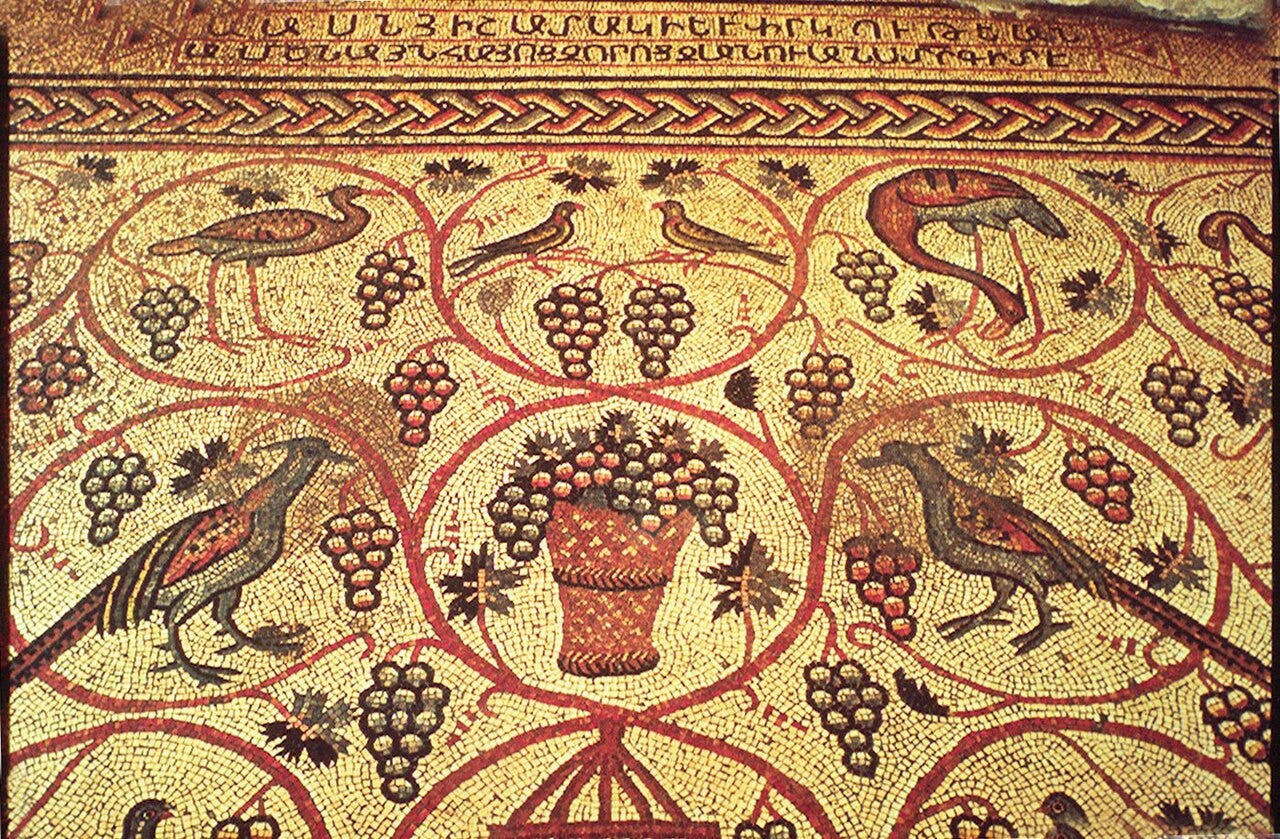
Besides, Egypt was a powerhouse of antiquity and an obvious destination for people travelling, trading and migrating. As I’ve sought to demonstrate in many of my articles, people in the ancient world really did travel around, and left samples of their languages behind. For example, a beautiful mosaic of birds entwined in vines, found in Jerusalem and dated to the 6th century AD, includes a strip of early Armenian writing at the top:
Returning to our papyrus, the linguistic evidence, specifically the choice of Armenian letters, indicates a free hand in writing down spoken Greek. Correspondingly, we can infer a lack of familiarity with written Greek and its conservative spelling. Otherwise, it might have shaped the author’s choices. The same unfamiliarity extends to the society and lifestyle of Hellenic Egypt, from household objects to the local calendar and smart-sounding references.
This altogether draws an outline of a newcomer to Egypt, having travelled from the northeast and now finding their (I’ve not spotted any direct indicators of their gender) way around the bustling, multicultural and multilingual streets of its cities. Some, such as Alexandria, had become world-changing centres of Greek language and literature. Being already fluently literate in Armenian, our newcomer was most likely an adult, or at least an elder youth.
It’s reasonable to describe this papyrus as a kind of phrasebook or aide-mémoire, an informal guide for remembering essential Greek vocabulary. It might be created for personal use, or even to distribute among new arrivals from Armenia. Yet, there is a glaring omission that speaks against this: there are no translations into Armenian.
It’d be a poor phrasebook that doesn’t make its vocabulary and phrases understandable in the reader’s own language. Instead, as James Clackson (2001a) suggests, a likelier context is one in which the papyrus didn’t stand on its own, but rather was a product of an educational setting, with a teacher who supplied the Greek words’ meanings. That is, its author was an adult Armenian learning from a compatriot already fluent in Greek. What they learned, they wrote down, in their own letters, in a kind of exercise book.
“It is possible that the writer took down information by ear from an informant who himself was only dimly able to remember his own educational experience.”
(Clackson 2001a: 216)
If our author was receiving Greek via a fellow Armenian, there might have been some interference in the signal; the instructor’s accent could have been non-native-like. This provides a possible origin of the ‘dark/light’ difference between Լ and Ղ: not in native Greek speech itself, but in someone’s Armenian accent when speaking Greek.
The casual context would also explain the apparent lack of overarching structure behind the entries. They read like someone rattling off whatever comes to mind: “Ah yes, there’s the foot, nerve, vein, blood, body, skull, brain. Also: sheath, sword, dagger, bow, but hopefully you won’t need those. Now, as for verbs, it can be tricky…” This also accounts for the inclusion of quotes and sayings, giving the learner a crash course in both the linguistic and the cultural local lexicon – “Oh, there’s this saying about Diogenes that goes down well with the Greeks…”
If this interpretation is correct, then the papyrus attests to at least two Armenians in Late Antique Egypt, with an established resident teaching a recent arrival. While still finding his feet, the newcomer is clearly committed to learning Greek and making a go of his new situation. Many of us today will be all too familiar with the daunting experience of being a stranger in a strange land. We can sympathise and imagine the daily challenges and stress. Thankfully, our author had a mentor on hand.
I have loved this papyrus (from afar; we haven’t met in person) for four or five years now. No other such documents come to mind as true rivals for my affection; I think I’ve made a good case for why. This unique survival from Late Antiquity is an invaluable witness to everyday real language, and therefore to the real people who lived through that language.
END.
References
- Clackson, J. (2000). A Greek Papyrus in Armenian Script. Zeitschrift für Papyrologie und Epigraphik, 129. 223–258.
- Clackson, J. (2001a). A Greek Educational Papyrus in Armenian Script. In Andorlini, I. et al. (Eds.) Atti Del XXII Congresso Internazionale Di Papirologia, Firenze, 23–29 Agosto 1998. 207–218.
- Clackson, J. (2001b). Vox armeniaca: new evidence for the pronunciation of Classical Armenian. Slovo, 26(1). 43–52.
- Kouymjian, D. (1996). Unique Armenian Papyrus. In Sakayan, D. (Ed.) Proceedings of the Fifth International Conference on Armenian Linguistics Delmar NY. 381–386.
- Matasović, R. (2019). A grammatical sketch of Classical Armenian. University of Zagreb.
Images my own or from Wikimedia. Cover image: photo (from Wikimedia) of a fragment of BnF Arm 332.
 Danny L. Bate