Reading time: 5 minutes
It’s December now, the month when the calendar helpfully provides me with a topic for the monthly article. So, here’s a short and sweet linguistic post with a festive theme: nine Christmas-related words that I think have interesting etymologies, one for each of the nine letters of the word Christmas. I hope you like this merry miscellany of word history.
C is for carol
To kick off, we have the musical term carol, pretty much exclusively used nowadays for songs sung at Christmas. Its meaning has shifted over the centuries though. The association with Christmas seems to begin only around the sixteenth century; in earlier sources it refers to any joyful song, or to a circular group dance set to such a song.
“This carol they began that hour,
Shakespeare, As You Like It 5.3
With a hey, and a ho, and a hey nonino,
How that a life was but a flower“
The English word carol goes back at least to Old French, but before then the trail is a little unclear. It’s been derived from Latin choraulēs, a flute player that accompanied a chorus dance, itself a term of Greek origin. The Greek word χοραύλης is formed from χορός ‘chorus’ and αὐλός ‘flute’. This Greek ancestry would make carol a cousin of chorus and choral.
H is for hark
Hark, what the carol tells us to do to herald angels, is an archaic verb meaning ‘to listen to’ and ‘to pay attention to’. It first appears in Early Middle English, and both its meanings and its form indicate that it shares a Germanic root with the verb hear. Beyond Germanic, that root has been connected to ἀκούειν, the Ancient Greek verb of hearing and listening, from which English gets acoustic.
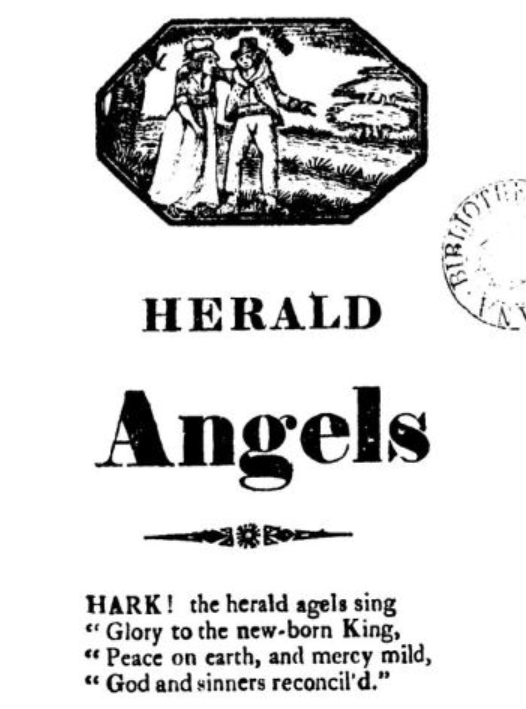
The main difference between hear and hark is that hark bears an additional K. This has been analysed as an ancient frequentative suffix, originally added to the word to indicate that the action was a repeated one. The same obscure -k suffix has been identified by varied authorities at the end of the words walk, talk, stalk and lurk.
R is for reindeer
The term reindeer first appears in English in the late Middle Ages. You might think that the deer part of reindeer is transparent in its origin, but it’s a little more complicated than that. Unsurprisingly, given the European distribution of the animal, English acquired the word from a dialect of Old Norse, spoken to the north in Scandinavia, Iceland and the Faroes. In Old Norse and its descendant languages, dýr/dyr/djur in fact means ‘animal’ in general. It’s their English cognate, deer, that has narrowed in its meaning, coming to refer to one family of animals.
What then about the rein- part of reindeer? This comes from Old Norse hreinn, which independently meant ‘reindeer’! So, a reindeer was originally a compound term that can be literally translated as ‘reindeer-animal’.
The later medieval appearances of the word reindeer are not the first time that the animal crops up in the written record of English. Hrān, a clear Old English counterpart to hreinn, can be found in one ninth-century text. This is the incredible account of Ohthere, a seafarer who spoke to King Alfred the Great about his impressive northern travels.
“Þā dēor hī hātað hrānas; þāra wǣron syx stælhrānas; ðā bēoð swȳðe dȳre mid Finnum, for ðǣm hȳ fōð þā wildan hrānas mid“
‘Those deer they call reindeer. Six of them were decoys. Those are very precious among the Finns, for they catch wild reindeer with them.’
Orosius 1.1
Hrān looks like someone’s ‘translation’ (maybe Ohthere’s own) of the exotic Old Norse word hreinn into Old English, rightly wapping the EI of hreinn for its cognate vowel Ā.
I is for icicle
Just as reindeer is an old compound containing a word for ‘reindeer’, icicle is made up from the word ice, plus something else. That something else as exists the independent (but rare) word ickle.
Ickle itself has a millennia-long history of icy meanings, going back to Old English ġiċel ‘icicle’, and beyond that into Germanic and Indo-European linguistic prehistory. The reconstructed Proto-Germanic word *jekila-, from which ġiċel descended, was a diminutive noun meaning ‘icicle’ or ‘piece of ice’. This ancestral bit of natural vocabulary is also behind the Icelandic word for a glacier: jökull.
S is for sleigh
Sleigh is one of the many words that Modern English owes to Dutch – along with cookies and Santa Claus.
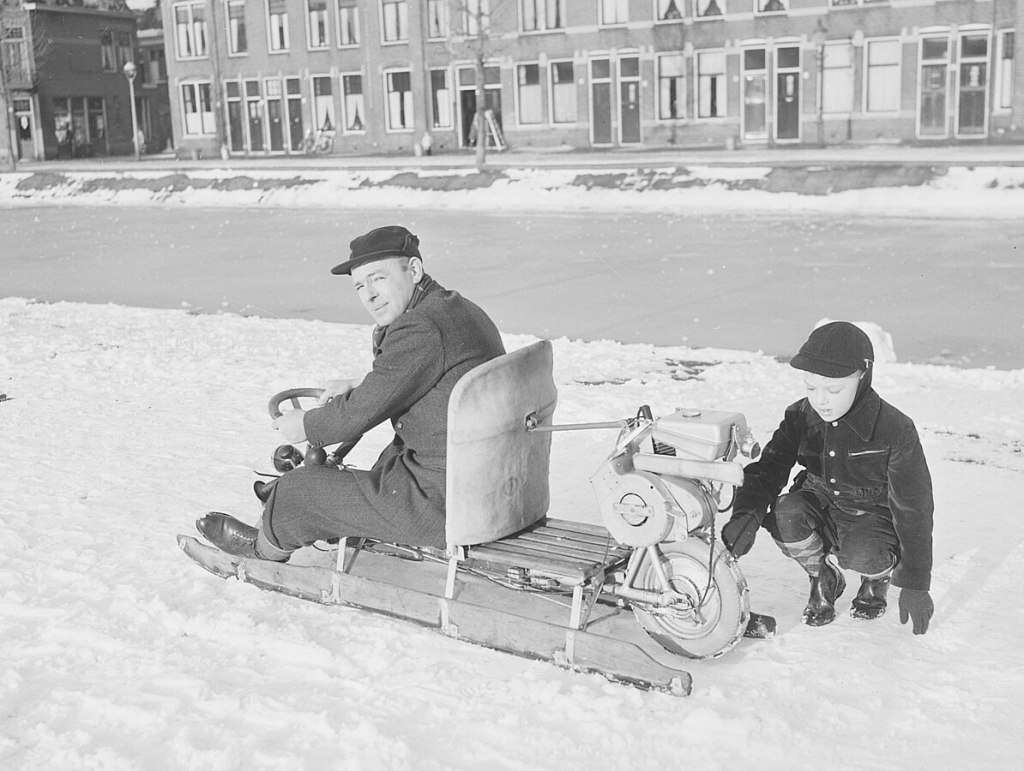
References to sleighs first begin in eighteenth-century American English. The Dutch donor was slee, a contracted version of slede. The uncontracted form better shows the connection to English words like sled, sledge and the verb slide. Slither belongs to this slippery word family too.
T is for tinsel
You might describe the strands of glittery tinsel around Christmas trees as scintillating, and you’d have good etymological reason to do so. The verb scintillate goes back to the Latin noun scintilla, meaning ‘spark’. In Modern French, a spark is an étincelle. It was from some Old or Middle French intermediate stage between the Latin and French words that English got tinsel.
In its earlier appearances, tinsel is often used attributively, in combination with a kind of material. ‘Tinsel satin‘, for example, was sparkly satin, interwoven with gold or silver. From there, it wasn’t so great a leap to use tinsel for glittery material on its own.
M is for mistletoe
Now, here’s my personal favourite! Once again, we have a compound noun. The first part, mistle, exists as a standalone word for the hemiparasitic plant itself. The second part, toe, is ancestrally unrelated to toes, although they have played a part in its modern form.
Toe, the part of the foot, was one of those words in English that used to form its plural with a final N. In Old English, one toe was a tā, two toes were tān. While plural N gave plural S a run for its money over the course of the Middle Ages, it now only lingers on at the end of children, brethren and oxen.
The relevance for mistletoe is that its Old English ancestor mistiltān contained the unrelated word tān ‘twig’ (mistiltān was literally ‘mistletoe-twig’), but speakers came to think of the tān in mistiltān as a plural, being homophonous with tān ‘toes’. Consequently, already in the Late Old English period, we find the final N being chopped off, to create a ‘false’ singular. Hence, we have mistletoe.
A is for antler
Once again, reindeer make an appearance in this selection! Crowning the heads of the Rudolf and the gang are antlers, and antler is a word at first glance without obvious ancestry. It seems to come from French, more specifically from Middle French or Anglo-Norman, from a word that has become andouiller in Modern French.
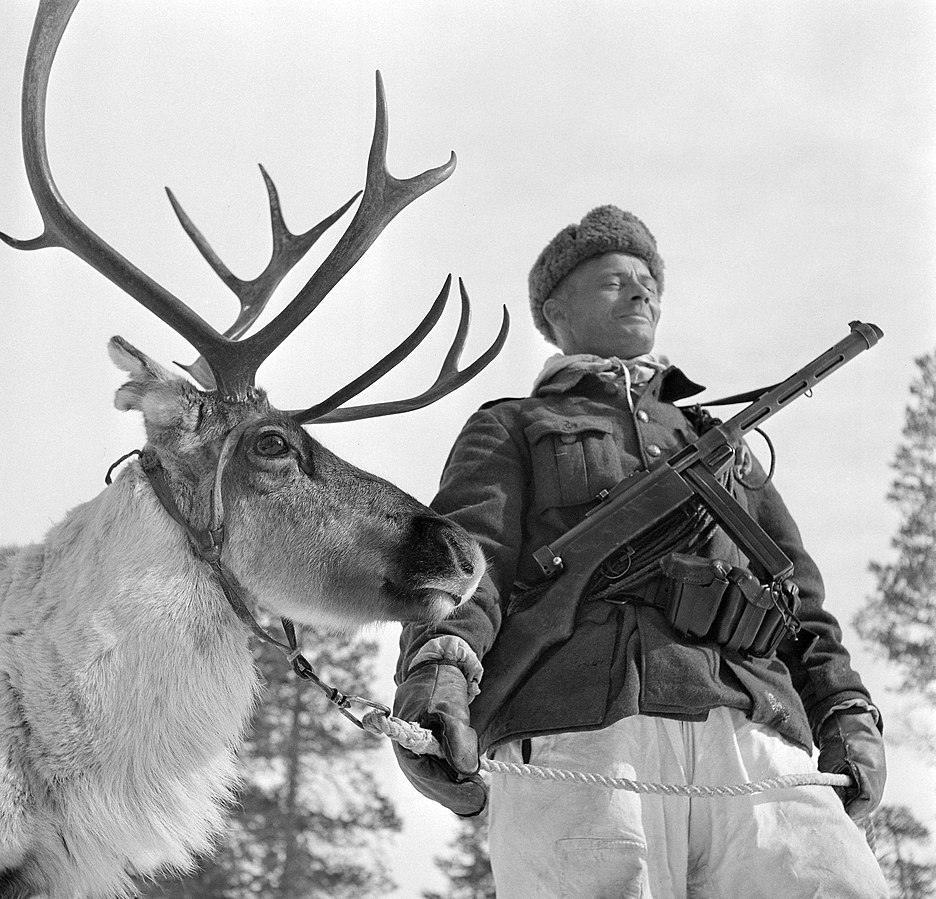
The consensus is that the French word developed out of a Latin word that left no written record behind, but that we can pretty securely assume to have existed: *anteoculāre. This is a little more transparent in its composition. An antler was once a horn in front of (ante) an animal’s eye (oculus).
S is for snow
To finish, we have the white wintry weather of snow. This is an English word that belongs to a recognisble word family across the Indo-European languages. Some members of that family likewise begin with the sound sequence /sn/ too: see Czech snih, Lithuanian sniegas and Irish sneachta for example, all meaning ‘snow’.
In other branches, the words are only N-initial. The Latin cognate is nix (accusative: nivem), and from this have since emerged Italian neve, Spanish nieve, French neige, and many more. The reconstructed root for this word family began with *sn-, which English maintains, but which appears partly lost in Latin and hence the Romance languages of today.
This could be an instance of the fascinating phenemenon of s-mobile (there was a certain optionality to initial *s– in Proto-Indo-European), or simply due to the fact that early Latin speakers didn’t like words beginning with /sn/. Either way, snow is an English word with some serious pedigree.
So, that’s my humble seasonal smorgasbord of etymological info, and that’s probably all from me for 2024. If you’ve been reading these posts over the past year, thank you very much for your time and interest.
If you celebrate it, I wish you a wonderful Christmas. If you don’t, I wish you a December no less lovely.
END
If you’d like more etymologising on a Christmas theme, do have a look at my seasonal posts for 2021 (Rockin’ Around Etymology) and 2023 (Christmas Trees and Etymologies).
References
- De Vaan, M. (2008). Etymological dictionary of Latin and the other Italic languages. Brill.
- oed.com
- Skeat, W. W. (1892). Principles of English etymology (Vol. 1). Clarendon Press.
All images either my own or taken from Wikimedia.
 Danny L. Bate
One thought on “A CHRISTMAS Full of Etymology”