
Reading time: 5-10 minutes
For this month, I’d like to shine an etymological spotlight on a humble bit of English vocabulary, which, at first glance, you wouldn’t give a second thought. As this post’s title implies, the everyday word in question is path.
What, I hear you cry, is so special about path? It’s a monosyllabic, mundane member of the English lexicon, and in its sounds, path doesn’t seem to stick out from the general picture of English phonology. It rhymes with bath and hearth, at least in my accent.
The Path Problem
The mystery begins when we consider its origins. In the written record, path goes back to pæþ in Old English. On the basis of both its early appearance and its sounds, it’s a safe bet to say that path is a long-term item of English vocabulary, as opposed to a loanword adopted later from French, Dutch or some other medieval European language.
Taking its ancestry one step further and into prehistory, clear matches in German (Pfad), Dutch (pad) and other local languages allow us to reconstruct path back to their point of departure – what we call Proto-West-Germanic. In that unwritten and therefore hypothetical language, its form would have straighforwardly been *paþ.
At this point though, the trail starts to go cold. There’s no trace of path in the two other traditional branches of the wider Germanic family: North Germanic (e.g. in Old Norse) and East Germanic (e.g. in Gothic). This is an impedient to following path one step further up the family tree, because it’s on the basis of comparative evidence from across Germanic that we can propose words for their older common ancestor: Proto-Germanic.

Perhaps, however, we can soldier on. Language is messy, and our historical sources paint an incomplete picture of historical languages. Maybe Proto-Germanic had the word, but it was either marginal in or entirely absent from the later North and East Germanic branches. It’s a flimsy reconstruction, relying only on the West Germanic evidence (as well as some from the dialectal Finnish word pade), but we can make Proto-Germanic *paþa- work.
Now, at this Proto-Germanic juncture, following the trail of *paþa– hits a dead end. The problem is consonantal. To take the word even further back in time, back to Proto-Indo-European, the word needs to have undergone the changes of Grimm’s law. This series of connected sound changes are the defining feature of Proto-Germanic, separating it and the subsequent Germanic languages from the rest of the Indo-European family free.

Perhaps the most famous of these changes is the *p > /f/ shift, which connects English father, foot and fish to the words pater, pēs and piscis in Latin, very much a non-Germanic language.
Two of the other putative changes within Grimm’s law are *b > /p/ and *t > /θ/. The outcomes of these two changes are the consonants present in path, and so to trace the word back beyond Proto-Germanic, we have to undo the two shifts. Reverse the rules of Grimm’s law, and we are left with the following Pre-Germanic word: *bat-.
This will raise alarm bells in the Indo-Europeanist’s brain, because this doesn’t look like a plausible Proto-Indo-European root. On the basis of the family-wide evidence, the reconstructed sound *b was the rarest consonant in that prehistoric language, perhaps even banned from the initial position of a word or absent altogether (see Olander 2020).
More damningly, to claim that *bat– was a word in Proto-Indo-European, we need evidence for it from non-Germanic languages. That is to say, we need to search for words like *bat- that are similar in sounds and meaning in Latin, Ancient Greek, Sanskrit, Hittite, Avestan, Phrygian, Classical Armenian, and so on. To this query though, the Indo-European family responds only with silence.
So, in sum, path leads us back to historical Old English, safely back to pre-historical Proto-West-Germanic, cautiously back to Proto-Germanic, and then disappears in a puff of language.
The Path Proposals
So, what can we say about the prehistory of path? The etymologist has a couple of choices.
One option is to deny that Grimm’s law applied in the case of path, or even that there is something wrong with the theory in general. This, I should stress, is always a possibility. A number of exceptions to the expected sounds led Karl Verner in 1877 to propose an additional expansion pack of Proto-Germanic sound changes, known as Verner’s law. However, Verner’s law does not apply here, and there is nothing obviously exceptional at work in the case of path. Grimm’s and Verner’s laws remain very strong, and to do away with them would create more problems that it would solve.
So, the stronger option is that path is an old loanword, taken from another language. With this view, we can look around for ancient languages containing a word like *bat– that might have been adopted at a Pre-Germanic point. There is one candidate; the Proto-Celtic language had the reconstructible word *bato-, ancestor of Old Irish bath. A Celtic origin is possible, and would not be the only instance of contact between early Celtic and Germanic. However, *bato– is a good fit in form, but not in meaning. It means ‘death’, and you’d have to do some serious semantic gymnastics to connect this to path.
Instead, the surer choice is to propose that path was borrowed into Proto-Germanic or a later stage. This way, it escaped the transitional era of Grimm’s law and was unaffected by its changes. In other words, the problematic /p/ of path is original, and was present in the donor language too.
Under this view, a much more solid connection opens itself up. Across Indo-European languages, we find words that have plausibly ‘path’-related meanings, and begin with a /p/.
- In Latin, we have pōns, which means ‘bridge’ (genitive singular: pontis)
- In Sanskrit, we have panthāḥ, meaning ‘path, way’
- In Ancient Greek, there is pátos, meaning ‘trodden path’, and also the formally similar póntos, although it means ‘sea’ – perhaps at one point, the ‘water path’?
- In (Younger) Avestan, there is pantā̊, meaning ‘path, way’
- In Old Church Slavonic, there is pǫtь, meaning ‘path, road’
- Even in our few sources for the Baltic language of Old Prussian, we find pintis, apparently meaning ‘way’

It looks therefore that we can securely identify a securely Indo-European word family for path, full of similar-sounding and similar-meaning cousins. Path belongs among them, albeit via a diagonal route.
This word family can itself be traced back to a Proto-Indo-European root: *pent-. If this root had itself passed directly into the Germanic branch and through the mangle of Grimm’s law, we must expect an inherited Germanic cognates that begin with /f/. Sure enough, we have the verb find.
Only one matter remains: from where exactly did the loanword path pass into Proto-Germanic, or Proto-West-Germanic?
The consensus today seems to be that it came from one of the Iranian languages, themselves another branch of the Indo-European tree. In Old Persian, for instance, we find paθim in one inscription from the fifth century BC. This is a good match in both sounds and meaning with English path.
An Iranian borrowing into early Germanic would be a very rare occurence, but still historically plausible. In antiquity, the Scythians were a people whose dominion and sphere of influence covered vast swathes of Central Asia and Eastern Europe, and who were very likely Iranian-speaking. We have fragments of indirect evidence for their language (like the local river Panticapes, mentioned by the Greek historian Herodotus), as well as a modern descendant language, Ossetian. For more on Ossetian, listen here!
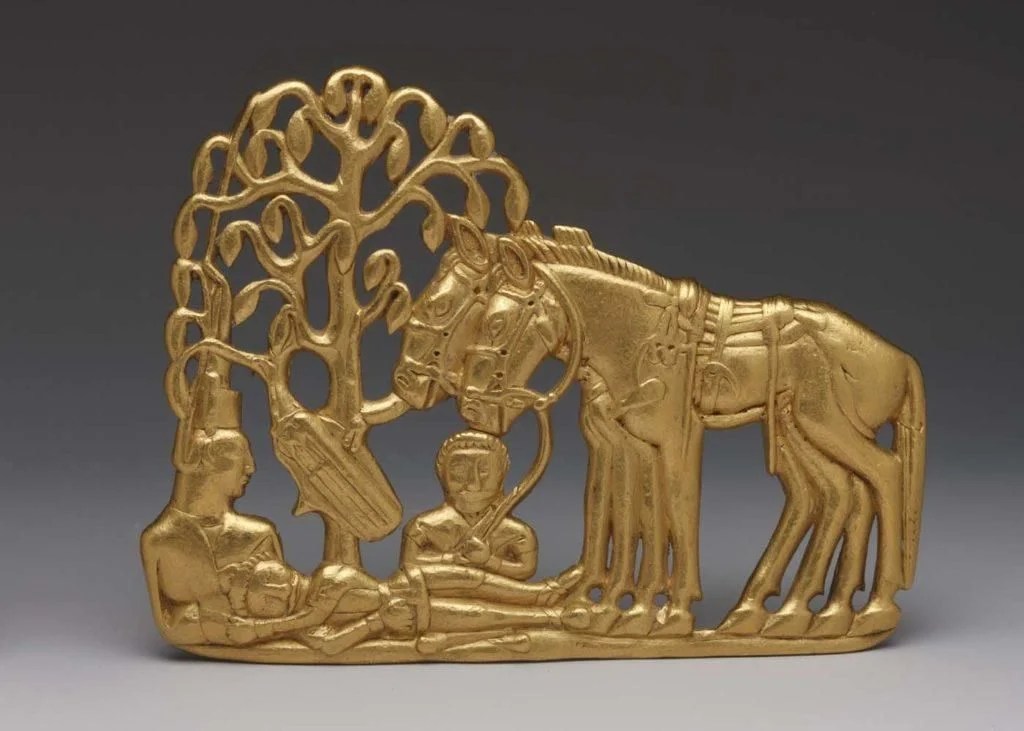
In Late Antiquity, the Migration Period between the fourth and sixth centuries AD saw many different nations move further west and into the boundaries of the Roman Empire. The Alans were one such people, some of whom migrated with the Vandals through what is now France, Spain, Algeria and finally Tunisia, where they founded a successful post-Roman kingdom. The Alans spoke an Eastern Iranian language, and some Alanic people who stayed in the Eurasian steppe migrated centuries later into the Kingdom of Hungary, speaking the now extinct Jassic language.
All of this goes to say that there was opportunity in the ancient and emerging medieval world for contact between Iranian and Germanic, and for the word *paþa– to be borrowed.
What though was so special about Iranian-speakers’ paths? Proto-Germanic speakers can’t have been stationary and stuck in place; they certainly had paths. We can only speculate about a motivation for the borrowing. With a nomadic and pastoral culture such as the Scythians’, perhaps the routes that they followed over the Great Steppe were particularly impressive sights in the landscape, well trodden by them, their horses and their livestock.
Scythians, steppes, horse-riding nomads, inscription-writing Persians, ancient historians, post-Roman kingdoms – it may all seem like another world. Yet all of this history can lie behind a word as humble as path.
END.
References
- De Decker, F. (2012). Are Latin pons and pontifex and the Indo-European cognates evidence for an i stem? Journal of Indo-European Studies, 40 (1/2), 11–45.
- Kroonen, G. (2013). Etymological Dictionary of Proto-Germanic (Leiden Indo-European Etymological Dictionary Series). Leiden, Boston: Brill.
- Kylstra, A.D., Hahmo, S., Hofstra, T., & Nikkilä, O. (Eds.). (1991). Lexikon der älteren germanischen Lehnwörter in den ostseefinnischen Sprachen, Band I. Leiden: Brill.
- Olander, T. (2020). To *b or not to *b: Proto-Indo-European *b in a phylogenetic perspective. Historische Sprachforschung / Historical Linguistics, 133, 182–208.
Cover image: part of the old Roman road of Sarn Helen, taken by yours truly.
 Danny L. Bate
“However, *bato– is a good fit in form, but not in meaning. It means ‘death’, and you’d have to do some serious semantic gymnastics to connect this to path.”
Easy, actually: “passage”. That’s even suggested by its etymology from *gʷh₂-tó-.
The Iranic option, on the other hand, suffers from serious problems when space and time are taken into account. Either you need to date Grimm’s law in the Bronze Age, in which case you need contact between the Nordic Bronze Age Culture of Scandinavia with the steppe, or you need some extremely conservative Iranic variant hiding among the Alans somehow.
However, the plot thickens when you take into account all the “patt-” words across Germanic, Romance and even Old Irish that mean “paw” (or sometimes “hare”).
“With a nomadic and pastoral culture such as the Scythians’, perhaps the routes that they followed over the Great Steppe were particularly impressive sights in the landscape, well trodden by them, their horses and their livestock.”
Mongolia today doesn’t look like that.
LikeLike
In case anyone without institutional access wants to download Olander (2020), here’s the accepted manuscript published as a preprint.
LikeLike