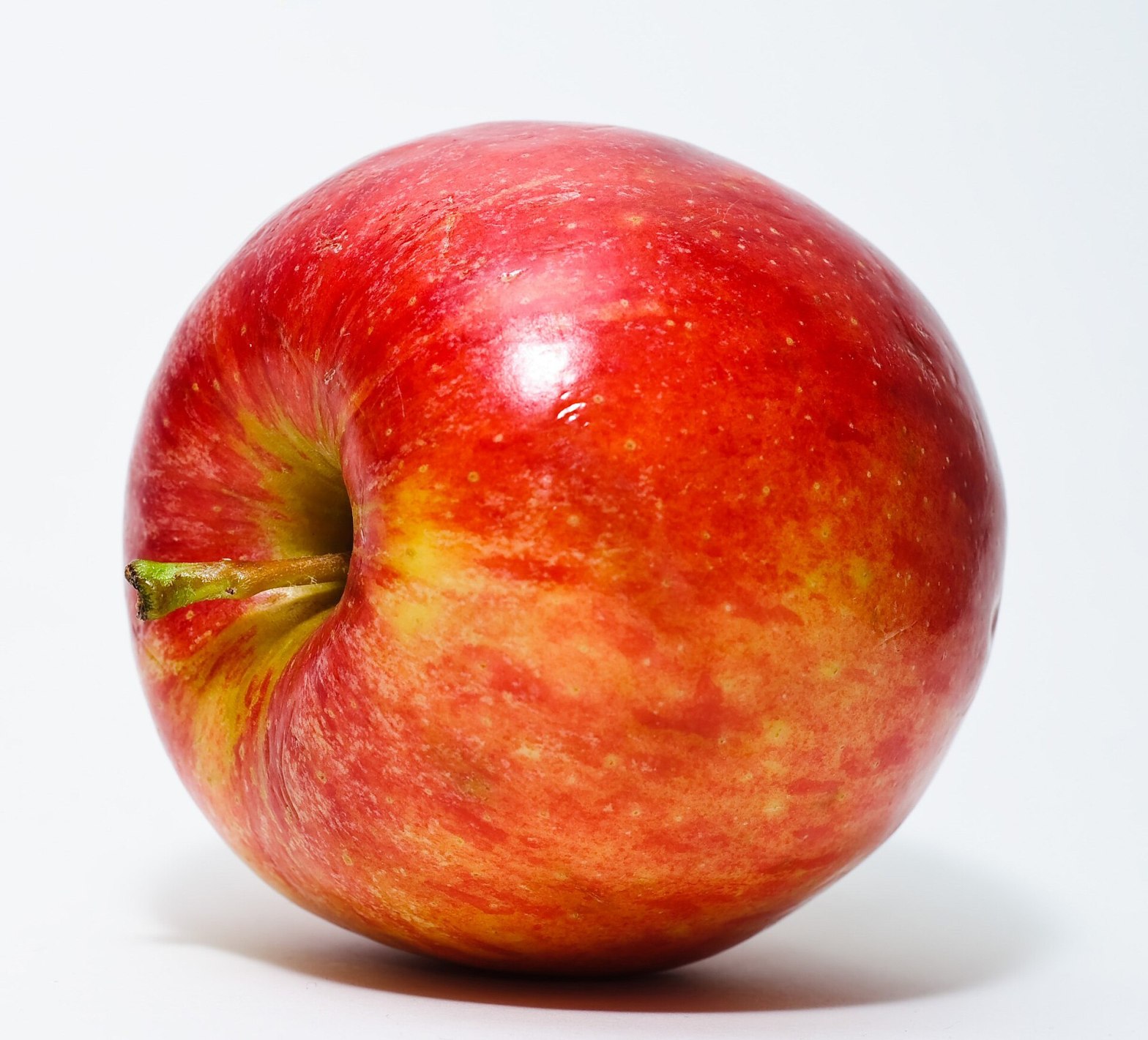
I remain resolute in the belief that ordinary, ten-a-penny words are far more interesting than the rare jewels and prized flowers of any language’s lexicon. Miss me with your petrichor and antidisestablishmentarianism; I’d much rather tell you about apple.
This isn’t my contrarian streak speaking. I take genuine joy in the fact that tracing the etymology of this everyday word has posed questions and challenges as yet unresolved, and has inspired a corpus of academic papers devoted to the noun’s prehistory.
It all comes down to sounds. Put briefly, apple has a problematic consonant, a sound that makes the word difficult to derive from the earliest conceivable point in the story of English.
In the business of etymology, we follow spoken words and their constituent sounds through history and into prehistory. When we quit the safety of our historical sources and cross the threshold of that undiscovered country, etymology relies on comparing words and their sounds across related languages. From this comparative method, we can ‘reconstruct’ ancestors from which those historically documented offspring descend.
For one example, historical sources for the words of English take us only as far back as the early medieval period, when an apple was an æppel. To rewind further, we bring in English’s siblings and cousins. These are the Germanic family, with sister Scots, cousins German, Dutch, Frisian, Norwegian, Danish, Swedish, Norwegian and Icelandic, great-uncle Gothic, and many relatives more.
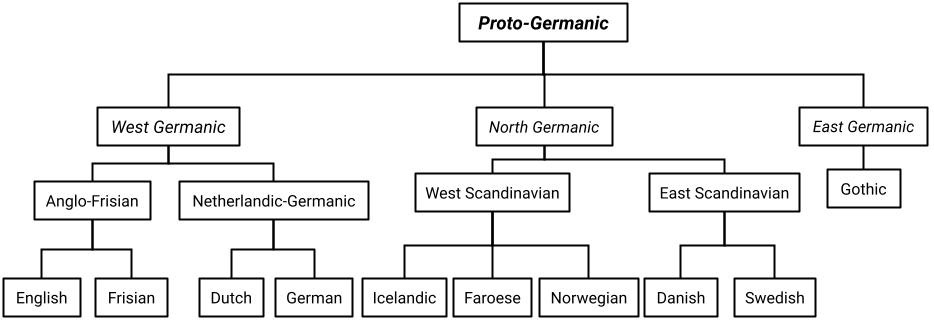
These together get our etymology back to the Proto-Germanic point in linguistic prehistory. At that point, *apla- was the noun for an apple or apple-like fruit – or rather, it must’ve been, but we lack the direct witnesses to it, hence the asterisk of uncertainty.
Then, if we bring in Latin, Greek, Hittite, Sanskrit, Avestan, Old Irish, Old Persian, Old Prussian and many more Olds, we can unearth the even older strata of Proto-Indo-European, spoken six-thousand-ish years ago.
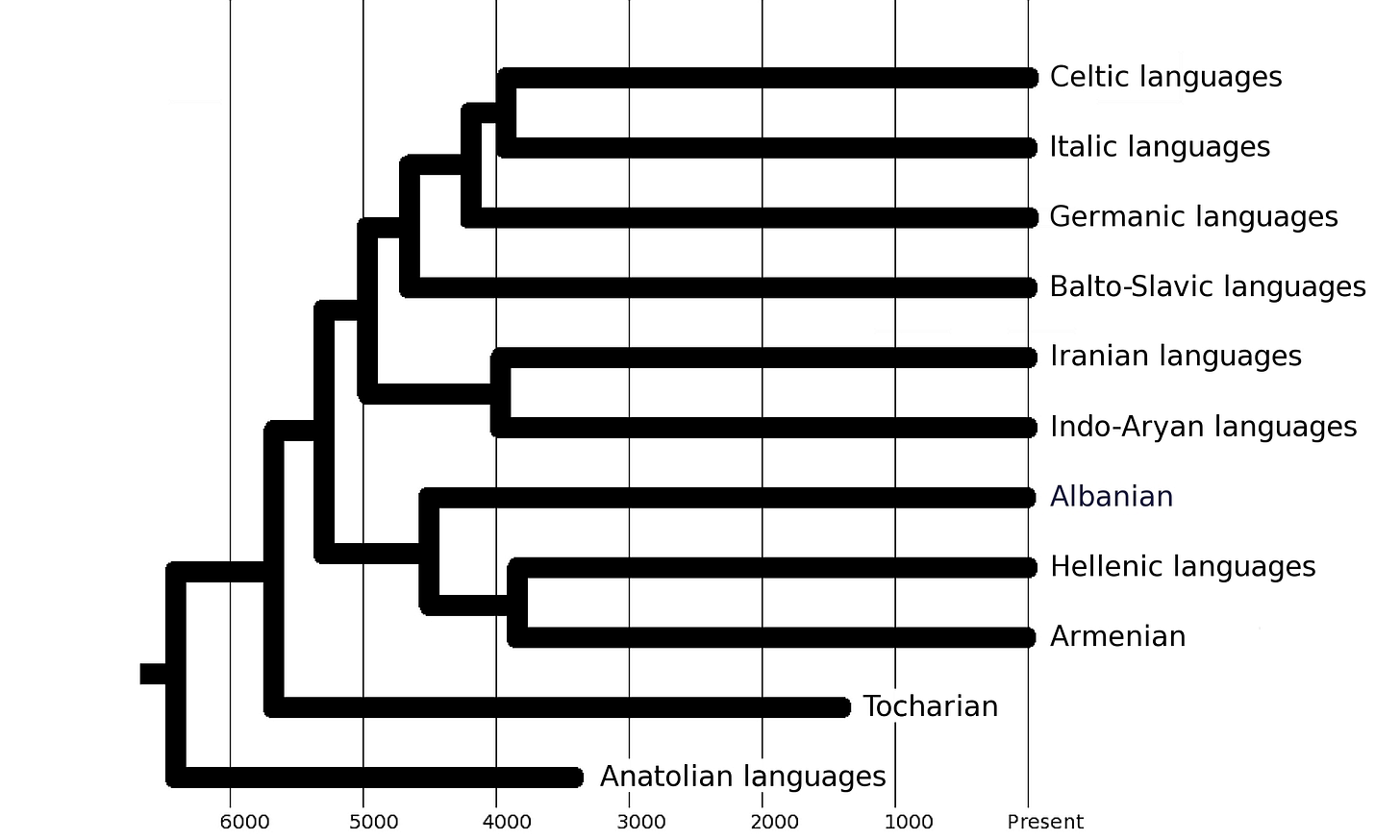
Since the resuscitation of this grandparent language began in the eighteenth century, we’ve developed a sophisticated account of what sounds, words and grammar we need Proto-Indo-European to have had. One aspect is a conspicuous absence.
It’s generally agreed by scholars, based on the accumulated Indo-European evidence, that the prehistoric ancestor eschewed words with *b, a lippy sound very much like the ordinary consonant in English by, bow or bob. Introductions and summaries for the reconstructed sounds of Proto-Indo-European typically contain comments like:
“The voiced bilabial stop was unexpectedly rare”
(Ringe 2006: 8)
“The reconstructed sound *b … may have been absent from the language”
(Clackson 2007: 33)
When setting out the sounds of this ghostly language, it’s typical to bracket *b in order to indicate its uncertain involvement.
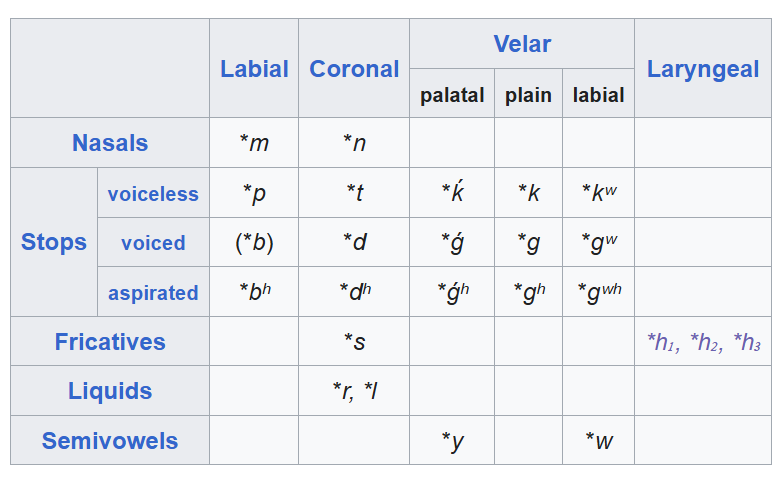
This absentee consonant is a problem for the word apple.
Confronted with the claim that the common ancestor of Indo-European languages had no *b sound, it’s okay if your reaction is one of incredulity. After all, aren’t Indo-European languages (English being one) brimming with B-words? Shouldn’t that mass of examples point to its presence in their shared grandparent, as per the axioms of linguistic comparison and reconstruction?
It’s on the experts of the field, and on me as their proxy, to justify this theory. The thing is, the evidence does lead us to this conclusion. As we sift through the vocabulary of the different Indo-European branches, the pattern is that the B-consonant is present, but is so often the outcome of changes to an alternative original sound. Genuinely ancient B is much harder to find.
To begin, take English. Having placed to one side the lexical loot that English has purloined from other languages, we are left with a ‘core’ of vocabulary that English has inherited from Proto-Germanic, and before that from Proto-Indo-European. Many of that set’s members do indeed contain B, like be, brother, brew, best, bend and beaver.
Case closed? Well, no. We must match these words up with their cousins across the Indo-European family. To build a bridge back to Proto-Indo-European, we require meaning-matching relatives that include B in the same place.
Some indeed do; the word for ‘brother’ in Old Irish is bráthair, and in ancient Avestan it’s brātā. Yet many don’t match the B; the Latin kin of brother is frāter, the Sanskrit is bhrā́tā, and the Ancient Greek is phrā́tēr. These words, geographically distant from each other, are clearly related via a shared origin. But, to explain their disagreement in initial sounds, it’s best to propose that it began not with *b, but with *bʰ.
The difference between the two is slight, but not trivial. The second (*bʰ) was an aspirated consonant, a breathy kind of B. Sanskrit preserved it (bhrā́tā), but it changed in the development of Latin (with fricative frāter) and Ancient Greek (with phi-spelled phrā́tēr). In proposing *bʰ as one of the consonants of Proto-Indo-European, we gain a common denominator that connects its varied descendants.
For the Germanic branch to which English belongs, *bʰ became an unaspirated *b via the sequential shifts collectively known as Grimm’s law.
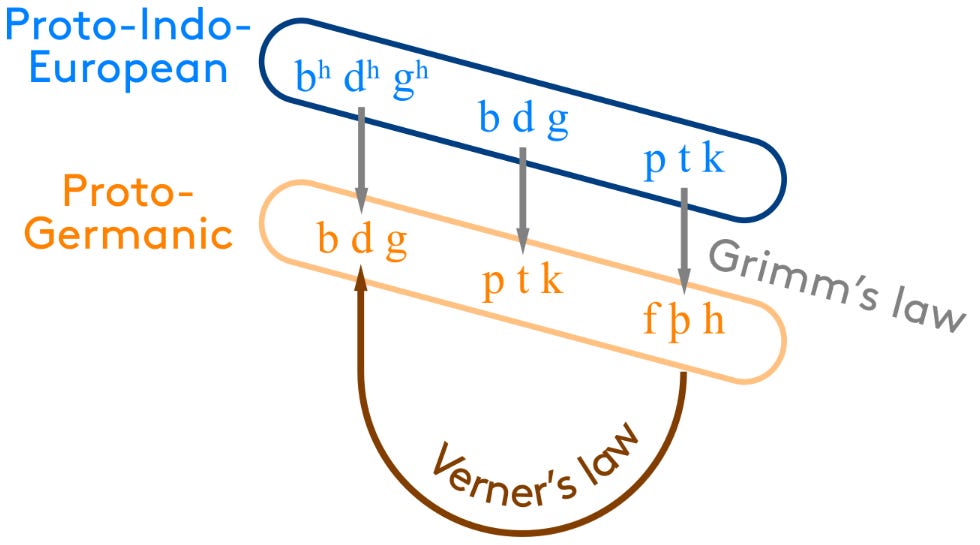
This is how it’s ended up in the aforementioned be, brother, brew, best, bend and beaver. These once began with *bʰ, prior to Germanic. The same correspondence of consonants is well exemplified with the English verb bear, related to Sanskrit bhárati, Latin ferō and Ancient Greek phérō, which all mean more or less the same thing.
Meanwhile, Grimm’s law would change any instances of Proto-Indo-European *b into Proto-Germanic *p, and more famously instances of original *p into *f. Hence, we get Latin-English cognate pairs like pater~father, piscis~fish, pedēs~feet, because Latin wasn’t subject to the same shifts.
Latin and also Ancient Greek sounds did not pass through the mangle of Grimm’s law, but regardless, their vocabularies don’t include a great deal of B-beginning words. If you turn to your trusty Latin dictionary, you’ll observe that the chapter for B is relatively short. In my Pocket Oxford Latin Dictionary, A takes up pages 1 to 17, while B finishes halfway down page 19.
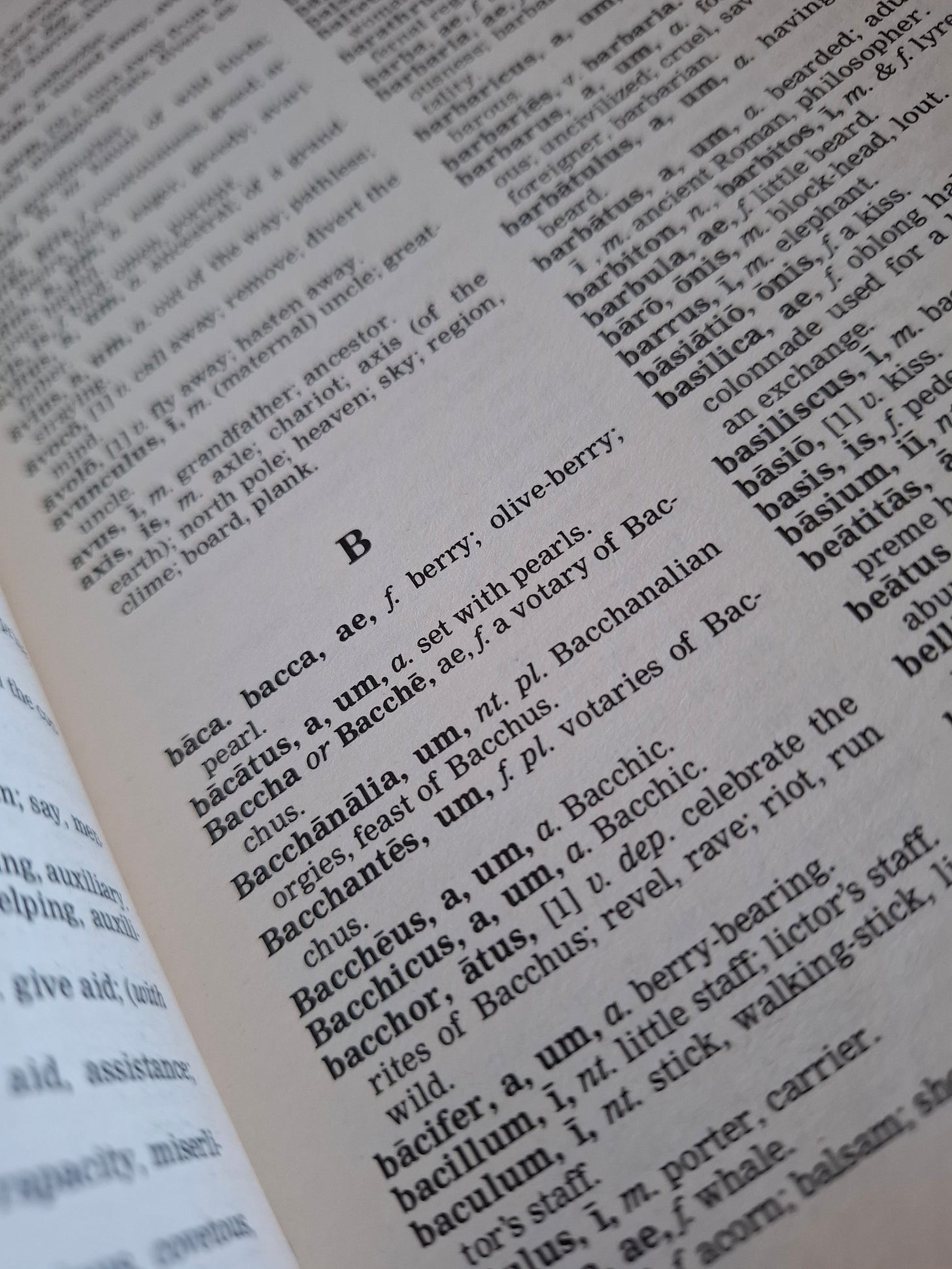
The list shrinks if we subtract those words derived from another or sharing a prefix. For instance, my dictionary includes all the words that begin with the prefix bi– ‘two’ (from biceps ‘two-headed’ to bivium ‘where two roads meet’), and these take up most of page 18.
The Latin B-team for sure includes vital vocabulary like bonus ‘good’, bellum ‘war’ and bis ‘twice’. Yet we have evidence that demonstrates that their B was a later development. The Duenos Inscription from the 6th century BC attests duenos, the older form of bonus.
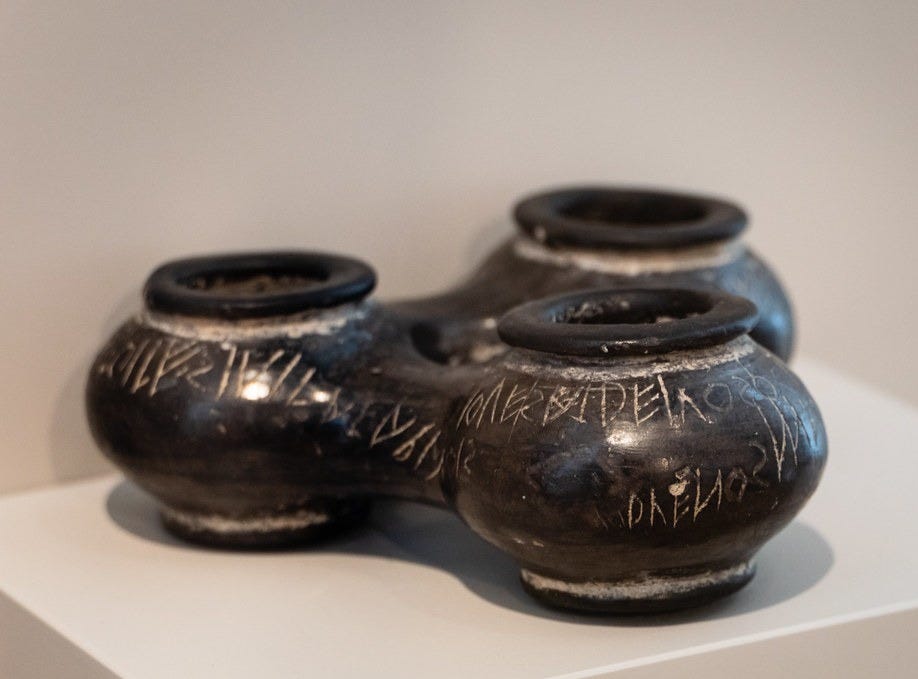
Likewise, bellum was once duellum (which has survived as the word duel), and bis ‘twice’ is related to duo ‘two’. Such examples of B at the start of Latin words are products of a ‘DU > B’ sound change. Meanwhile, most instances of B in the middle or at the end of words can be derived from an original aspirated *dʰ. Through this PIE consonant, Latin verbum (hence the loanwords verb and verbal) is connected to inherited English word.
Chapter Β in your Ancient Greek dictionary might be a bit longer. In it you’ll find words like basileús ‘chief, king’ (hence English basil, basilica and basilisk) and boûs ‘cow’ (hence English butter and boustrophedon). Yet this initial Β also looks to be a secondary sound.
Mycenaean writers, our oldest evidence for Greek, spelled basileús with an initial Q-type character (𐀣). Comparative evidence, such as from English cow and Sanskrit gó, also leads us to propose that the Β of boûs was once pronounced back in the mouth. For these reasons, we can confidently think that both basileús and boûs formerly began with a *gʷ consonant, as in the name Gwen, before a later shift.
The point here is that Latin and Ancient Greek display a scarcity of secure B-words that we can trace back to Proto-Indo-European, especially once we remove the products of later sound changes. The same applies to Sanskrit over in India. As a spoken language, it certainly made use of words containing the sound /b/, usually committed to writing under the Devanagari character ब.
For one, there’s the Buddha! This term, literally meaning ‘awake’, shares a root with the verb bódhati ‘to wake’.
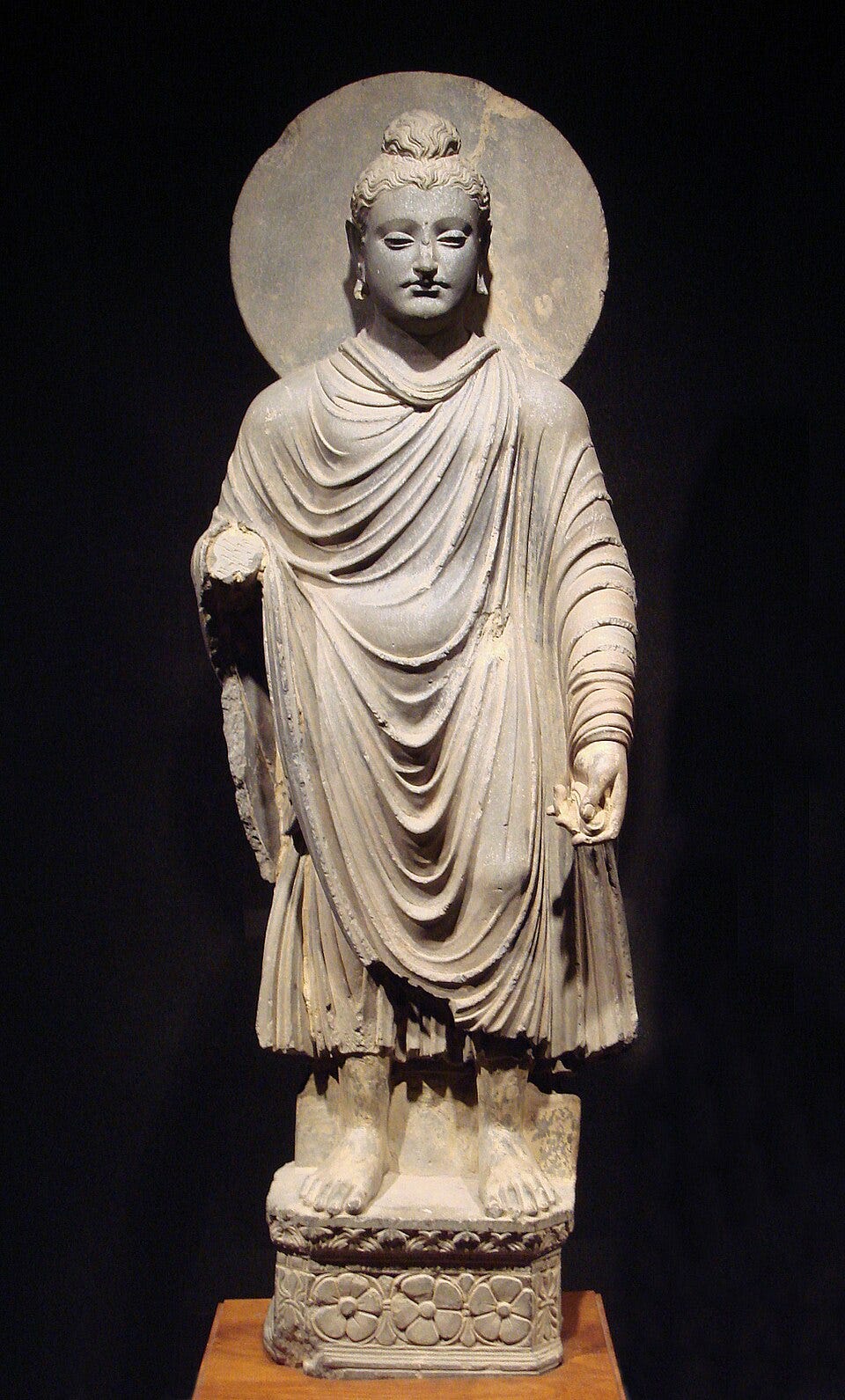
Yet such Sanskrit vocabulary has also been shaped by sound change. The B of Buddha was also once an aspirated *bʰ too. It would’ve remained so, were it not for Grassmann’s law. This was a rule against a spoken word having two aspirates in quick succession; the first got unaspirated, turning ‘bhódhati’ into bódhati. This restriction was operational in the prehistory of both Sanskrit and Greek – the jury’s out on whether this parallel occurrence was just a coincidence.
All of this language-specific theory has one purpose: to show that the amount of evidence for a Proto-Indo-European *b sound is considerably smaller than first appearances indicate. So many of those appearances in Indo-European languages past and present are best explained as the outcomes of shifts and mergers of consonants. The set of Indo-European words which point to *b in PIE is small and complicated. Our apple is a member.
Long ago – seven paragraphs, to be precise – I mentioned Grimm’s law, which took the consonants of Proto-Indo-European and shifted them. Although there aren’t many good examples of this specific change happening, the programming of Grimm’s law would turn a *b into Germanic *p. To find evidence for PIE *b in an English word, the first condition is that the word should contain a P. The second condition is that the word should not have been taken from another language, but rather be part of English’s begrimmed Germanic inheritance.
Apple meets both of these conditions, as words like path, play and plot may do too. However, the second two don’t help us look for *b in Proto-Indo-European, because they don’t satisfy a third condition: to have cognates from other branches of the Indo-European family tree. To reach back to Proto-Indo-European, we have to build our theories as we would a chair. Attaching just one leg is far too wobbly; two legs isn’t much better; three is okay; four is ideal; and five is fine but overkill.
Play and plot lack that external corroboration. Where they came from before Germanic is a mystery. Path, meanwhile, is a word rich in history that I’ve written about previously, and might not even satisfy the second condition. Apple clears the bar again.
Of course, we have the Germanic evidence: German Apfel, Icelandic epli, etc. It even appears as “apel” in Crimean Gothic, a lost Germanic cousin fortunately recorded by a Flemish diplomat in the sixteenth century. But, in addition to this, we also find words for the fruit elsewhere in Indo-European that look and sound like apple.
Where I live, the local word is Czech jablko, just like it is jabłko in Polish and jabǎlka in Bulgarian. Strip away their Slavic accretions, and you have ‘abl’. Up by the Baltic Sea, the Lithuanian and Latvian words are obuolys and ābols. The Elbing Vocabulary, a rare surviving source for Old Prussian, names the fruit as “woble”. From the Celtic branch, we can harvest the Old Irish word ubull and Modern Welsh afal. The latter might be beyond the mythic island of Avalon, apparently a place rich in apple trees.
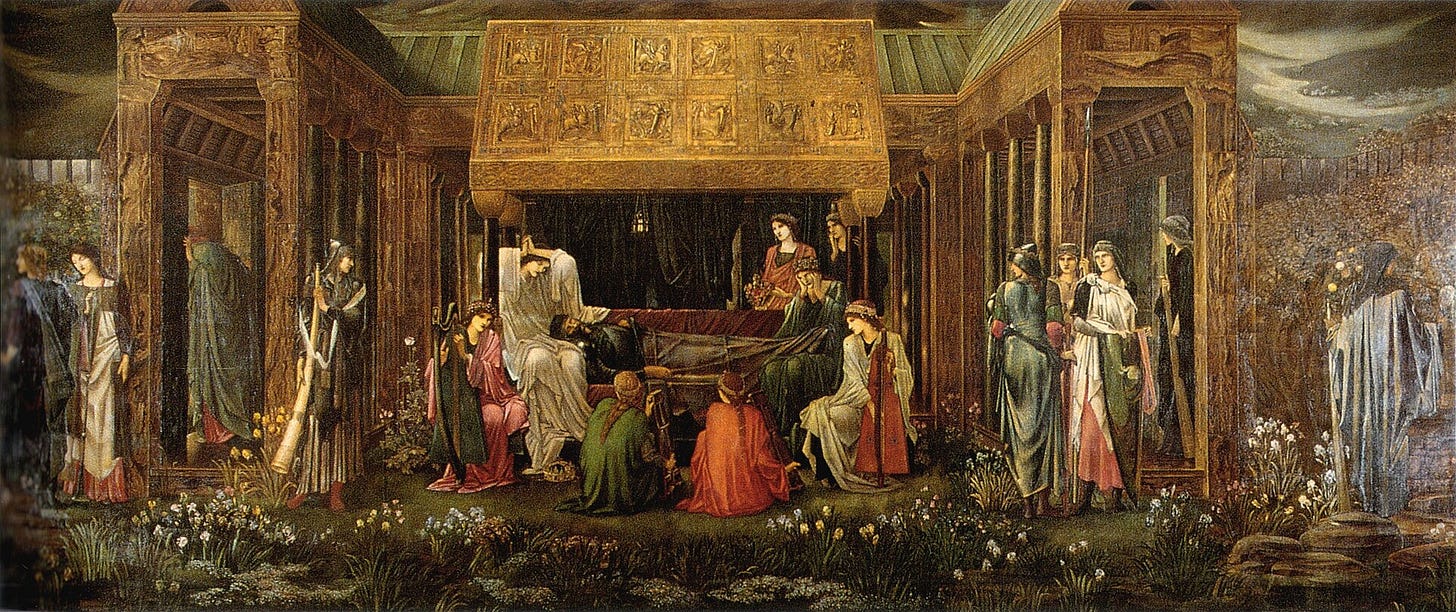
Moreover, down in southern Italy, there’s a speculative relative in the city of Avella, known as Abella in antiquity.
This windfall of words across Europe provides matches in sounds and meaning with English apple. There’s a key difference between these words and apple, which is that they include a B, not P. Since these words and their languages have not undergone Grimm’s law, this is what we expect to find. We have all the substance we need to propose that they all descend from a common ancestor in some early stage of Indo-European development. This ancestor would’ve included the consonant *b.
To strengthen this case, we can add that some descendants show traces of ablaut, the vowel-swapping system of grammar that is definitive of ancient Indo-European. Also, I believe that the tree of which apples are the fruit comes from Central Asia, not a million miles away from the steppe homeland of Proto-Indo-European. This makes the presence of a word for ‘apple’ in the proto-language plausible.
So, now: case closed? Don’t words like apple support the existence of *b in Proto-Indo-European? The pool of evidence may be shallow, but such words are clearly of great antiquity.
It’s still a no. The ancestor of apple cannot confidently provide evidence of *b in Proto-Indo-European, because we cannot confidently reconstruct it that far back. Returning to my wobbly-chair metaphor, the strongest structure is one that has its four legs spaced well apart in geography and time. This is to say, it should draw from evidence from across the Eurasian spread of Indo-European languages, and from the family’s oldest-documented members, like Hittite. This way, descent down from Proto-Indo-European becomes the best explanation for the wide distribution.
Our apple-family of words is more or less limited to the Baltic, Celtic, Germanic and Slavic branches of Europe. The Abella-connection from ancient Italy is tenuous, while the candidates for relatives over in Indo-Iranian are unconvincing. We have a possible word for apples among the Hittites, šam(a)lu-, but this looks more like unrelated words in Latin (mālum) and Ancient Greek (mêlon).
The Balto-Celto-Germano-Slavic limitation of apple-words cannot avoid the alternative explanation that a loanword has been at work – that apple doesn’t go back to Proto-Indo-European, but rather to an external word that was adopted into its later offshoots in Europe.
This theoretical alternative would account for both the presence and absences of related apple-words across the family. Having been borrowed in Europe, it wouldn’t appear in the Asian branches. It would also offer a solution for why it contained a rare consonant (*b) otherwise lacking from the earliest Indo-European speech: namely, because it wasn’t an Indo-European word.
Like so much English vocabulary, apple might be an acquisition from elsewhere. Since the 1960s, some scholars have suggested that apple falls into the category of a ‘Wanderwort’, a piece of vocabulary that made its way through the various languages of a broad geographical area, likely accompanied by the thing to which it referred.
If apple can’t offer a sure witness to *b in Proto-Indo-European, then the consonant’s list of allies grows thin. Of the other candidates proposed by scholars, none are convincing. Among inherited English vocabulary, lip, deep and thorp are among the few, each displaying the post-Grimm P. The problems throughout the small set have led Thomas Olander, in a well-titled article, to summarise the situation thus:
“Our analysis has shown that there are no candidates for initial *b in Proto-Indo-European … in earlier stages there is no evidence whatsoever for initial *b and only disputable reconstructions containing non-initial *b”
(Olander 2022: 14-15)
Of the few candidates considered, Olander hesitantly reconstructs only two words (or rather, two roots) containing *b back to the oldest stage of Indo-European development. The apple-root isn’t one of them.
So, the evidence for claiming that Proto-Indo-European had a B-sound doesn’t pass muster. This is not the same as to claim that it didn’t have one – perhaps it did, but the prehistoric sound’s signal has faded so much as to be unhearable now from the evidence. The whole topic is also under threat of circular thinking; if we are led to believe that there was no *b in PIE, we might then miss or dismiss evidence for it.
Is it odd for a spoken language to lack a particular sound? Certainly not! The world’s countless varieties of speech use only a subset of the consonants and vowels that humans can produce. A sound that’s normal in European languages can easily be alien elsewhere; Arabic, for example, has historically lacked the plosive /p/. Speakers may substitute it in foreign words with /b/ instead.
Nonetheless, Proto-Indo-European seems to have utilised a lot of consonants (twenty-four by my reckoning), among which were both voiceless *p and aspirated *bʰ. The consonant *b would’ve also fitted in along side the unaspirated stops *d and *g, for which we have plentiful evidence. The hole has certainly been the subject of much speculation:
“The marginal status of *b is difficult to understand from a typological viewpoint and is totally unexplainable within the traditional framework. This problem was investigated in 1951 by the Danish scholar Holger Pedersen. Pedersen noted that, in natural languages having a voicing contrast in stops, if there is a missing member in the labial series, it is /p/ that is missing and not /b/”
(Bomhard 1988: 9)
The gap in the inventory between the two is therefore pretty odd, for sure, but it’s not beyond the borders of possibility.
This altogether provides a good example of how following the trail of etymology can lead us deep into the woods, where lurk languages of prehistory that we would scarcely recognise as related to our own. A word as down-to-earth as apple can be the starting point for that etymological encounter.
So, that’s the complicated etymology behind the Ps in apple. In another post, I might tell you what the problem is with its initial A.
END.
References
- Bomhard, A. R. (1988). Recent Trends in the Reconstruction of the Proto-Indo-European Consonant System. Historische Sprachforschung 101(1). 2–25.
- Clackson, J. (2007). Indo-European Linguistics: An Introduction. Cambridge University Press.
- Hamp, E. P. (1979). The North European word for ‘apple’. Zeitschrift für celtische Philologie 37. 158–166.
- Joki, A. (1964). Der wandernde Apfel. Studia Orientalia 28. 1–17.
- Kroonen, G. (2013). Etymological Dictionary of Proto-Germanic (Leiden Indo-European Etymological Dictionary Series 11). Brill.
- Kroonen, G. (2016). On the origin of Greek μῆλον, Latin mālum, Albanian mollë and Hittite šam(a)lu- ‘apple’. Journal of Indo-European Studies 44. 85–91.
- Markey, T.L. (1988). Eurasian ‘apple’ as arboreal unit and item of culture. The Journal of Indo-European Studies 16. 49–68.
- Olander, T. (2022). To *b or not to *b: Proto-Indo-European *b in a phylogenetic perspective. Historische Sprachforschung 133(1). 182–208.
- Piwowarczyk, D. R. (2014). The Proto-Indo-European root for ‘apple’ and the problem of comparative reconstruction. Studia Etymologica Cracoviensia 19. 161–167.
- Ringe, D. A. (2006). From Proto-Indo-European to Proto-Germanic (Vol. 1). Oxford University Press.
- Stifter, D. (2019). An apple a day…. Indogermanische Forschungen 124(1). 171–218.
Images my own or from Wikimedia/Wikipedia.
 Danny L. Bate