
Reading time: 5-10 minutes
For this month, I’d like to revisit two languages very close to my heart: Latin and Czech. Besides English, they’re the two languages I tend to spend the most time with. Specifically, this is a simple post about how the former has historically affected the latter.
As a European language, it’s unsurprising that Czech vocabulary today exhibits many words of Latin origin, often formal or technical terms that relate to modern professions, inventions and scientific discoveries. These include words recognisible to English speakers like adrenalin (from Latin ad– ‘near’ and rēnēs ‘kidneys’), frekvence (from Latin frequentia), oficiální (from Latin officium) and recepce (from Latin receptiō). That said, there are also more ordinary and general Czech words that derive from Latin, like its words for ‘normal’ (normální) and ‘to function’ (fungovat). So far, there’s nothing unusual or unexpected here.
However, what I’d like to highlight is an older layer of Latin loanwords present within the Czech lexicon – words taken directly or indirectly from Latin at a much earlier point in time, long before Czech had emerged as a distinct Slavic language. Their entry into the developing Czech dialect, or earlier into the language’s prehistoric ancestor (Proto-Slavic), occurred in the indisputably best era of European history, the early medieval period.

With an older date of transmission, these words have had more time to undergo changes in sound and sense. Consequently, their ancestral Latinity might not be at all obvious to the interested linguist or the struggling learner. A bit of surprise can make the connection and the etymological epiphany all the more satisfying.
Here’s a personal selection of ten favourites, each with some explanatory notes about their history and journey from Latin into Czech, and into other languages – including English!
1: osel ~ ‘donkey’
To start off, we have the humble donkey. This stubborn but useful animal was much liked by the Romans, who depended on donkeys for transporting goods around their empire. It’s not too surprising then that their word for the animal, asinus, formed the basis for other languages’ donkey-words. It may have been a diminutive ‘little donkey’ (asellus) which made its way into Proto-Slavic as *osьlъ. This would in turn become Czech osel.
Far to the west of the old empire, Celtic languages like Welsh and Irish had also adopted asinus from the Romans. From one of these languages, likely the ancestor of Welsh spoken in Britain, English gets ass.
2: třešeň ~ ‘cherry’
The cherry fruit (třešně) and the cherry tree/fruit (třešeň) may now both begin with a T, but they can be reconstructed back to a Proto-Slavic word like *čerša. This in turn was a borrowing of Late Latin ceresia, a word for the fruit that the Romans had themselves taken from the Greeks.
From Mediterranean climes, the word travelled northwards not only into Slavic languages, but also into the Germanic family. Among them, Modern German calls the fruit Kirsche. Meanwhile, medieval English speakers interpreted Old English ċirse and Norman French cherise as a plural word, and so they cut off its S to create the singular form – hence, cherry.
3: kostel ~ ‘church’
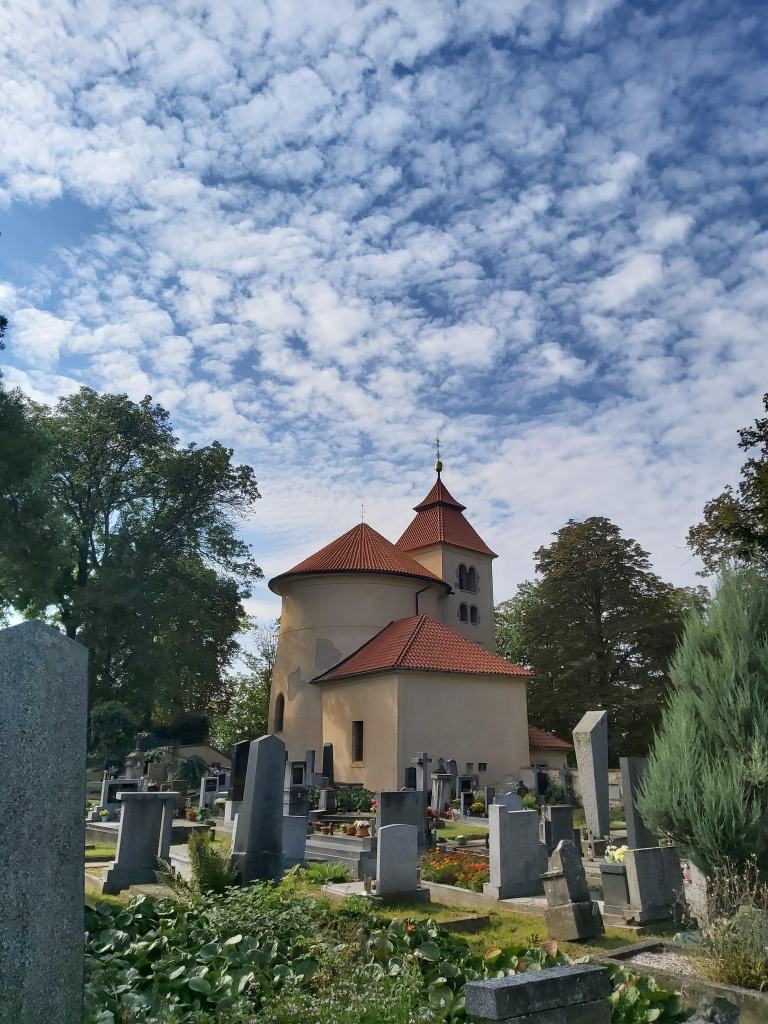
While the Latin word castellum ‘fortress’ is straightforwardly the origin of English castle, it has taken on a religious meaning in Czech. Along with Slovak (kostol) and Polish (kościół), the Czech word kostel refers to an ordinary church building.
It’s a fascinating shift in meaning, and I imagine it to be rooted in the circumstances of Christianisation in the Czech lands. The first churches would have been built in prominent places, often made of stone, and some within the confines of a fortified settlement (a gord) with royal patronage. In these first cases, they would have been quite castle-like.
4: mlýn ~ ‘mill’
A Roman molīna was literally a ‘grinder’, since the root of the word is the Latin verb molere ‘to grind’ (see also: your molar teeth). Without it, Paris wouldn’t have its Moulin Rouge. Introduced along with the technology of milling with water or wind, the Latin word became Proto-Slavic *mъlinъ, and then Czech mlýn.
Like so many of the words on this list, its journey may well have been taken it through a Germanic intermediary. In German today, the word is Mühle, just as it is mill in English. Over the centuries, both the German and the English have lost the N of molīna, but Czech preserves it. Mylen, the word in Old English, is visibly closer to mlýn.
5: ředkvička ~ ‘radish’
As its similar-looking English translation hints at, ředkvička is a word with various connections in languages further west than the Czech Republic. The radish is a root vegetable, and its Latin root is appropriately a word for ‘root’, rādīx. This also gave rise to radish in English and Rettich in German. Moreover, if you want to change things at their roots, you’re a radical.
The appearance of rādīx in early Germanic languages is limited though. This distribution, along with their umlauted E vowel, suggests that Slavic words like ředkvička come from Latin specifically via an old West Germanic language, such as Old Saxon.
6: ocet ~ ‘vinegar’
The primary component of vinegar is acetic acid, both words of which derive from the Latin verb acēre ‘to be sour’. The Romans called vinegar acētum, and this developed into a broad range of medieval words for the condiment. These included Proto-Slavic *ocьtъ, hence Czech ocet.
Despite appearances, the English word also belongs to this word family. Vinegar was originally vin-aigre ‘sharp/sour wine’, an Old French compound derived from Latin vīnum and ācer.
7: koupit ~ ‘to buy’
A lowly tradesman in Roman times was a caupō, and to trade or barter was to caupōnārī. From either the noun or the verb, the modern Germanic languages of Swedish, Dutch and German get their words for ‘to buy’: köpa, kopen and kaufen. What’s more, the capital of Denmark is the related ‘merchant-harbour’, Copenhagen.
Probably via the extinct Gothic language, the Slavic family also gets its verbs for ‘to buy’ from the same Latin source. In Czech, these are koupit (for completed buying) and kupovat (for ongoing buying).
The English verb buy is of course unconnected to this word family, but Old English did have the word ceap, meaning ‘trade’ or ‘bargain’. Through good deals at low prices, this has given English its adjective cheap.
8: jeptiška ~ ‘nun’
Strip away the Slavic and Germanic accretions from jeptiška, and we find the Latin word abbātissa – an abbess! An abbātissa was the female counterpart to an abbās in Latin, and a spiritual mother in charge of a religious community. Jeptiška has clearly been demoted in rank, since it refers to any old nun.
Abbās itself has a Greek and ultimately Semitic origin (see: Aramaic אבא ʾabbā, meaning ‘father’), so jeptiška has quite a word journey to track back.
9: lev ~ ‘lion’
Speaking of long journeys, words for ‘lion’ in European languages might also have origins in the Middle East, although we should also bear in mind that lions inhabited southeastern Europe until the first few centuries AD.
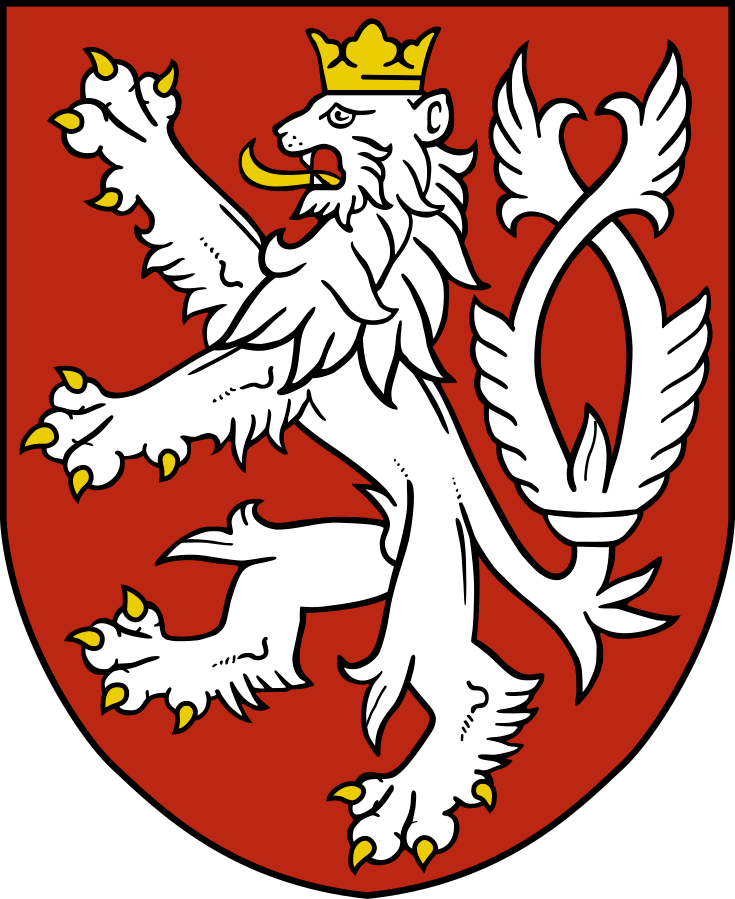
The general consensus seems to be that Slavic words like Czech lev go back to Latin leō, although this journey most likely passed through Germanic again (see: German Löwe).
10: kříž ~ ‘cross’
To finish, my personal favourite.
The cross, the ultimate Christian symbol, brought both belief and vocabulary to new peoples in the early medieval world. Words like English cross and German Kreuz descend from Latin crux, the Romans’ term for the wooden frame upon which they performed their very worst act of punishment and execution. While Czech kříž definitely belongs among the offspring of crux, the sounds of this Slavic word are nonetheless noteworthy.
In particular, the final consonant of kříž and its Slavic sister words is an unexpectedly voiced Ž. It’s unexpected, because in crux and in cross/Kreuz, the equivalent consonant is voiceless. This has led at least one scholar (Pronk-Tiethoff 2013: 179) to propose that Latin crux passed into the Slavic languages specifically in the northeast of Italy, where people have traditionally spoken Venetian.
Like Italian, the Venetian language emerged out of Latin, and part of its development has involved giving voice to formerly voiceless consonants. Coming from Latin crux, the Venetian word for ‘cross’ today is cróxe, pronounced like ‘krozeh‘. It might specifically have been this local Venetian descendant of crux that the Slavs first adopted.
That region of Italy has also for centuries shared a border with Slavic-speaking areas (today, the country of Slovenia), so it’s also a plausible location for the word to cross over. Perhaps it was from a local city like Aquileia that missionaries got to work among the newly arrived Slavs. This is some very specific historical speculation to propose on the basis of one sound in one word, and I love it.
So, that’s all from me! Just ten jewels of Latinity hiding within the Czech lexicon (or Czexicon, if you will). I hope they’ll be of interest and use to someone out there, just as they have been for me.
END.
References
- Pronk-Tiethoff, S. (2013). The Germanic Loanwords in Proto-Slavic. Brill.
- Rejzek, J. (2001). Český etymologický slovník. Voznice: LEDA.
Cover image: an illustration of Prague from the Nuremberg Chronicle (1493), one of the earliest printed books with pictures. From here.
 Danny L. Bate
Dear Danny, thank you for your work, I enjoy it immensly. Here you mentioned třešně. In Slovak its nearer to its latin origin, it´s čerešně. Perhaps you have seen the new movie Vlny, there you can hear the song Čerešně sung by Hana Hegerová.
Looking forward to read more from you.
David
LikeLiked by 1 person
Dear Danny, excellent article.
A native Czech I did not know.
Without your permission I have already spread the text to my colleagues in the Living Latin circulus at UCL.
Thanks a lot
Vladimir
LikeLiked by 1 person