
Reading time: 5-10 minutes
Just a simple piece from me for this month, in which I’d like to shine a spotlight on a Latin root that’s been remarkably successful in English vocabulary. It all goes back to hanging things.
In Latin, we find the very similar verbs pendere and pendēre. They’re close not only in form but also in meaning: pendere primarily means ‘to weigh’, while pendēre means ‘to hang (down)’.
Their shared root, pend-, must have originally meant ‘hang’. Pendere was at first the verb derived from it for hanging something, while pendēre was its intransitive counterpart. Pendēre maintains the older ‘hang’-meaning, while pendere has narrowed in its reference, most likely thanks to the hanging masses of weighing scales.
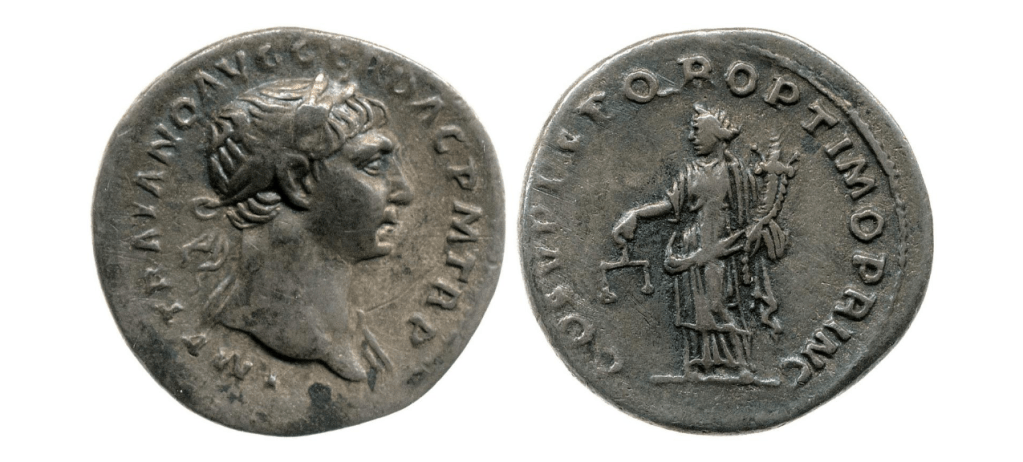
Unsurprisingly, pendere, via Latin suspendere, is the origin of English suspend. In addition to this, Latin formed the perfect participle of suspendere by adding the ending -tus. The final D of the root pend– and the initial T of –tus combined as usual to produce an S. Hence, from suspendere came the perfect participle suspēnsus, meaning ‘suspended, hovering, uncertain’. This of course is the source of suspense.
Recognisibly related hanging-words include pendulum, an early-modern coinage, and pendant, borrowed from French. Moreover, a perpendiculum in Roman times was a plumb-line, a hanging weight used to check if something is vertical. From this word, English gets the adjective for being at a right angle to something else: perpendicular.
If something’s hanging over you, typically in an imminent and threatening way, it is impending, while to hang on something, perhaps literally but usually in a sense of a necessary condition, is to depend on it. By adding its suffix -ing, English has formed an adjective and preposition, which similarly expresses senses of waiting and necessity: pending.
Latin appendere can mean ‘to hang on, to weigh out’, and it’s the source not only of English appendage and appendix, which hangs upon both books and bowels, but also penthouse!
An unattested derivative of pendere (*pendicāre) looks to be behind the French verb pencher, which means ‘to lean, tilt’. Hence, if you have an emotional leaning towards something in English, you might have a penchant for it.
Then there are words to do with money and finances, not hanging. This sense comes from pendere, which meant ‘to weigh out’ and, by extension, ‘to pay out’, since payments were originally made with weighed amounts of valuable metals. A payment, for example, was a pēnsiō – hence, pension. Likewise, tribute or tax paid might be called a stīpendium, that is, a stipend.
Combining pendere with the ending –tāre, Latin formed the frequentative verb pēnsāre, which had the additional nuance of intensity and habit. Pēnsāre ‘to weigh out carefully’ is the source of English words like recompense, compensate and dispense.
A pēnsum in Latin was a weight or an amount of something to be undertaken or provided, such as an allotment of wool for spinning or weaving. The word passed into Spanish, resulting in its word for ‘weight’ and a common name of currency, the peso. The same Latin word also passed into French; it’s behind the Modern French word for ‘weight’, poids. Having been adopted into English, it developed in meaning from ‘weight’ to ‘balance’ and ‘equilibrium’, namely the word poise.
Expendere ‘to weigh out’ seems to have been passed into the Germanic languages at an early point; we find words like āspendan and spendung already in Old English. From this borrowing or (or and) from Old French despendre, English gets the humble verb spend.
Yet another set of pend-words concerns thought and thinking. It wasn’t too much of a stretch to extend pēnsāre from weighing out to weighing up, and already in Classical Latin it can mean ‘consider, examine’.
“Reliquās cīvitātēs monēre, ut ex factīs, nōn ex dictīs amīcōs pēnsent“
‘He advised the remaining cities to consider their friends by their deeds, not their words’
Latin. Livy 34.49
It’s through this development that some Romance languages acquired their word for ‘to think’, such as French penser. The root pend– is therefore present in the reflective adjective pensive, and even in a flower associated with remembrance, the pansy.

Finally, there’s a group of English words one step removed from the all the vocabulary mentioned so far.
As well as the verbs pendere and pendēre, Latin had the noun pondus, meaning ‘weight’. The noun is clearly related to the verbs, the notable difference being that the root has a different vowel, which is a regular product of the ancient system of ablaut.
With the same semantic development of ‘to weigh > to consider > to think’ as with pēnsāre, Latin ponderāre is the source of English ponder.
Pondus also made the journey beyond the borders of the Roman world and into the emerging Germanic languages. It came to be used for a specific measurement, either of goods or precious metal. This early borrowing is unsurprisingly the source of German Pfund, Dutch pond and English pound.
“CXX huaetenra hlafa ⁊ XXX clenra ⁊ an hriðer dugunde ⁊ IIII scep ⁊ tua flicca ⁊ V goes ⁊ X hennfuglas ⁊ X pund caeses“
‘One hundred and twenty wheat loaves, and thirty fine loaves, one fit ox, four sheep, two flitches, five geese, ten hens, ten pounds of cheese’
Old English. Charter of Oswulf and Beornðryð to Christ Church, Canterbury.
The early pound measurement was an equivalent to the Romans’ lībra, which is the translation of the British pound in various languages, and is why the symbol for pound sterling is £, a stylised L for lībra.
I dare say this all demonstrates what a prolific root Latin pend- has been for the English lexicon! No doubt I’ve missed some of its offspring, and there are even more connections to be made by digging into where pend- itself came from.
That being said, its origins before Latin are not completely clear. One idea is that it comes from the root *ped-, meaning ‘to fall’, with the addition of the nasal infix. Another is that it derives instead from *(s)penh₁- ‘to weave, spin’. Both etymologies have their strengths! But for the moment, let’s just admire the lexical productivity of their possible Latin descendant, pend-.
(P)END.
References and Resources
- Bosworth Toller’s Anglo-Saxon Dictionary online
- Charter Document – 03691042
- De Vaan, M. (2008). Etymological dictionary of Latin and the other Italic languages. Brill.
- Logeion
- OED Online
Cover photo from here.
 Danny L. Bate
Dear Danny,
Thanks and congratulations on the article.
I really loved reading it and “pondering on” it.
I was recently researching the word “budget”. You probably know the connection to the Latin word “bulga”. I didnt.
I came across it in my favourite reading “Orbis pictus” by Comenius.
https://www.google.cz/books/edition/The_Orbis_Pictus_of_John_Amos_Comenius/ Vq48PvVCUTIC?hl=cs&gbpv=1&dq=orbis+sensualium+pictus&printsec=frontcover
Chapter 83 Traveller
Another theory which I have is probably silly.
It is the the possible connection between “silly” and the Latin word “silicernium”
Being on my way to become and silly old fart – well, rather being there already – my curiosity was raised by the similarity of the word with the Latin word “silicernium”
All languages like to cut short difficult words. “Memorandum” becomes “memo” and “hyppopothamus” “hyppo”.
Google search is negative: “silly”
late Middle English (in the sense ‘deserving of pity or sympathy’): alteration of dialect seely ‘happy’, later ‘innocent, feeble’, from a West Germanic base meaning ‘luck, happiness’. The sense ‘foolish’ developed via the stages ‘feeble’ and ‘unsophisticated, ignorant’.
also Wiktionary seems to ignore the meaning of silicernium as old fart
silicernium n (genitive silicerniī (https://en.wiktionary.org/w/index.php?title=silicernii&action=edit&redlink=1) or silicernī (https://en.wiktionary.org/w/index.php?title=silicerni&action=edit&redlink=1) ); second declension (https://en.wiktionary.org/wiki/Appendix:Latin_second_declension)
However Comenius was certainly more a Latinist than I am and he writes in Orbis pictus about the seven ages of a man and the final stage is silicernium
I hope I am not wasting your time.
Vladimir
LikeLike
It’s bits like pension and stipend and really excite me, Danny.
FanTAStic piece!
LikeLiked by 1 person