
This post was inspired by communication between me and James McConnachie, who recently and kindly reviewed my book, Why Q Needs U, for the most recent edition of The Sunday Times.
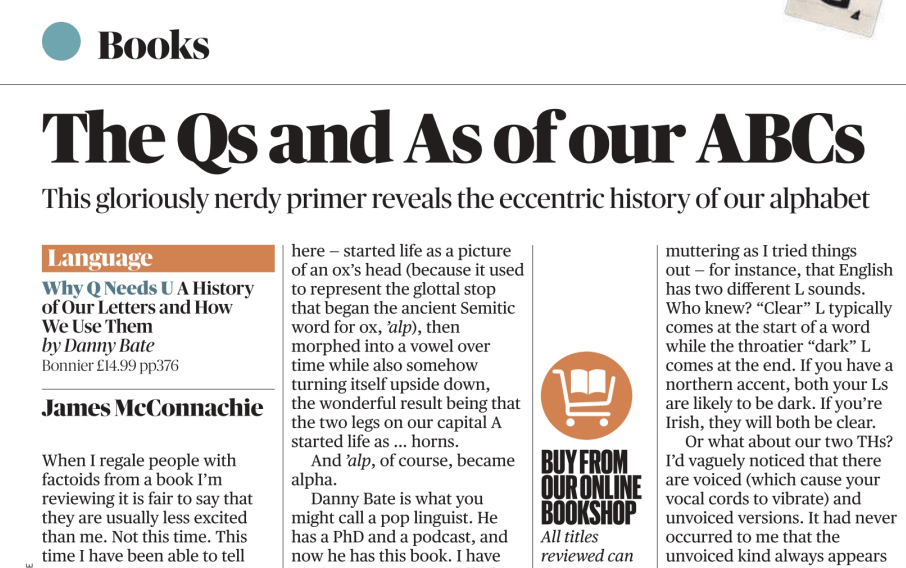
The review, which can be found online here, was joyous in its wide selection of facts and features of spelling that James enjoyed. It concludes with a paragraph on silent letters (a topic on which my book and I are apparently “fascinating”), and I grasped this as a reason to shepherd my thoughts on so-called ‘silent’ letters in English into structured prose.
“Oh, English spelling, awful – all those silent letters” goes the cry of later-life readers, those who endured an education in English long after the infant age that so benefits its natives; when those of us in that club first learned, we had empty diaries and nothing better going on at the time. Theirs is a fair criticism. The German, faced with an obligatory B in the words debt and doubt, may rightly balk at this insult to efficiency. The Italian, watching American children cheered on at national spelling bees, may mock the foundational fact that the sounds of spoken English words don’t easily match up to exact counterparts on the page. The right-writing nations of the world don’t know whether to laugh or cry at a misuse of the ancient alphabet that apparently hushes each of its twenty-six letters in at least one word, save V.
‘Every letter?’ you may incredulously query, and fairly so. We have a sense that some are worse troublemakers than others, the better behaved members of the alphabet, like X and Z. Yet, if we rendezvous to watch the upcoming grand prix, even those two fall silent. ‘But those are French words!’ you object. ‘Yes they are,’ I riposte, ‘and now they’re English too.’
Quickly then, silent letters take us out into murky, blending waters, at the confluence of two languages. There we are confronted by questions concerning the permeable borders of a language – at what point adopted words can be said to belong to the recipient. Moreover, as a linguist, I cannot deny that the presence of silent letters in written English is a complication and source of frustration, but I also invite the scoffers to reflect on what exactly silence in spelling may mean.
Take that final word there, mean. Operate on it with your mind’s scalpel. It comprises four letters: M, E, A, N. The first, second and fourth clearly merit their inclusion. Yet the pronunciation of the word bears no acoustic resemblance to the possible sounds of the letter A, to neither the A in ate nor the A in at. Would you then label the A in mean a silent letter? I guess you wouldn’t, and neither would I. We recognise that the E and A function together, spelling a vowel sound found also in meat, meal and meagre. The technical term for such cooperative pairs is a ‘digraph’.
Standard written English relies greatly on digraphs; the letter H is especially imbued with combinatory power. We utilise H to spell the CH, SH and TH sounds (e.g. chin, shin and thin) that were absent from the mouths of the Romans, and therefore from the rendition of the alphabet that they left us. We recognise that the H in a word like their, in tandem with T, pulls its weight much more than it does in heir.
But what about what? The difference between a plain W and the H-augmented digraph in what, whale and white reflects a diminishing difference in speech, as fewer and fewer speakers pronounce whine as separate from wine. Must we wait for their dialects to die out or submit to the merger, before we designate the H in what as yet another silent letter? Even if so, the Y in mayor may remain a further point of disagreement within English, being audible for many (most?) Americans, yet mostly mute for me and my fellow Brits. Silent letters invite us to examine the fragmented state of English speech.
If collaboration with another alphabetic colleague rescues a letter from redundancy, a load more letters evade the charge of idleness. A final E is a common sight at the close of many English words, like cape, kite, code and cute. It would be remiss of us, however, to eject E from these words, lest we be left with cap, kit, cod and cut. This characteristic practice of English spelling, which I was taught as ‘Magic E’, again involves two cooperative letters that represent the single intended vowel sound – meaning that, in a strange way, you can hear the ‘silent’ letter E. This is another example of a digraph, only this time with the two ingredients split from each other in the sequence. No one said it couldn’t work that way.
Since we have extended our defence to written words in which a ‘silent’ constituent ensures a particular pronunciation, we are compelled to hear the plea of similar cases. The GH within everyday words like night seems at a glance like an egregious waste of ink. It’s a relic of a lost sound, dropped from speech during English’s gradual transition from medieval to modern. Over the North Sea, the loss hasn’t occurred in its sister languages, like Dutch (nacht) and German (Nacht). Yet the English GH didn’t go quietly. Its absence left a void that the vowel could fill, which lengthened ever so slightly to bridge the gap. It came to sound like ‘neet’. This new length then rendered the vowel prey to the Great Vowel Shift (c. 1400–1700 AD), through which we arrive at my southern-England pronunciation of night. Consequently, the GH in the word night is in fact responsible for the sound of its letter I. Without the GH, we’d now be left with nit, just as light and fight would be lit and fit. Being jointly to blame, the I and GH work as one to spell a single vowel – a trigraph!
We’re now a far cry from the ‘one sound for one letter’ rule of the alphabet’s inventors, living four millennia ago. Trigraphs are both offenses to that rule and the conclusion of it. Amidst the endless dance of shifting speech, writing can stand still and continue to spell the final result. They are especially hard to rethink when the division of labour seems equal; my one candidate for a quiet Q is the rare word lacquer, but in its trigraph CQU, is there a primary speller of the underlying consonant /k/? Is it the C or the pair QU, or does the whole trio function as one seamless whole? Such a trigraph tests our perception of which sound matches up to which letter. The QU does at least save the C from softness (subtract it and read: ‘lacer’), while ‘laquer’ without the C might be read with a different vowel, as if it started like lake. Both C and QU then contribute to the pronunciation of this French acquisition; can either then be called silent?
But with a common word like night, couldn’t we at least swap the trigraph IGH for a split digraph, with I and Magic E? Wouldn’t that tidy up English spelling a bit? Yes we could, and yes it would. A word of warning, though: we might throw the odd baby out with the bath water, as this would finalise the merger of sight with site, and right with rite. These homophones are for the moment still separate in spelling, which brings us to another use for mute letters; those silent in speech may yet scream at the speedy reader not to mistake their word for another. If this function, as a signpost towards a writer’s right meaning, gives silent letters a free pass, then heck, even the K in knot, knight and know (not not, night and now) deserves to stay.
Spare a thought then for English spelling’s silent letters, many of them conscripted assistants that are there to make other letters shine. Some may still earn their keep in the medium of writing alone, guiding the reader’s eye to a quick recognition of meaning. That said, a few really have no place receiving the same grateful thanks due to the alphabet’s workhorses, the Es and Hs, that keep the engine running. I would have to agree with that frustrated German – the B in debt and doubt needs to go.
END.
Original Substack post, cover image taken from Wikimedia.
 Danny L. Bate
I wouldn’t summon any Germans to judge the efficiency of English spelling.
Just look at the way German spells certain sounds that appear quite frequently in the German language:
SCH — a trigraph. Compare that with English SH, or Czech Š
TSCH — a tetragraph! Even English caps its craziness at trigraphs. TSCH is often spelled as CH in English, and it’s just one letter, Č, in Čech (Czech).
Deutsch oder Tschechisch? … some efficiency, huh?
LikeLiked by 1 person
An older relative of mine emigrated to Australia in the 1960s, a monolingual Finnish speaker with very little formal education. He learnt English and ended up in a white-collar job. And he once told me how his English-speaking colleagues just couldn’t believe that if he wrote down an English phrase in Finnish orthography, just like a naïve Finnish speaker would do, a Finnish monolingual would be able to read it aloud so that it would sound a little funny but completely understandable.
Phonological orthographies of younger written languages are less connected to the history of the language at issue and therefore, more universal.
Also: as a Finnish speaker who has learnt English by way of formal education, always accompanied by writing, I have never understood what makes “spelling” so difficult for English speakers. For me, learning English meant first memorizing the written form and then, gradually and intuitively, developing the rules (“deep phonology”) by which the pronunciation can be derived from the written form. Works much better this way than the other way round.
LikeLiked by 1 person
Your examples for K and GH remind me that on the Isle of Wight there are two villages – Niton and Knighton. To avoid confusion, the latter is pronounced “Kay-niton”.
LikeLiked by 1 person
I would only defend the silent “b” on the grounds that it allows for the joke about putting the “b” in “subtle”.
LikeLiked by 1 person