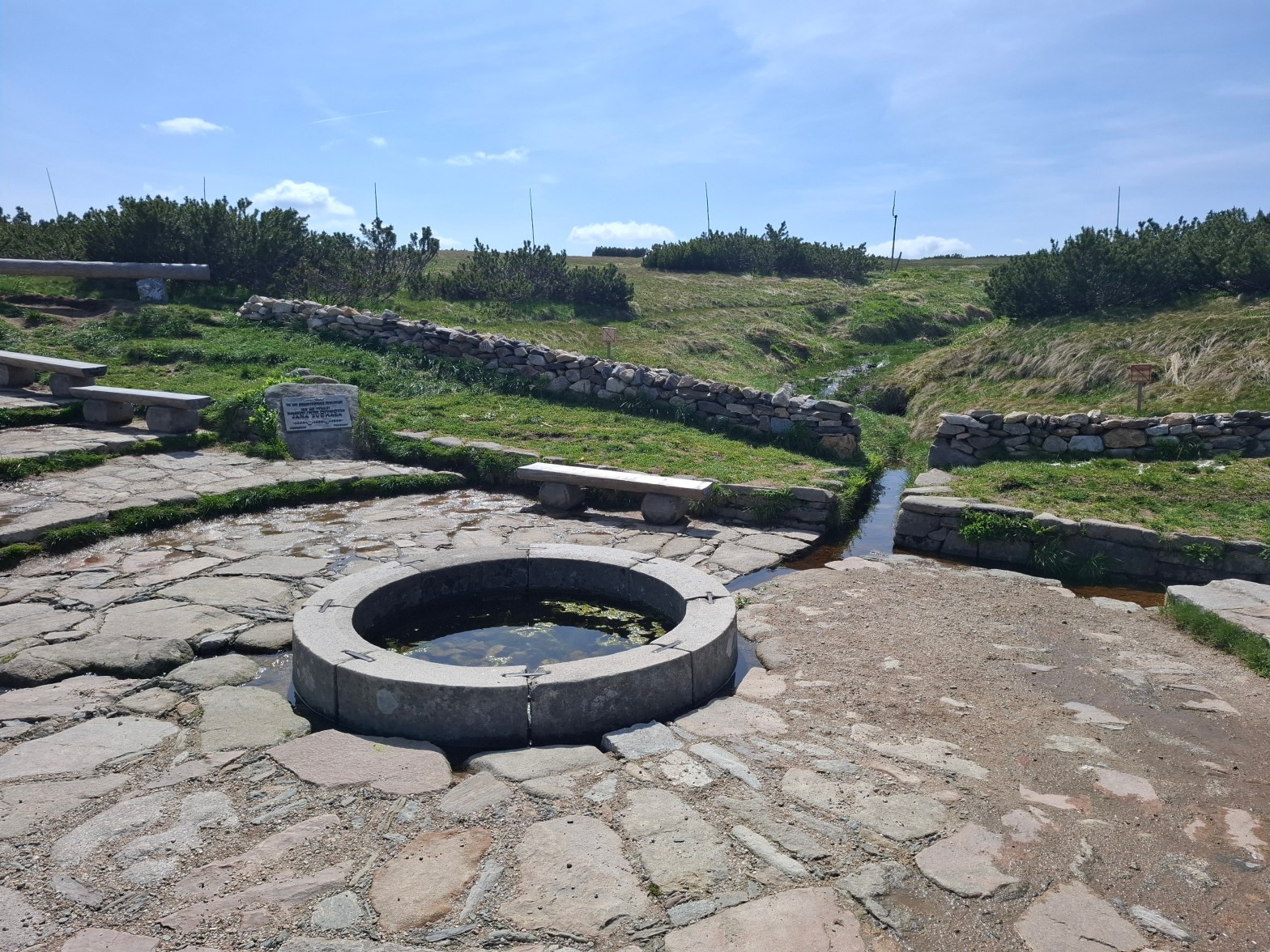
High up in the Giant Mountains (Krkonoše), in the north of the Czech Republic, one of Europe’s mightiest rivers bubbles into life as a bit of soggy bog. This river is the Elbe, which rises on the southern slopes of Mount Violík, and soon picks up speed by crashing over and down the Elbe Falls, off on its journey towards Germany and the North Sea.
The Elbe is a defining feature of Central Europe, ancient and unbothered by the young nation-states through which it flows. Its international nature is reflected in its variable name.
English follows German, calling it Elbe, with an initial E. However, for the locals of the land of the Elbe’s origins, it’s called the Labe in Czech, with an L. Likewise, on the other side of Violík, Polish speakers know it as the Łaba. The Sorbs of eastern Germany call it the Łobjo, again with an L-like letter.
Why the hydronymic disagreement? I discussed this very question during a recent hike past the source of the Elbe, as you do. Having first inflicted the answer on my obliging hiking companion, here it is now in text.
This article sets out to explain the differences in national names for the Elbe. Much like a river, its breadth soon expands, as the article flows on, past its primary purpose, into a widening world of languages, peoples and historical connections. How, for instance, does Charlemagne fit into the story?
Trickling into history
The major difference to be noted is that this is a faultline between two families of languages: the Germanic (like German) and the Slavic (like Czech, Polish and the two flavours of Sorbian).
Once upon a time, the Slavic languages were one. It was during this early medieval era, in and around the 6th century AD, that speakers of ‘Proto-Slavic‘ arrived in Bohemia and settled beside the banks of the Elbe. Proto-Slavic was by this time increasingly widespread and therefore fragmented, so I prefer ‘Common Slavic’ for referring to this collection of emerging accents and dialects. The particular dialect of the newcomers in Bohemia would eventually become Czech.
When they arrived there, the Slavs would have learned from the locals already present (whom they would eventually linguistically dominate) that this great river was called something like ‘Albi‘. Barring some variation in its ending, this had been its name for centuries.
Our earliest mention of the Elbe comes from the first decades of the first century AD, when the Greek geographer Strabo wrote about the river Ἄλβις. Likewise, in around the year 30 AD, the Roman historian and senator Marcus Velleius Paterculus wrote about a Roman army being led
“… quadringentēsimum mīliārium ā Rhēnō usque ad flūmen Albim…”
… four hundred miles from the Rhine, as far as the river Elbe…
Velleius Paterculus’ History II, 106.2
The original namers of the Elbe are unclear. A traditional view is that it’s a river name of Celtic origin, derived from the Indo-European root *albʰ-, meaning ‘white’ (see also: Latin albus). The waters of the Elbe may have been noticeably bright and clear in appearance, or perhaps frothy and foamy.
Another theory is that Elbe was first and foremost a Germanic appellation, originally a word simply meaning ‘river’. Nordic languages have clearly related cognates for ‘river’ (Danish elv, Norwegian elv), although it’s long been remarked that it may have happened the other way around – that these words for ‘river’ come from the Elbe, such was its fame.
Wherever the Elbe ultimately derives its name from, a form of that name like *Albī is behind the German name Elbe, with the additional change of umlaut producing its initial E. It appears in one Old English text with the name Ælf. A version like *Alb(i)ja– was also first adopted from the local Germanic language by the incoming Slavs. They would have borrowed the name as *Olbja.
With this in mind, we can appreciate that the German name Elbe preserves the older arrangement of sounds: the vowel first (once an A-type vowel, now E), followed by the consonant L.
What the Czech name Labe shows is the legacy of a fascinating and illuminating sound change, one specific to Slavic speech.

Swirling syllables
During its later period of Slavic linguistic unity, when the cracks between prehistoric dialects were only just starting to show, Slavic speech went through a radical restructuring. Its focus was the language’s syllables.
As I’ve written about previously, later Common Slavic worked to make sure that all its syllables were open ones. This is to say, they had to end in a vowel sound.
My first name, Danny, would be acceptable (Da-nny) in the new Slavic that emerged. My surname (Bate) would not be, as it’s a syllable that ends in a /t/ consonant. Many Slavic words had to change to fit the pattern, and there were numerous ways that this could be achieved.
Take, for example, the ancestral Slavic word *melkò. It meant ‘milk’. As it stood, this contravened the so-called ‘Law of Open Syllables’, because its first syllable (*mel-) didn’t end in a vowel. Something had to be done.
One solution was to make the L move, and instead pronounce it instead before the vowel *e in *melkò. Another was to add in an extra vowel, thereby separating the illegal *lk sequence. Geographical faultlines emerged, between west/south and east.
The western dialect that would become Czech went with the first option, coupled with the lengthening of the vowel. Hence, *melkò became the Czech for ‘milk’: mléko. This movement of sounds is called ‘metathesis‘. It was also the chosen solution of future Slovak, future Polish and future South Slavic languages.
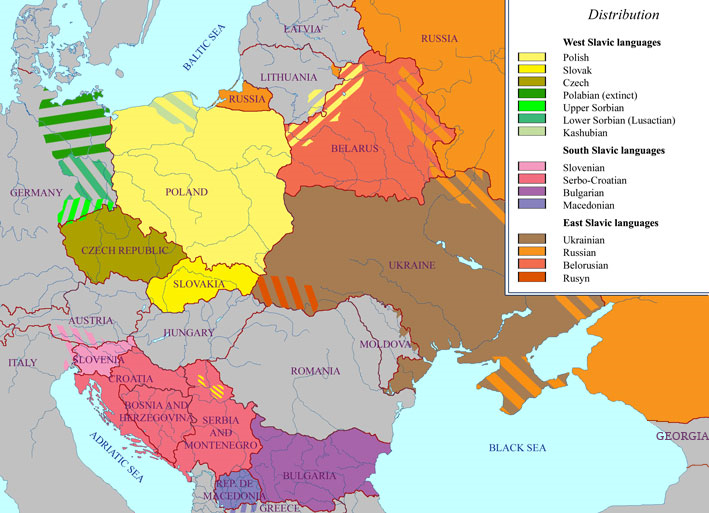
In the eastern zone of Common Slavic, the solution was to add another vowel into *melkò. This change is known as ‘pleophony‘. Consequently, the Russian for ‘milk’ today is молоко (moloko).
To give another example, related to milk, the proto-word for ‘cow’ in Slavic was *kòrva. This contained another banned sequence of words (*kor–), only this time with an R-sound, not L. The highly resonant sounds behind the letters R and L are known jointly as ‘liquid‘ consonants. Both sounds underwent either metathesis or pleophony, to obey syllabic law. As a result, the Czech for ‘cow’ today is kráva. In Russian, it’s predictably корова (korova).
Through either liquid metathesis or pleophony, the emerging Slavic dialects could satisfy the Law of Open Syllables. Words that had the abstract sequences *ColC *CorC *CelC and *CerC (where C stands for some other consonant, in the same syllable or the followng one) could be fixed by making sure that the liquids preceded the vowel.
Metathesis could occur right at the beginning of a word too. Proto-Slavic words that began *olC or *orC swapped the initial vowel and the liquid consonant around. This metathesis affected the whole Slavic family. See here, for example, in the development of Czech specifically:
- PS *ȍlkъtь ‘elbow’ > Czech loket
- PS *oldi ‘boat’ > Czech loď
- PS *òlkomъ ‘greedy’ > Czech lakomý
- PS *orbòta ‘work’ > Czech robota
- PS *òrdlo ‘plough’ > Czech rádlo
To be clear, this restructuring was all happening before Slavic was properly written down. When texts in Old Church Slavonic first start to emerge, from the 9th century onwards, the changes are basically a done deal.
Through this swapping of sounds that happened in the prehistory of Czech and other western Slavic languages, we have all we need to understand how Elbe corresponds to Labe.
After the name of the river passed into western Common Slavic as *Olbja, its initial *Olb- sequence later became prey for the Law of Open Syllables. The initial vowel and the following liquid traded places, a change that did not happen back in Germanic speech.
Hence, German today has Elbe, while Czech has post-metathesis Labe.
Linguistic confluences
Understanding and recognising ‘liquid metathesis’ and pleophony has incredible explanatory power; it’s very helpful for making connections between Slavic and non-Slavic Indo-European languages. Those in the first group will have gone through one of the changes, those in the second will not have.
For example, we saw above how Czech mléko was once *melkò – one step closer to English milk. Likewise, awareness of the shifted R allows us to connect Czech robota (the origin of robot) to German Arbeit ‘work’. Metathesis gives us an explanation for how the rock known to the Romans as marmor, which has become English marble, has also ended up as Czech mramor.
The elbow, known to the Czechs as a loket, once began *ol-. This allows etymologists to connect it to Latin ulna and indeed English elbow. Armed with the concept of metathesis, we can also better appreciate how Czech rameno ‘shoulder’ is related to English arm, or how the Czech for ‘swan’ (labuť) may derive from the same ‘white’-root as encountered already in Elbe/Labe.
For making connections into and out of the Slavic languages, knowledge of liquid metathesis is a helpful tool.

The flow of time
However, as etymologists, we can go nerdier still, and talk about time. This is what most fascinates me. If you’d like to know more, continue downstream.
A good question to ask is: if all Slavic languages have always shown the changes to liquid consonants above, what is our evidence that they actually happened? What’s our evidence for the before-stage, prior to metathesis and pleophony?
We do have a handful of recorded words in Old Church Slavonic texts that show the original sequence of sounds, such as “а҅лдии҆” (aldii), meaning ‘boat’. Compare this with its modern Czech niece: loď. These archaisms may have come about through input from conservative Slavic speakers, or because they were somehow special, sacred words. They are also very few in number.
Much cooler, in my opinion, is how we have evidence from outside the Slavic-speaking environment. After the Slavs settled across Europe, it took a couple of centuries, and their conversion to Christianity, before they started to write things down. However, during those centuries, this didn’t stop other people writing about them. Greek-writing people in the Eastern Roman Empire had good reason to chronicle the deeds and misdeeds of these new people on the Balkan scene. In so doing, they recorded names that didn’t yet show the liquid metathesis typical of South Slavic languages.
For example, these Byzantines recorded names like Βαλδίμερ (Valdímer). In Slavic languages that have since undergone liquid metathesis, you’ll find this name as Vladimir. Likewise, the documented name Δαργαμηρός (Dargamērós) has become Dragomir. Ἀρδάγαστος (Ardágastos) was a 6th-century Slavic warrior and leader, and he shares his name with the Slavic god Radegast.
What’s more, we have places that were named by Slavic speakers, but then passed into other communities and even other countries. Take, for example, all the places in Greece called Gardiki. This is Slavic in origin, cognate with words for ‘stronghold, castle’ like Serbo-Croatian grad, Polish gród and Czech hrad. The city of Graz in Austria reflects the same root, except adopted by German speakers after the sound switch of metathesis.
Because we have these manuscripts with examples of Slavic words before and after metathesis, we have things that allow us to date (approximately) when the change actually happened. This is a real treat for historical linguists; very often, famous sound changes are dated to simply ‘before the written record’.
On the basis of documented individuals and place-names, metathesis had probably not started in the Slavic speech of the Balkans in the early 7th century. However, when St. Cyril and St. Methodius picked up that speech and started writing it down in the early 9th century, our evidence suggests that metathesis-ed words were now the norm. This gives us a window of two centuries in which it happened in Southern Europe, which is pretty precise by historical-linguistic standards.
We can also date its end through words and names that arrived too late to be affected. To the east, the changes must have settled when Helgi, a prince of Scandinavian origin, rose to political prominence in Kiev. As the prince of Kievan Rus’ (ruled 881−912), his Norse name was adopted by the Slavs not as ‘Hlegi‘ or ‘Helegi‘. Instead, the vowel of Helgi continued to precede the L, and he is remembered as Oleg.
Meanwhile in Central Europe, our written sources show that metathesis was over in the Czech lands by the end of the 9th century. This is why Latin writers in Germany were writing “Rastiz“, and not ‘Arstiz‘, for Duke Rastislav of Moravia (ruled 846–870).
However, we’re also led to believe that liquid metathesis and pleophony were still active processes about a hundred years earlier, at the turn of the 8th and 9th centuries. This was the era of the great king and emperor, Charlemagne (c. 742–814). His enormous Frankish dominion looked to all intents and purposes like the Roman Empire reborn, and would have had many interactions with Slavs at its borders. Charlemagne was a man to be admired, obeyed and feared by the various Slavic peoples to the east.

With such status, it’s no wonder that his Germanic name, Karl, passed into Common Slavic as *kõrľь – simply meaning ‘king’. That’s some political success to have, when your name becomes someone else’s word for a monarch.
No sooner had the title settled in the Slavic lexicon, than the Law of Open Syllables got to work on its illegal structure. For those dialects that chose to metathesise the *r, it moved to precede the vowel. Hence, the Czech for ‘king’ is král. For those opting for pleophony, a vowel was inserted. Hence, the Russian equivalent is король (korolʹ).
Charlemagne, a well-documented and dateable individual, therefore offers us a way to narrow in even further on the timing of sound changes in a language unrelated to his own. More than that, he provides evidence that Slavic was at that time still fairly unified. His name diffused through the new flavours of what can still be called ‘Late Common Slavic’, rather than through one or two members of a new family group.
For historical linguists, that’s a lot more impressive and interesting than the whole empire thing.
So, that’s the linguistic story of the river Elbe, and much more besides. It’s a meandering piece, going where the currents of its author’s mind takes it, but that seems appropriate for the topic.
END.

References
- Bichlmeier, H., & Blažek, V. (2014). Elbe–zu den Quellen eines Hydronyms. Acta Linguistica Lithuanica 71, 125–146.
- Blažek, V. (2010). Etymological Analysis of Toponyms from Ptolemy’s Description of Central Europe. Studia Celto-Slavica 3, 21–45.
- Collins, D. (2018). 81. The phonology of Slavic. In: J. Klein, B. Joseph & M. Fritz (Eds.), Volume 3 Handbook of Comparative and Historical Indo-European Linguistics. 1414–1538. Berlin, Boston: De Gruyter Mouton.
- Derksen, R. (2008). Etymological Dictionary of the Slavic Inherited Lexicon. Leiden: Brill.
- Pronk-Tiethoff, S. (2013). The Germanic loanwords in Proto-Slavic. Leiden: Brill.
- Sussex, R., & Cubberley, P. (2006). The Slavic Languages. Cambridge: Cambridge University Press.
All images my own or from Wikimedia.
Bonus word-nerdery
If you’ve made it this far, here’s some extra info, as a thank-you. The Slavic languages, during their history, have not only been influenced by other languages, but have influenced each other.
Old Church Slavonic was based on a South Slavic dialect, but its sacral status as a religious language meant that it was transported to other dialectal zones, namely to East Slavic-speaking areas. Consequently, a modern East Slavic language like Russian includes words borrowed from the language of the Church. Some sit side by side with sister words inherited directly from Proto-Slavic.
If applicable to that word, the Old Church Slavonic borrowing will show metathesis, as it comes from the south, while the ‘native’ Russian will show pleophony. This is how Russian has two words for ‘milky’: inherited молочный (moločnyj) and borrowed млечный (mlečnyj). It’s also how you can have Russian cities like Petrograd and Novogorod.
Also, relatedly, liquid metathesis could separate two inherited words from a common root, if the conditions were right. We met above the Czech noun for ‘plough’: rádlo. The verb for ‘to plough’ is orat. As you might now be able to tell, these come from the same ‘plough’-root, but metathesis has made them look like strangers. It didn’t affect the verb, because the *r in Proto-Slavic *oràti came at the start of the second syllable. Yet it did alter the noun *òrdlo, because there the *r liquid came at the end of the first syllable, and that just wouldn’t do.
 Danny L. Bate
This is tangential in the extreme, but on the very last page of the Latin-language newspaper (1889-95) I’ve been editing, its author mentions the loss of a couple of copies of his previous issue, heading to subscribers in the US, with the sinking of the “Albis”. Bearing in mind that this Latin-language newspaper is, duh, in Latin, it took me far too long to realise that I couldn’t find any reference to the shipwreck of the “Albis” because the ship was actually the SS Elbe, which did indeed sink in the North Sea (a notorious disaster) in January 1895.
LikeLiked by 1 person
Wow! One of your better newsletters! Great way to start the day. Keep em coming
LikeLiked by 1 person
I always look forward to your fascinating posts, but hesitated with this one, as I know nothing about things Slavic, and probably thought it too difficult, and only loosely connected with the few languages I’m more comfortable with, but I’m glad I plunged in. Great stuff!
LikeLiked by 1 person
What would be of equal interest to me is the socio-politico-economic process through which the open-syllable dogma became entrenched. Grassroots or top-down? Consensus or dialectic? Single-stranded or accompanied by other social or economic changes?
LikeLiked by 1 person
That’s an excellent point, and always something to be considered. Language doesn’t exist in a social vacuum. I’ll only add that sometimes change can originate in certain ‘pressures’ in other domains of language, such as the acquisition of language by infants, whose speech doesn’t have much social clout. A pressure to standardise syllable structure could build in children’s language, and come to fruition in their adulthood.
LikeLike
P.S. Many thanks for a brilliant article.
LikeLiked by 1 person