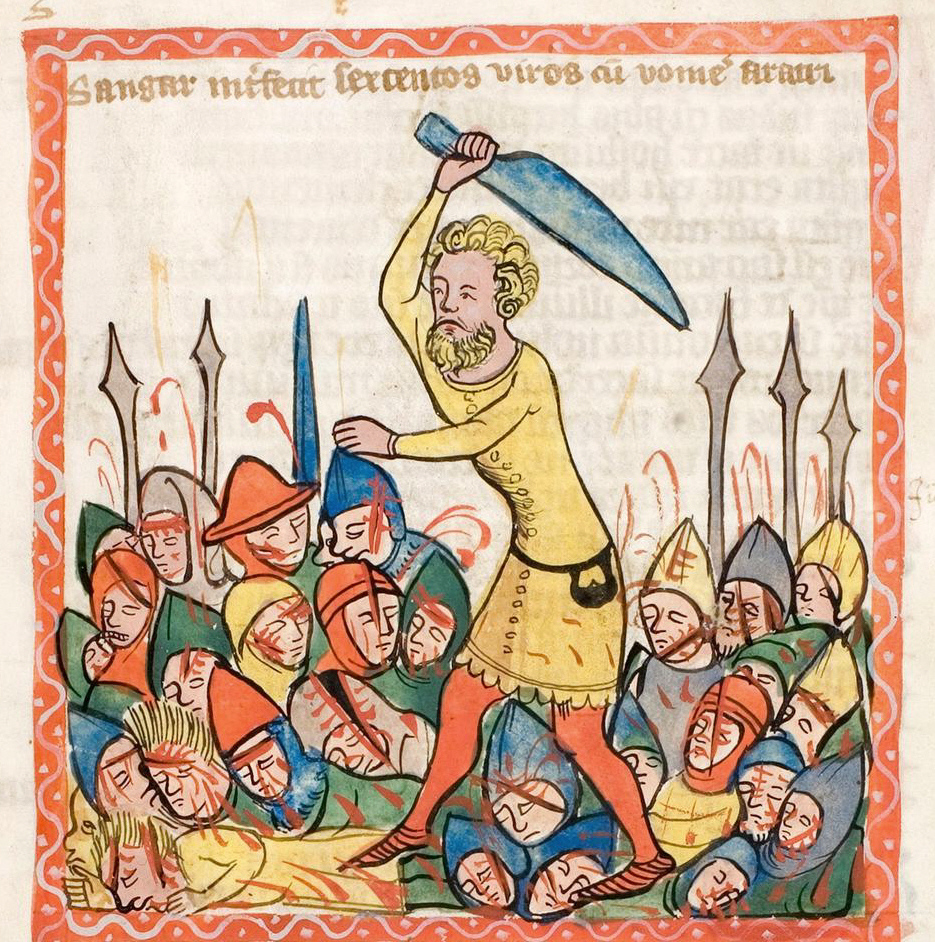
The Bible can make for a gruesome read. An effortless observation (which has led to much reasonable criticism) is that, for a collection of texts which many people take as foundational for life, it contains a lot of violent death.
This can be of a single named individual or of an uncountable number of nameless victims. Violence is more prevalent in some books of the Bible than others¹; the Book of Judges, for one example, explores the consequences of (un)faithfulness to God through the narrative of its stars, the Israelites, doing awful things and having awful things done to them. Judges 3 moves quickly from the bloody oppression of the Israelites by the neighbouring Moabites, to the gutsy assassination of the Moabite king and the killing of 10,000 of his subjects, all in the short space of seventeen verses.
Yet, despite the horror of the deeds and the magnitude of the slain, it’s possible for these passages to wash over their readers, to seem unremarkable, vapid. This may be due partly to our unnerving cognitive ability to process high numbers of fatalities unfeelingly (as Stalin probably didn’t once comment on), and partly to scepticism in the numbers. I have no doubt that life in the Bronze Age could be nasty, brutish and short, but the thousands of dead have the ring of authorial exaggeration, written centuries after the fact. If actually true, the total death toll of the Hebrew Bible would surely have left the region a depopulated wasteland.
Perhaps the indifference of readers is also in response to how the passages are constructed. Their simple, often impassive description of events, combined with an unfamiliar social context and repetitive conjunction (‘and … and … and…’), means that the passages – and, importantly, subsequent translations of them – are unlikely to provoke emotional responses from their modern audience.
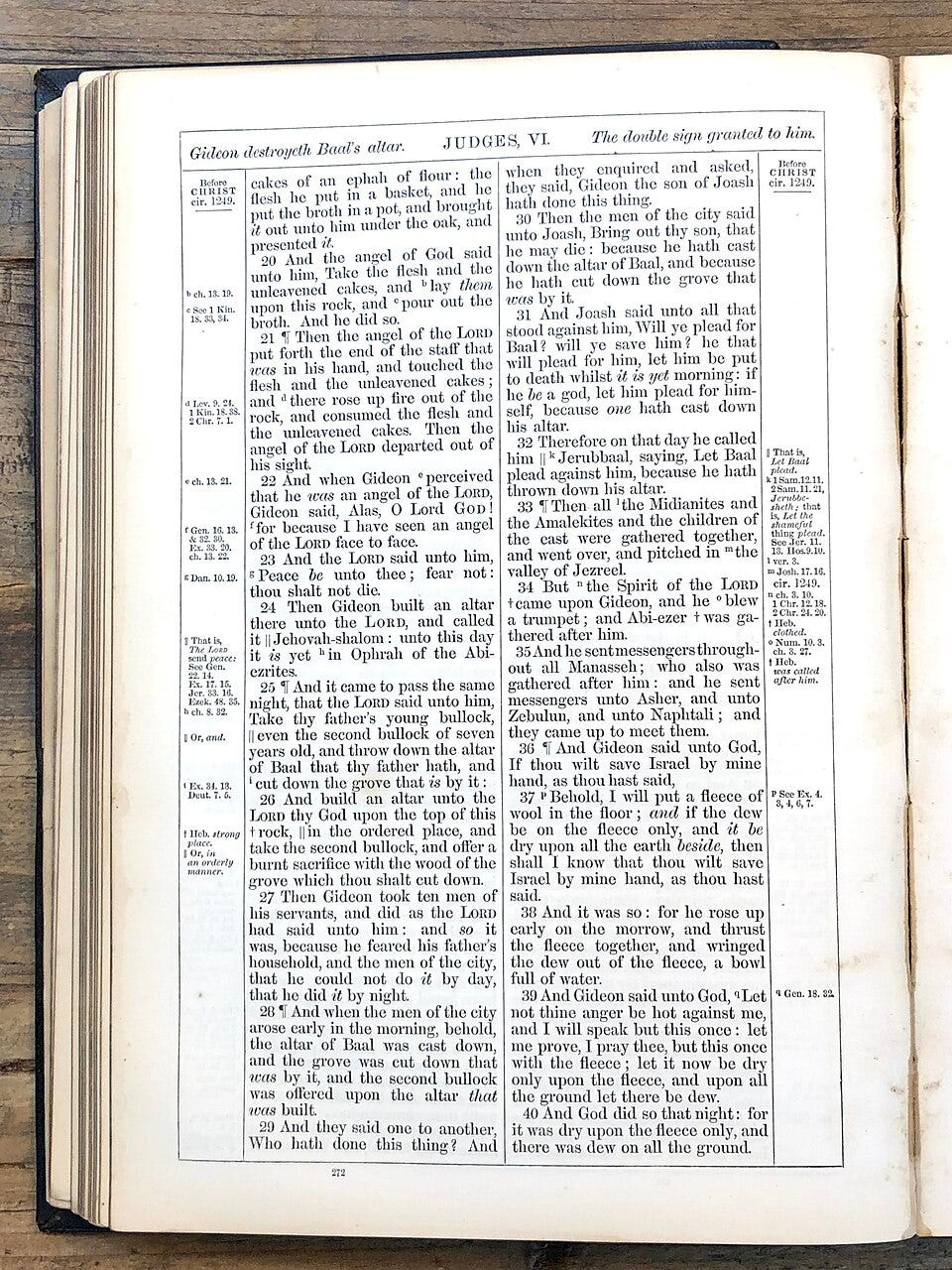
Add in a deep cultural immersion in these texts and their presentation in unusual, archaic English, and you have a situation where Monty Python can make them a target of parody:
“…And spotteth twice they the camels before the third hour. And so the Midianites went forth to Ram Gilead in Kadesh Bilgemath, by Shor Ethra Regalion, to the house of Gash-Bil-Bethuel-Bazda, he who brought the butter dish to Balshazar and the tent peg to the house of Rashomon. And there slew they the goats, yea, and placed they the bits in little pots.”
(Monty Python’s The Meaning of Life)
I am fully guilty of this dispassionate attitude towards ancient texts, Biblical or not. Consequently, I deeply appreciate any means of jolting and resetting my conception of them, thawing out stories frozen by genre, and getting back to the real people behind the texts. I think that one way to do so, you will not be surprised to learn, is via language.
Shibboleth is a great English word. True, its greatness is a subjective quality that the word itself is unaware of, but I’d bet that other English speakers will agree with me. Any pleasure derived from shibboleth is due to its lexical rarity, fricative sounds, and composition as a word that unconsciously marks it out as a borrowing into English. Shibboleth does indeed come from elsewhere, specifically from Biblical Hebrew.
It can be used in English with a handful of related meanings; the Cambridge Dictionary provides two:
“a belief or custom that is not now considered as important and correct as it was in the past”
“a word, phrase, custom, etc., only known to a particular group of people, that you can use to prove to them that you are a real member of that group”
These contrast greatly with its meanings for speakers of its language of origin: ‘ear of grain’ (i.e. of wheat) and/or ‘flood, stream’.
The English usages arise from a single context in which the word was written, a story recounted in the twelfth chapter of the Book of Judges. It’s not unusual for the book, being yet another account of one Biblical people (the Gileadites) slaughtering another (the Ephraimites). The Ephraimite dead are reckoned at 42,000 at the cessation of hostilities. Yet the episode is notable for a small detail that gives it an air of remembered reality.
In this story, the major geographical landmark is the river Jordan, flowing, as it still does, from north to south. Looking out from their home on the west side (Cisjordan) was the Tribe of Ephraim. On its east side (Transjordan) lay the region and people of Gilead, chief among them being the judge Jephthah. Don’t imagine a legal bigwig for the term judge in this context; the judges of the Hebrew Bible are more active, more martial individuals.
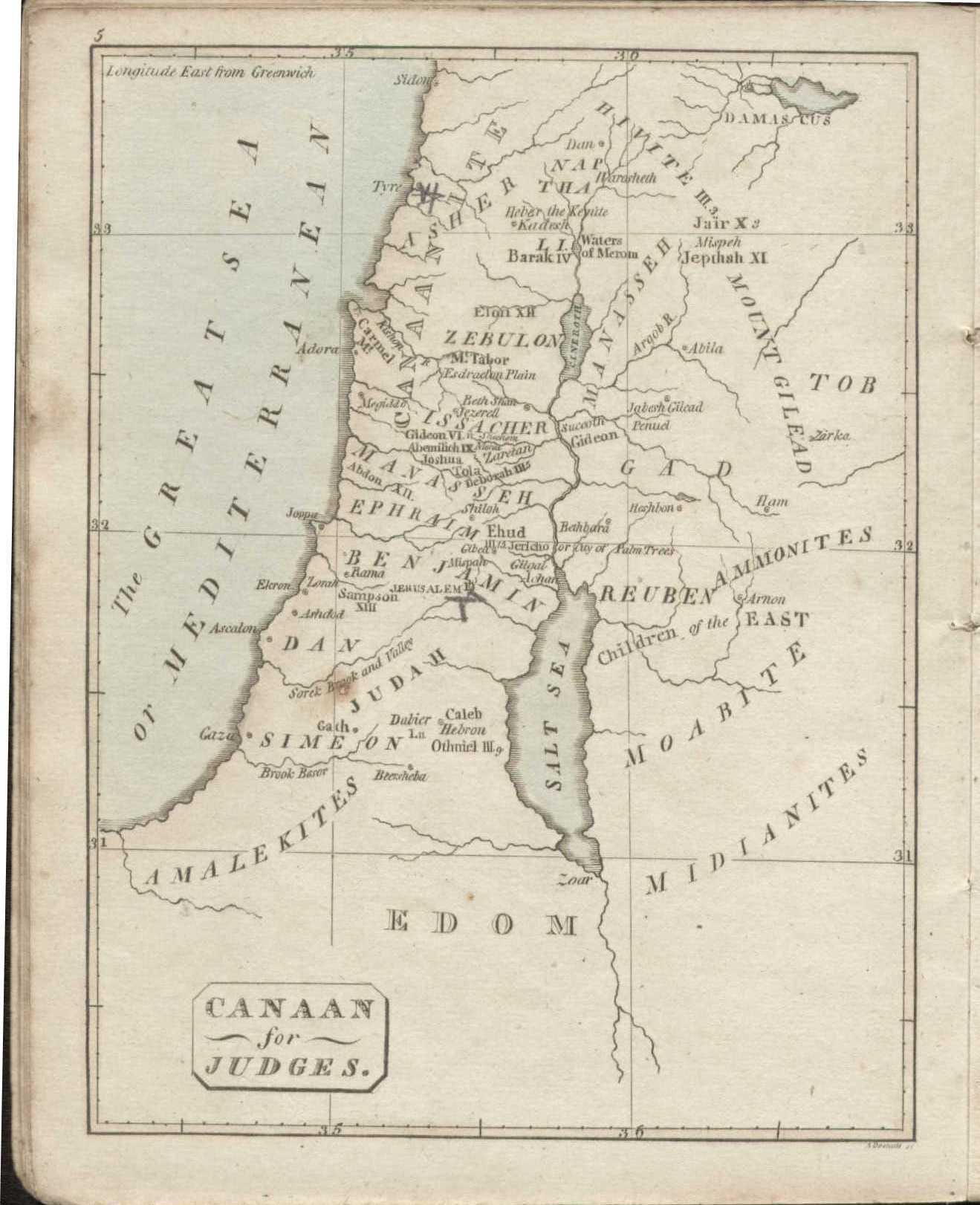
The necessary context is that the Ephraimites and Gileadites were feuding. The former hadn’t helped the latter during an earlier time of peril, and then the Ephraimites had the nerve to be bitter that they were not invited to join in with the Gileadites’ battle and eventual victory against the Ammonites. This, by the way, was not a fight against fossilised shelled mollusks, but rather a separate people, living to the south of Gilead in what is today Jordan. The Ammonites gave their name to the capital city of the modern-day country of Jordan, Amman.
The Ephraimites fought the Gileadites, lost against them, then fled back towards the Jordan and home. But the Gileadites were waiting for them there, having secured the crossings already. You could pass their blockade and reach the safety of Cisjordan by passing a test: just say the word shibboleth. It sounds simple enough, Pythonesque again in its anticlimax, but the Ephraimites fatally failed by the thousands.
The Ephraimites could not pronounce the word correctly, thereby signallying their social allegiance. The Hebrew text of Judges conveys the right and wrong pronunciation with two spellings: harmless שִׁבֹּלֶת and deadly סִבֹּלֶת. They differ only in their first letter: ש (rendered Roman as shibbolet) and ס (in Latin letters: sibbolet). After an Ephraimite answered with sibbolet, death was dealt out.
It’s from this test that the English word gets its meaning of a distinguishing feature for a particular group. As said, its meaning at that time was maybe ‘ear of grain’, maybe ‘flood, stream’. Its varied translations could be due to a case of homophony through a merger of two unrelated words. Given the riverside setting, the ‘flood, stream’ sense would make more sense. Regardless, the meaning was unimportant. What mattered was its phonetics; mispronunciation was a fatal misstep.
This challenged later translators of the Hebrew Bible. Do they translate the word, to make it intelligible to their new readership? Or stay true to its phonetic purpose by leaving it untranslated? Responses have differed. The scholars behind the Septuagint went with the first option, rendering it as “στάχυς”, the Ancient Greek word for ‘ear of grain’. St. Jerome in his Latin Vulgate left it as “scibboleth” instead. SC represents the sibilant that the Roman alphabet has no single letter for, being absent from native Latin words. I have to wonder how the Romans shushed one another.
But what is actually going on with this story? Is this a tale of a tongue-twister, unknown among the Ephraimites? It’s actually something bigger than this one word; it was a matter of dialect.
Based on the animosity and conflict chronicled in books like Judges, you could be forgiven for thinking that the peoples and groups mentioned were totally alien to one another. Instead, the historical and archaeological evidence indicates that all of this disharmony was actually happening within a shared culture of belief, lifestyle and language.
Ephraimites, Gileadites, Ammonites and many other characters of the Biblical story (even the Phoenicians to the north) were speaking flavours of a broader ‘Canaanite’ language. This in turn belonged to the wider Semitic family. It would at one point have been unified, before its disintegration into new accents and dialects across a broad geographical area. Of the offspring of Canaanite, only Hebrew has survived until today, thanks to its enduring sacral function and return to speech in the modern era.
The line between dialect and language is vague (the Ephraimites and Gileadites had armies but probably not navies). Nonetheless, the story of slaughter beside the Jordan implies that the two groups could communicate with each other perfectly – so well that a fleeing Ephraimite soldier wouldn’t give himself away after saying “Let me cross over”, but only after the single trap word.
Accents and dialects emerge through accumulated small differences, such as in the sounds of speech. A particular group of speakers may shift a sound that another group retains; the innovative and the conservative now differ, but correspond systematically. One such difference lies behind the shibboleth story. A leading explanation is that of E. A. Speiser (1942), namely that the Gileadites pronounced the initial sound of shibboleth conservatively, and the Ephraimites innovatively.
The theory goes that, east of the Jordan, Gileadites and Ammonites preserved a /θ/ consonant (as in English thistle and thorn) in relevant words – the safe pronunciation to their ears was ‘thibbolet’. This /θ/ was conservative, inherited from Proto-Semitic, the ancient ancestor language.
Meanwhile, over in Cisjordan, instances of /θ/ had shifted and merged with the existing sound /ʃ/ (as in English words like shift and shibboleth). This accentual innovation cost many Ephraimites dearly. They couldn’t pronounce /θ/, and tried in vain to substitute it for a /s/ sound. This is the reason for the ‘wrong’ answer of סִבֹּלֶת (sibbolet). Our English pronunciation of shibboleth is indicative of the scriptures’ origin west of the river.
Whether the phonetic details of this theory are correct or not (it has its gainsayers), what is surer is that the Jordan was a faultline not only within the land, but also within a colourful spectrum of Canaanite speech. The different hues could signify, if not also contribute to, social frictions that might spark violence.
As an aside, I had to get these Semitic sound shifts fixed in my head while writing Why Q Needs U, because it’s in this corner of space and time that our alphabet is developing. The key players in that development are the aforementioned Phoenicians. Their version of the already-old letters, well adapted to their version of Canaanite speech, was highly influential in the region of the eastern Mediterranean. It held so much prestige that, in addition to being embraced by the Greeks, other Semitic languages adopted it without adaptations that would better suit their particular phonological needs.
The Phoenician accent seems to have been distinct in what consonants it had merged in speech; the three Proto-Semitic sounds */ʃ/, */θ/ and */ɬ/ had become simply /ʃ/ for the Phoenicians. The primary evidence for this is that words that once included them were spelled there with just one letter: 𐤔. This is the origin of Greek Σ and Roman S.
Elsewhere, the southwestern accent that would become Hebrew merged the first and second, but kept the third consonant separate. Yet the Phoenician alphabet was the foundation for the Hebrew, and could offer no extra letter. The Hebrew letter ש (from Phoenician 𐤔) consequently has to double up and spell two unmerged sounds. These are today /ʃ/ and /s/. Later scribes solved the ambiguity by adding the separate letter ס after and above ש, when it stood for /s/. This has since simplified into a little dot: שׂ.
What do I want to achieve with all of this Biblical and philological information? Do I want to share a sinister delight in the story of the massacre of the Ephraimites? No, I do not. Do I want to provide an accessible introduction to some hardcore historical linguistics? Yes, obviously, but I have a bigger goal in mind: to restore a bit of life to ancient people.
Behind the possibly historical and definitely horrible shibboleth incident, there lies a lost world of linguistic and social variation – not of impermeable blocks of two-dimensional actors, but of real people, getting along and getting past minor differences. In between instances of conflict, we can imagine many more moments of harmless inter-linguistic awareness in Biblical times, as people said things like ‘What, “shibbolet”? Talk properly!’ and ‘That lot over the Jordan do talk funny’ (this could work in both directions).
If the Speiser account is correct, then we have a case of people swapping ‘TH’ for ‘S’, something that happens among plenty of adult learners of Modern English. It reminds me of the famous Berlitz advert, in which a German junior coastguard asks the crew of a ship in peril “What are you sinking about?” It’s a reasonable phonetic approximation, one that would’ve also occurred during happier interactions across the Jordan.
An appreciation of the dialects that ancient people must have had – hearing and speaking in them, assigning and associating them with certain groups, just as we do today – allows me to appreciate the reality of ancient people. Even in the dark places of the texts that document these people, amidst all the drama and death, there are glimpses of real life to be enjoyed.
END.
Footnote:
- That said, I think I’m correct in rejecting the simple characterisation of the God of the Hebrew Bible/Old Testament as wrathful, in contrast with a God of love and peace in the Christian New Testament. You can find tenderness and quietude with the former, as well as violence or threats thereof with the latter.
References:
- Blau, J. (2010). Phonology and Morphology of Biblical Hebrew: An Introduction. Linguistic Studies in Ancient West Semitic. Eisenbrauns.
- oed.com
- Rendsburg, G. A. (1988). The Ammonite phoneme /ṯ/. Bulletin of the American Schools of Oriental Research, 269(1). 73–79.
- Rendsburg. G. A. (2013). Shibboleth. In Khan, G. et al. (Eds.) Encyclopedia of Hebrew language and linguistics (Vol. 3). 556–557. Brill.
- Speiser, E. A. (1942). The Shibboleth Incident (Judges 12:6). Bulletin of the American Schools of Oriental Research, 85. 10–13.
Images my own, from Wikimedia, or from credited sources. Cover image: 14th-century illustration of the character of Shamgar, mentioned in the Book of Judges.
With my thanks, as always, to Benjamin Suchard for letting me bother him with DMs about ancient Semitic phonology.
 Danny L. Bate
Danny, thank you for this! As usual, your combination of scholarly detail with everyday curiosity (how did they shush each other, lol) makes your essays a delight to read! Your explanation of this Biblical incident is very interesting.
Your topic is a timely one for your American readers. Tragically, speaking a language other than English in the wrong place at the wrong time —or even pronouncing English in a manner of having grown up speaking a different language— is having fatal consequences.
(Meanwhile, re your footnote, it sounds like you already know this, that the consistent behavior of God in the Hebrew versus the Greek scriptures is a point of division among Christians, the consistency being part of what “reformed” or “covenant” theologians call the Continuity of Scripture. The disagreeing guys are the “dispensationalists”.)
LikeLiked by 1 person
Really interesting explanati
LikeLiked by 1 person
Hi Danny. I am enjoying the synergies between your writing and John Barton’s History of The Bible, which I am slowly working through.
I write, however, to mention another “shibboleth” instance. I had reason, some years ago, to visit Scheveningen in the Netherlands and discovered thereby that a friend of mine had a grandmother who lived near there during WWII. Locals could identify German interlopers by their pronunciation of the name. I have neither the keyboard knowledge nor the reliable phonetics to attempt to represent the difference, but it hinged mainly on whether or not the g had a touch of “ch” about it.
Such distinctions also allow judgmental types like me to snarl at newsreaders who will take care to pronounce French or Italian place names correctly, yet little or none when faced with Welsh – though I have never felt moved to attempt their execution. Perhaps I should study The Bible more!
LikeLiked by 1 person
Scheveningen is [sχeɪ̯fənɪŋə]. If you start from German, however, you see sch, say [ʃ], and all is lost.
Speaking of [ʃ], I really don’t think Proto-Semitic had one. Much more likely, it had a retracted [s] like Greek and northern Spanish do today. When [tsʰ] became a new non-retracted [s], the old one moved out of the way by becoming [ʃ] in Hebrew. (In Arabic, they merged instead, and a [ʃ] formed much later from [ɬ]…)
LikeLike
I have to wonder how the Romans shushed one another.
Even in German that’s pssst, so I don’t see a problem there…
LikeLike
David, while I welcome engagement and activity on my website, certainly from linguists of your obvious high calibre, not every sentence I write needs to stand up to scrutiny, nor express the totality of my knowledge. These are not academic articles submitted for a meticulous review; some sentences are just there to anticipate an elementary reader’s questions or to lighten the mood.
LikeLike
…I’m sorry for the misunderstanding! I didn’t intend any mockery or bickering or anything. ~:-| I find comparative interjections/paralinguistic effects a fascinating field full of surprises, and figured so might your audience, so I blithely answered the implicit question.
Don’t overestimate my calibre either! I’m a trained phylogeneticist of organisms, not of languages; in linguistics I’m an autodidact, and my knowledge there skews noticeably to what’s freely accessible online.
LikeLiked by 1 person