
Central-Bohemian towns with 4,000 inhabitants rarely star as the headline destinations of travel vloggers and guidebooks to the Czech Republic. Prague, Brno, Karlovy Vary, Plzeň, Olomouc, Český Krumlov – these are where I’d personally send a first-time tourist. The town of Sázava, meanwhile, lying twenty miles southeast of Prague, I would reserve for the history-desperate guest on their fifth or sixth visit. No offence meant to the citizens of Sázava.
The town straddles a river that shares its name; the picturesque waters of the Sázava in time contribute to those of the Vltava, then the Elbe, and finally the North Sea. Consequently, the river is perhaps better known and better enjoyed than the eponymous town (except perhaps for fans of the Kingdom Come: Deliverance games). Buried in a leafy Bohemian valley, Sázava seems an unlikely spot for historical events as momentous as the title of this essay suggests – but such events have to happen somewhere. My argument is that Sázava was the setting for the culmination of the medieval emergence of ‘the West’, a vaguely defined geopolitical unit that has maintained its relevance until today.
There was once a time when ‘the West’ was not, and I cautiously put forward the idea that its process of coming into being ended in Sázava. Naturally, though, no one knew it at the time. The notion may also surprise the modern Western reader who assigns the Czech Republic to the recent grouping of ‘Eastern Europe’. The flimsiness of such designations is exposed with a glance at the map of Europe, with Sázava standing further west than Vienna and Stockholm.
Allow me to make the case, which I approach first and foremost not as a historian, but as a historical linguist. Yet language both reflects past currents of society, politics and religion, and contributes to them. All four facets of the human experience are closely woven in this tale of Sázava.
In 1096, a group of monks were kicked out (again) from their monastery, on account of being monks the wrong way. This is the kind of deeply medieval debacle that leaves modern souls perplexed and yawning. Their home for a few decades had been Sázava Monastery. This had its origins as a riverside cave, home to the holy hermit Procopius. Such was the fame of this Bohemian recluse (who died in 1053) that he was joined by other hermits. See how the eremitic life, done well, is self-defeating, in that the exemplary hermit soon attracts company.
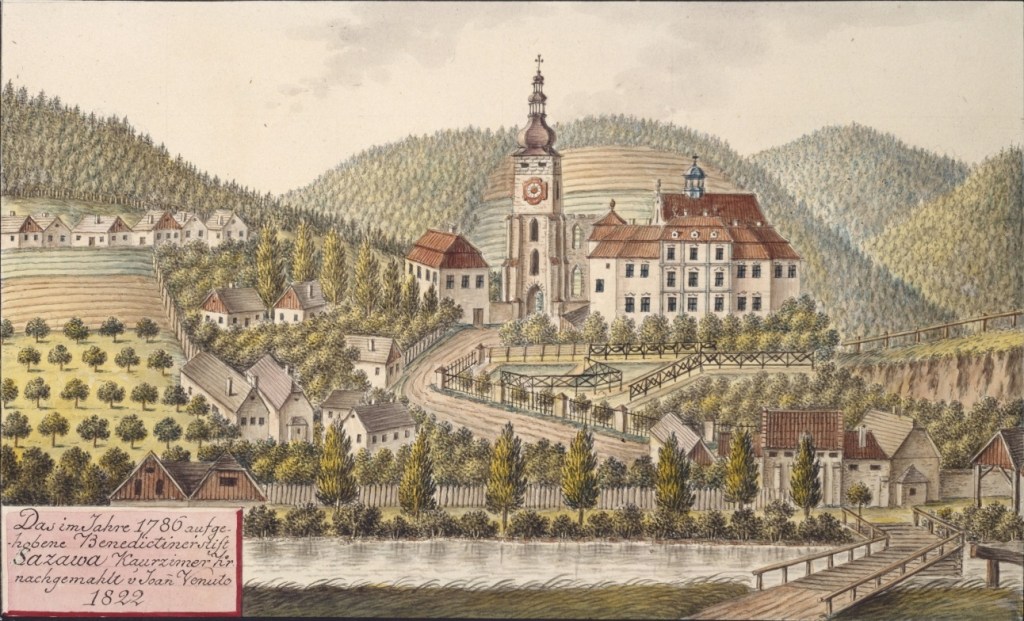
Their society of solitaries was in 1032 regularised into a monastery, where daily life operated according to the Rule of St Benedict. The monastery can be visited today and is well worth the trip. Its single tower greets guests from a distance, and its unfinished, unroofed and unwalled nave is a skeletal sign of the religious destruction that rocked Bohemia in the fifteenth century. This was when the Czechs, ever the trend-setters, got stuck into their own reformation long before Germany’s Martin Luther wrote a single one of his theses.

Yet it wasn’t the Hussites of the 1400s who rang the death knell for Sázava Monastery. It was finally closed in 1785 by the Austrian emperor Joseph II, a Catholic with a talent for closing down Catholic churches.
Within the strata of Sázava Monastery’s millennium, I want to dig into that 1096 expulsion. By most metrics, Bohemia (today one part of the Czech Republic) sits in the middle of Europe. Sázava sits in the middle of Bohemia. A priori, we expect its history to involve ideas and practices imported from both west and east. This is what we find in the eleventh century. Christianity, originally a Mediterranean religion, had been brought to Bohemia from more than one southern source.
Czechs today celebrate the saintly brothers Cyril and Methodius as the stars of their Christianisation, having been sent by the eastern Roman (‘Byzantine’) emperor in Constantinople in 862. Yet the biographical Life of Cyril suggests that Christianity had arrived already in the area; the local ruler, Rastislav of Great Moravia, had written to the emperor:
“Though our people have rejected paganism and observe Christian law, we do not have a teacher who can explain to us in our language the true Christian faith”
Rastislav’s statement records evidence of missionaries at work among the Bohemians and Moravians, apparently unable to speak directly to the Slavic population. (Their language would in time become Czech and Slovak.) The unnamed forerunners may have been Franks from the powerful Germanic empire to the west. What Rastislav wanted was to host preachers and teachers with knowledge of Slavic speech and a gift for scriptural translation (Cyril and Methodius could provide both), and perhaps also to cosy up to Constantinople.

What the brothers set up was an oven-ready Church for the Slavs, with a calendar of saints and services, and all the essential Biblical texts translated. Given their eastern origins, it may have unintentionally incorporated customs that were the norm in Constantinople, but at odds with the Church in the west. They were working close to the border of two segments of the Christian world: the Church of Constantinople and the Church of Rome.
The latter refers to a ginormous swathe of Europe (and Northern Africa) that nominally owed respect and deference to the Bishop of Rome. It was by far the largest of the five zones of episcopal authority set up in Late Antiquity, and known collectively as the ‘Pentarchy’. According to this arrangement, the five top dogs of Christianity (at least within the borders of the Roman Empire) were the Bishops of Rome, Constantinople, Alexandria, Antioch and Jerusalem. They were in principle all equal in authority, but one or two saw themselves as more equal than the others.

Given their geography, the Czech lands of Bohemia and Moravia were closest to the remit of Rome, but might also feasibly be in touch with the powers-that-were in Constantinople too. Both Rome and Constantinople were looking to win different groups of Slavs over to their own team, and in the process get one over each other. There were no tears yet in the fabric of Christendom, but there were networks of personal loyalties, minor differences in the business of worship, and emerging local customs. These include the questions of unleavened vs. leavened bread for the Eucharist, and whether or not to fast on Saturdays. These may seem so trivial to us today, but when Europe was staking its souls on a singular salvation, it mattered to get things right.
Just as Cyril and Methodius came from Thessaloniki to oust previous would-be apostles, their mission in turn was later kicked out. After Methodius’ death in 885, a new prince, a new pope and newly resurgent Germanic missionaries saw their disciples driven from Great Moravia. They fled to friendly Bulgaria. We see how right from the start, these Czech lands were a wrestling ring for missionaries from the south. They were caught between representatives of the Church of Rome and those loyal to Constantinople. Christendom was more or less still unified at this time, but the rise and fall of the Methodian mission foreshadows the enduring divide between Roman Catholicism and Eastern Orthodoxy.
Language was caught up in these medieval competitions. The arrival of the Slavs in Central and Southern Europe (from the sixth century onwards) introduced a new dimension to the existing linguistic landscape. They had not come equipped with a tradition of writing for their distinct speech, so how were they going to fit into the scripture-grounded religion of ‘the Word’? Would they have to put up with written Greek and Latin? Or could they be given their own script, specific to Slavic language? Cyril and Methodius thought they ought to be, and are credited with the creation of the distinct Glagolitic script.
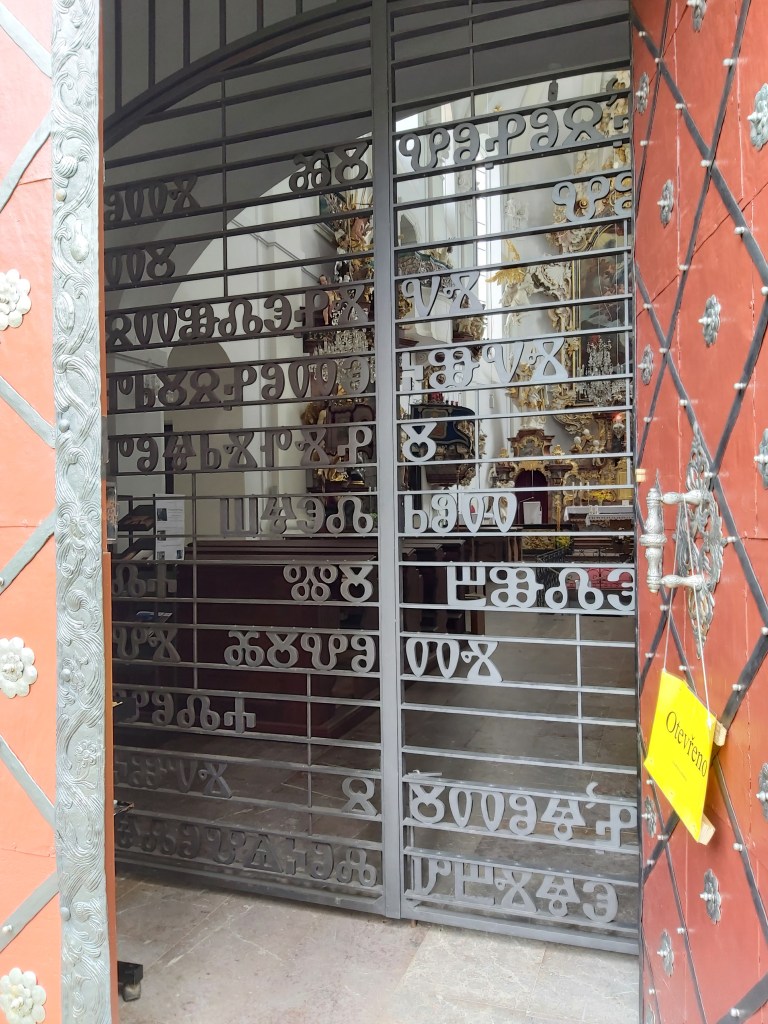
Although later surpassed by Cyrillic, I see in Glagolitic an attempt to raise up Slavic to the level of a prestigious language. A unique writing script could make Slavic a medium for sacred literature, just as scribes of Greek and Latin, but also of Syriac, Gothic, Armenian, Georgian and Coptic had already achieved.
Yet unlike those existing traditions of translation and writing, Slavic writing was met with mixed reviews and some vociferous opposition. More specifically, it was poorly received elsewhere within the orbit of the Church of Rome. Cyril and Methodius took their new culture of writing and liturgy to Italy. There, the Life of Cyril tells us, it was first met with hostility. In Venice, Slavic was scorned by people who believed that only Latin, Greek and Hebrew were the only acceptable languages of worship and scripture. Cyril and Methodius disagreed, labelling their opponents’ view the “trilingual heresy”. I sense in this debate a fight over the linguistic borders of the classical world, and how to include the language of newcomers.
All was far from unanimous; the Bishop of Rome (the pope) in fact welcomed the brothers and their creation:
“Accepting the Slavic Scriptures, the Pope placed them in the Church of St. Mary called ‘Phatne’. And the holy liturgy was celebrated over them. Then the Pope commanded two bishops, Formosus and Gauderich, to consecrate the Slavic disciples. And when they were consecrated, they at once celebrated the liturgy in the Slavic language in the Church of the Apostle Peter.”
Pope Adrian II (d. 872) therefore gave Slavic writing and worship as good a seal of approval as you could get – or at least, that’s what the Life reports. Different popes had different opinions. Adrian’s successor, John VIII (d. 882), changed his mind on the issue in favour of Methodius, but then Pope Stephen V (d. 891) outright banned translations and religious services in Slavic speech. In 855, he wrote to Svatopluk of Great Moravia, enforcing a prohibition that apparently Methodius himself had previously agreed to:
“… The divine services, sacred rites and solemnities of the Mass, which the same Methodius dared to celebrate in the Slavic language (although he had assured by an oath on the most holy body of the blessed Peter that he would not do so, dreading the guilt of his own perjury), it is henceforth in no way by anyone to be undertaken [in the Slavic language]. By God’s and our apostolic authority, under the bond of anathema, we prohibit it, with the exception of the attainment of edification by the simple and uneducated people…”
Strong words from the servant of the servants of God. In disagreement with his bullish predecessor Adrian, Stephen insisted on the use of Latin in formal religious contexts within his territory. This attitude has shaped the modern world; up until the Roman Catholic reforms of the mid-twentieth century, you would witness only Latin worship within the European remit of Rome, despite it containing a large Slavic population of Czechs, Poles and Slovaks. Slavic sermons, chants and texts took root elsewhere, such as in Bulgaria, Serbia and Russia, where Cyrillic writing also remains the norm.
In the ninth century, we see the Bishops of Rome flexing their muscles and beginning to insist not just on preeminence and respect, but on obedience and uniformity. Religious language was both a factor and a symptom of this attitude. An idea of Western European coherence and conformity was emerging, with Rome at its centre, but it would need a couple more centuries to establish itself.
We can at last rejoin the brothers of Sázava in their Bohemian forest. Their religious life in the eleventh century was a good example of the just-about-still-unified shape of Christianity. Their monastic life was organised according to the template of St Benedict, an Italian, yet they worshipped in the eastern Byzantine style. They also maintained the Slavic language of the Methodian mission in their services and holy texts, apparently unbothered by the ban of Stephen V. The Church designed for the Slavs had clearly managed to put down some roots in Bohemia since the expulsion of Methodius’ disciples.
Great Moravia by this time had fallen, but Bohemia had its own independent dukes who might be interested in continuing its legacy. Duke Oldřich I (d. 1034) was in charge when Sázava was made a monastery, and for a while it was a centre for Slavic writing, learning and worshipping. It even exported Slavic texts and established short-lived links with eastern powers like the Kievan Rus. However, in contrast with its idyllic setting, Sázava sat on a rumbling faultline.

By the end of the eleventh century, the brothers and their Slavic rites had been definitively expelled from Sázava. Latin-leaning monks from Břevnov replaced them. That century saw the papacy in Rome reach new heights, as it recovered from the lows of the tenth century, and revived a fortitude glimpsed in popes like Stephen V. It witnessed the reforms of Gregory VII (d. 1085), who fought to clean up the Church of Rome, confirming its clergy and property as independent from secular powers. This may sound like our modern separation of Church and State, but what Gregory was working towards was both the separation and the elevation of the former. John Julius Norwich describes his tenure in The Popes (2011):
“His strength lay, above all, in the singleness of his purpose. Throughout his life he was guided by one overmastering ideal: the subjection of all Christendom, from the two emperors down, to the authority of the Church of Rome. The Church could make them and unmake them; it could also absolve their subjects from their allegiance. But just as the Church must be supreme upon Earth so too must the Pope be supreme in the Church. He was the judge of all men, himself responsible only to God; his word was not only law, it was the Divine Law.”
Gregory’s mission, eagerly continued by his successors, was centralisation. Across his ancient jurisdiction, established through the Pentarchy, Rome gathered all authority unto itself and its bishop. The pope was no longer just a senior colleague to be respected by other western bishops; now they were his lower-ranked employees. Emperors, kings and dukes also had to submit. As you can imagine, there was considerable backlash to this audacious upgrade and programme of reform; the backlash involved one unbelievable episode in which an emperor stood barefoot outside a castle in January snows, waiting for the pope’s forgiveness. Abject humiliation or imperial one-upmanship? It’s hard to say.
The Gregorian elevation of the papacy was somewhat successful, however, and so Western Europe gained a degree of coherence that it had not had before. There had been nothing structural to unite its immediate post-Roman landscape of Italians, Franks, Bavarians, Slavs, Norsemen, Irishmen, Angles and Saxons. Now, at least in theory and in the minds of Gregory’s allies, Western Europe had a single over-monarch (the pope), a capital city (Rome), and a common language (Latin).
However much Gregory and successive popes managed to make this vision politically real, the reforms did at least bring the religious life of the ‘Latin West’ into the Roman hierarchy. Through this, a stronger warp of ideas, institutions, traditions, philosophies, artistic trends and language could be threaded through the territory. With the Church of Rome as its nervous system, the body of ‘the West’ was now in its infancy.
I fully admit that the concept has varying relevance and reality for people today; it doesn’t occupy my own thoughts very much. Moreover, of course, it has changed almost beyond recognition since the days of Gregory VII, in both its nature and geography; ‘the West’ now includes such westerly locations as Australia. Later reformations and rebellions against papal authority, such as those launched by Hus, Luther, Calvin and Henry VIII, also severed many sinews. But nonetheless, if we trace the genealogy of the concept, it emerges in the eleventh-century consolidation of Roman jurisdiction.
Sázava Monastery was a hole in that Roman tapestry. Along with the notable exception of Croatia (which maintained a unique Church identity in its Balkan base), a community like the one in Sázava was an anomaly. It was a relic of a more catholic and less Catholic Church. Though officially within the Roman orbit, its linguistic and liturgical loyalties lay elsewhere. Through its Methodian pedigree, it was a Constantinopolitan intruder in the emerging West. With the 1096 expulsion of the community from Sázava and Bohemia by Duke Bretislav II, the hole was sewn up. The Czech lands were for the next few centuries a seamless component in the medieval West, albeit not too far from its frayed eastern edge.
Finally, in this socio-politico-religious consolidation of Rome’s jurisdiction, I detect a linguistic shift too. In areas further east, the linguistic story is generally one of plurality. There, as mentioned above, separate writing traditions for separate languages grew up around the separate Churches. Meanwhile, within the West-to-be, Latin held a supremacy that transcended the territory’s many linguistic borders. I insist that this is not a story of unidirectionality and homogeneity; the rich corpora of Old English, Old Norse and Old Irish writing quickly put paid to that notion. A revival of Slavic language, literature and liturgy in Bohemia under Charles IV (d. 1378) also bucks the trend.
Latin nonetheless achieved a supranational prestige, and therefore motivated a change of climate: from a time of linguistic practicality, in which incoming languages had a chance at equal status, to a time of linguistic allegiance, in which Latin was a token language that signalled loyalty and orthodoxy. Rather than equip the many peoples of medieval Western Europe with their own translations and put the language of the Church into their hands, we instead find the centralisation of language, and therefore its restriction to a Roman-right clerical class.
Exclusivity in religious language was nothing new, nor necessarily a bad thing; some religions of the ancient world had successfully traded on esoteric language that gave their practitioners an appearance of expertise and mystique. Inclusivity is an ever-present alternative, though, as people want to participate more fully in their faith. In the case of the Latin West, the bloated weight of Latin would eventually burst as the medieval world became the modern; the Renaissance and Reformation together begot a litter of new languages and literatures. The second of those movements in particular demanded access to the language of liturgy, just as the Slavs of Great Moravia had wanted from Cyril and Methodius.
In the linguistic consolidation at work behind the eradication of sacred Slavic from Sázava in 1096, I spy a glimpse of the end of the Middle Ages, when it would all fall apart.
END.
Original website post. References and sources included as a links within the text. Pictures my own or from Wikimedia. Cover image: icon with four Czech saints, St Procopius on the right.
 Danny L. Bate
2 thoughts on “Sázava and the Consolidation of the West”